Climate Change and Apocalypse in Mokoto Shinkai’s Weathering with You
Mokoto Shinkai is not an anthropologist of human sacrifice. He is a storyteller and an artist. But storytellers and artists who are faithful to their mission of depicting the reality of the human condition may intuit by the canons of their art some truth that holds as much robust reality as any anthropological discovery.
Shinkai became rose to fame in Japan after his 2016 film Your Name surpassed Spirted Away in box office records, earning him the title as “the next Hayao Miyazaki.” Similar to Miyazaki, Shinkai’s films bring traditional Japanese mythology alive again for modern audiences, weaving allegories of environmentalism and respect for nature that are rooted in Shinto beliefs. Although Shinkai’s second feature, Weathering with You (2019) did not attain the same commercial success as Your Name, it grabbed my interest far more, for a number of reasons. In his attempt to graft traditional myth into a modern context, Shinkai also, perhaps by accident, exposes the reality of human sacrifice and violence behind myths. For this reason, René Girard, who wrote extensively on the subject of the hidden violence in mythology, may have had some remarks on this animated romantic comedy.
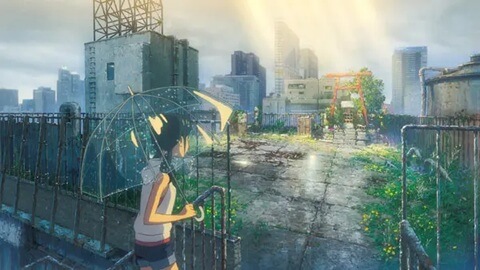
In Weathering with You, runaway high schooler Hodaka takes the ferry to Tokyo in search of a job. He meets another young outcast around his age, Hina, with whom he will later fall in love. Hodaka learns that Hina is a “sunshine girl” who has the powers to make rain stop for a brief time through her prayers. The two set up successful a “sunshine business” together, taking customer requests to clear the skies for various occasions. The demand is high, since Japan has been plagued with torrential rains for months with no signs of letting up.
Hodaka later discovers through a priest that Hina is not just a “sunshine girl” but a “weather maiden” from traditional Japanese myth, whose powers come with a terrible price. In order to bring about an end to the spell of rain which will eventually flood Japan entirely, the weather maiden must be sacrificed, to appease whatever gods of the sky that have been angered.
If there is any message, political or otherwise, behind Shinkai’s Weathering With You, it certainly was not intentionally Girardian. Shinkai himself has stated that he wrote the story primarily with the impact of climate change in Japan in the back of his mind. But Girard often voiced his curiosity regarding the possible link between modern climate concerns and his own theories of human conflict. Regardless of whether this was not what Shinkai had consciously intended, his film portrays the mythological relation between natural disaster and human sacrifice that cannot help from recalling Girardian insight.
Girard’s thought can easily be misunderstood—not due to obtuse language or convoluted writing, but because people often compartmentalize his three central ideas:
1) Mimetic desire: the observation that humans “mime” or mimic the desires of others, which causes human conflict.
2) The scapegoat mechanism: collective violence against a single victim which resolves mimetic conflict.
3) Apocalypse: the Hobbesian “war of all against all” that inevitably follows Christ’s defeat of scapegoating on the cross. For Girard, Christ exposed through his death and resurrection the illusion of scapegoating.
Depending on one’s field of expertise, one may easily cherry-pick any of these theories for his or her purposes. But Girard was, his biographer Cynthia Haven has put it, the “master of the long thought.” Mimetic desire, scapegoating, and apocalypse must be understood as a single thought if we are to understand him at all. Unfortunately, many so-called “Girardians” often fail to embrace his full vision. J.D. Vance, who credits Girard for opening his eyes to the reality of scapegoating (he believes Donald Trump was scapegoated) speaks far too little about mimetic rivalry, and thus never notices how the Republican Party is gradually building up its own form of “wokeness” and “cancel culture.” By ignoring mimeticism, Vance becomes its victim: insisting on the illusory “fundamental difference” between himself and his rival.
In 1972, Girard published Violence and the Sacred (La Violence et le sacre) entering into dialogue with the works of James Fraser, Claude Levi-Strauss, Freud, and Darwin. In this book, as well as in later works such as Things Hidden Since the Foundation of the World, Girard argued that plagues and floods served as a kind of mythological shorthand for human conflict. Like a plague, conflict is infectious. Like a flood, conflict breaks down differences. Due to each side’s mutual violence, the lines between good and evil become increasingly indistinguishable, turning the human landscape into a swelling and raging ocean of unanimous sameness. Only the “scapegoat mechanism,” says Girard, was capable of solving the conflict: a unanimous act of collective violence exerted on a single victim who was accused as being responsible for the “plague” or the “flood” and expelled from the community via exile or ritual sacrifice.
Theorizing that ecological crises in myth may be a metaphor for human conflict provides astounding explanatory power on historical and prehistorical texts. Mythical sage-kings of ancient China like Yao, Shun, and Yu are venerated for their peaceful maintenance of political harmony; this harmony included their supernatural ability to control floods. The traditional Chinese religious belief in the “Mandate of Heaven” (tian ming 天命) held that natural disasters such floods were a sign that the ruler had lost his divine favor from Heaven, justifying his dethroning through violent revolution. And of course, the Biblical account in Genesis has God flooding of the world as a direct result of human evil. The modern insistence that climate change is caused by human interference is not in fact totally foreign to traditional wisdom.
Climate change activists, who often claim to be irreligious (while remaining largely unconscious of the religion of environmentalism itself) may take offense at the suggestion that current climate concerns may be on par with certain primitive “superstitious” beliefs like the Mandate of Heaven. On the contrary—far from dismissing the current concerns of climate change, I am rather suggesting we take traditional mythology and its concomitant association between ecological catastrophe and human error more seriously. Of course, since natural disasters are real, and human conflict is real, it is not surprising that myths would employ the former as a metaphor for the latter. We need not speculate on the precise extent to which the two actually participate with one another to see the fundamental relation. It is sufficient to say that climate change, far from being a distinctly modern phenomenon, has not only always existed, but has always been understood as a fundamentally political issue. Ecocriticism, as it turns out, is older than the Industrial Revolution.
Shinkai’s conclusion to Weathering With You is brilliant as it is surprising. Hina voluntarily sacrifices herself to the sky, and as foretold, the rain stops. But Hodaka, unwilling to live in a sunny world without Hina, journeys up to the cumulonimbus cloud where Hina now resides and brings her back down to Earth. As they careen through the atmosphere clasped in each other’s arms, Hodaka tells Hina, “I love you more than any blue sky—the world can go crazy!”
The brilliance of Shinkai’s ending is that he does not, like so many other directors, try to cheat his way to a happy ending. As a result of Hodaka’s refusal to sacrifice Hina, the rains return, and Japan gradually becomes totally submerged underwater. There are no benevolent bureaucratic gods who conveniently sweep in at the last minute, so sentimentally moved by Hodaka’s love for Hina that they decide to let off the rains anyway. Shinkai is too good of a storyteller for that sort of thing, too committed to the real narrative logic: if you refuse to sacrifice, the world ends. Was this not precisely Girard’s apocalyptic message?


Related Posts