The Enduring Spirit and the Problem of Power
With the possible exception of India’s Hindu population, the Jewish people embody the oldest living culture on earth. What is most remarkable is that, since Abraham, the Jewish people have survived and thrived through the passage of time largely without a homeland to call their own. One key reason for this is the Jewish relationship to God, a relationship defined in part by the name Israel. Israel means “to wrestle with God.” It is a wonderful symbol that can inform a person when they ask questions of God, such as, do you exist? Do you care for us? Why do you permit evil to happen to good people? Job is a personification of the symbol. It is relational, and recognizes that while it is necessary to humble oneself to God, humility does not mean we cannot face our Creator with questions and with doubt.
Elie Wiesel’s book Messengers of God, and his chapter titled And Jacob Fought the Angel, explores the character of Jacob and the name Israel in fascinating detail, drawing insights not only from the Torah but from Talmudic and Midrashic texts. Before his nocturnal encounter with the angel by the Jabbok River, Jacob is a fearful and immature character. Jacob, Wiesel writes, was “reluctant to enter into the world,” and in reference to the tears that fall when Jacob is embraced by others, “we get the impression of a big child yearning for love and protection.” Jacob is a dreamer, is insecure about living up to his father’s legacy, and is a man in “constant need for personal reassurance and outside approval.” Jacob “lacked imagination” and did not “even have an aura of tragedy.” He “could not free himself of either his anxiety or his weakness,” he was instead “gnawed by doubts,” a man who could not “obey the divine commandment,” which made him “aware of his inferiority” to Abraham and Isaac’s greatness.
Jacob’s moment of change began with the battle at Peniel when he fought an angel, or God, a moment brought about by Jacob’s intentional step into solitude and silence. The implication, writes Wiesel, is that “there is a connection between divine and human solitude: man must be alone to listen, to feel and even to fight God, for God engages only those who, paradoxically, are both threatened and protected by solitude.” Solitude is a dangerous place to be, Wiesel reminds us, “because it inevitably leads to God” which leads to “another kind of solitude.” Jacob’s encounter with God would not be a cure-all in his relations with other people, beginning with his brother Esau, but it would give Jacob insight into who he was, a reminder, in light of Abraham and Isaac, of his responsibilities in history, and a new realization that he was not alone.
Wrestling with God yields evocative questions, doubts, and wonderings, some of which Wiesel articulates for us. In light of Holocaust, why would God put an untouchable tree in the middle of the garden of Eden, and then tell two people without historical memory not to touch it? Why would God ask Abraham to sacrifice his only son, whom he loves? Was Jacob emulating Abraham when he sent his son Joseph into the wilderness to find his older brothers, who hated Joseph? Did Job turn against God in order to defy Him to grow closer, Job knowing he would be condemned, but still preferring a cruel and unjust God to an indifferent God? These are not merely academic questions, but questions that keep biblical characters alive and present now, characters who accompany us through our wanderings and wonderings on this earth. The questions enliven faith and the scriptures that inform the faith, and they allow God to remain at the center of Jewish culture even after horrific encounters with evil. Talmud, Midrash, and Kabbalah are examples of this on-going dialogue between Jews and God through millennia.
A literary example of this dynamic relationship between God and a Jew is Isaac Bashevis Singer’s novel, Enemies, A Love Story. The book is inciteful and has a prophetic edge that informs the reader today. The story is about two lovers in New York, Holocaust survivors, wrestling with one another and with God, trying to understand their experience of loss, the depths of evil human beings are capable of sinking to, and the nature of God. The character Masha, who has lost two children to Holocaust, asks her lover Herman, “if God could allow the Jews of Europe to be killed, what reason is there to think He would prevent the extermination of Jews of America? God doesn’t care.” Yet, in the end, Masha cannot forget God, in part because she fights with Him every waking hour of her day. She reflects that “only God in heaven knew how much she suffered,” and while she rejects a God who will only watch in silence as evil occurs, she also knows people have souls, and that her dead children, who come to her during her waking hours, are now in a place where “they are children again.”
Masha’s lover Herman wrestles with God in silence. He understands the Torah when it says, “For the imagination of man’s heart is evil from his youth,” but accepts the response to this teaching, that “that’s why there is a Torah.” Herman understands that the only way to escape the principle, “might is right,” was to turn to God. He recognizes his doubts, but “even if one were to doubt the existence of oxygen, one would still have to breathe…Since he was suffocating without God and the Torah, he must serve God and study the Torah.” And in Herman’s meditation on the Psalms, “Be gracious unto me, O Lord, for I am in distress…For my life is spent in sorrow, and my years in sighing,” he can only wonder at how the words of the Psalms fit all ages and moods while secular literature over time “lost its pertinence.”
Of course, it would be foolish to reduce the Jewish experience of God to the act of questioning, or to assume that the relationship between God and person was never experienced as an intimate relationship. For example, in reading Elie Wiesel and Etty Hillesum, one question is whether their experience of God in Nazi concentration camps was more profoundly incarnational than a Christian could claim of their faith in Jesus. In Night, Wiesel tells the story of a boy being killed by hanging in front of the camp prisoners. As the prisoners watched over a course of hours for the boy to die, one old man asked another, “where is God now?” The answer he received from his neighbor, “Here he is. He is hanging on this gallows.” Etty Hillesum, in one of her final letters before her death, wrote, “if we care just enough, God is in safe hands with us despite everything.” These soul-troubling and intimate encounters with God amidst unimaginable horror serve as a reminder of how the Jewish faith upholds life as sacred because, ultimately, God is present in a human life.
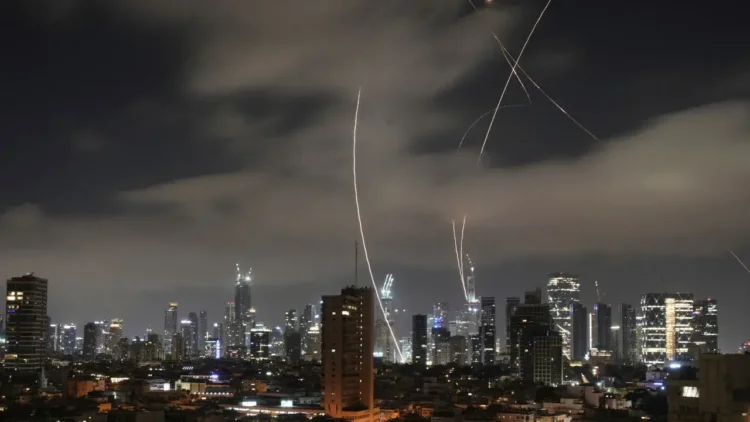
The inevitable tension that arises between faith in a God of stillness and silence and the politics of worldly power is not easily resolved. In the Judeo-Christian tradition as a whole, the tension is revisited by each generation on their own terms, in their own unique circumstances. Pope Francis muddied the teachings of the Catechism on the “just war theory” when remarking that no war is just. There was nothing wrong with the Pope doing this, particularly in the nuclear age, exactly because he brought people with faith and without faith back to the problem of how to reconcile love and hope with political necessity and armed conflict. Following the October 7, 2023 Hamas attacks on Israel, the exercise of self-defense by Israel, whether one approves of it or not, is a political and military action rooted in the reality of power. Hamas-Iran tried to flex their power in the hopes of broadening the conflict with Israel to include the entire Middle East, and Israel flexed their power to subdue the threat. War is a moral evil that people typically wish to avoid, but war is also a reality in human affairs that is brought about for various reasons including an imbalance or misappropriation of power. Israel is currently fighting a war on multiple fronts against Iran and Iranian backed terrorist organizations like Hamas that have vowed to wipe Israel from the map, which is to say, organizations that are intent on killing Jewish people. Lost in the hand-wringing over Israel’s war on terror is that Iran and its terror organizations are enemies not only of Israel but of Western democratic nations and their values, including the oppression of free speech, women’s rights, and the persecution of sexual minorities.
It appears that people with faith, Jewish, Muslim, and Christian people for example, understand power as a reality in the world better than many secular Western nations. This is because people with faith understand the opposite of power, that being the love and hope found in divine presence. As a nation, Canada has been unwilling to recognize the reality of power in global relations for the past decade of Liberal rule, for which Canada has paid a cost, economically, politically, and culturally. The overall impression is that Canadians have drunk themselves blind at the well of woke ideology. Canadians have convinced themselves that power is not a prime principle in the history of nations, and recoil with offended distaste when confronted by its reality. As a result, Canada continues to support the Hamas project in Gaza, calling Israel’s actions in Gaza a genocide. Incredibly, Canada now has their national police force, the RCMP, investigating Israel for war crimes. The Canadian government would prefer a never-ending proxy war with Iran, though it is an easy preference for Canadians to cheer for since they live on the other side of the world from Israel-Iran. Meanwhile, one can only marvel at a nation like France when they abandon Israel as an ally, particularly after the devasting Islamist attacks on France over the past ten years. The moral obtuseness of the French nation, a neo-colonial power that has been manipulating, and in some cases destroying, human life in Central Africa since World War Two, has been masked by sidewalk cafes, fresh bread, and the Louvre.
Of course, the will of the anti-Israel protestors has extended into political reality, which means a scrutiny of the protestors is warranted. In particular, it has been disheartening to see university campuses overrun with anti-Semitic, pro-Palestinian protests. Regardless of what is happening in the current Middle Eastern war, the university protestors who chant for a “free Palestine,” and shout “from the river to the sea,” are engaging in hate-mongering, anti-Semitic violence that has nothing to do with fostering peace. The protestor’s words and actions call into question the health of their souls.
We can apply Wiesel’s insights of Jacob before Peniel to the mob-created, anti-Semitic protestors who study in our universities, with all their shouting and threats from behind masks, and ask some basic questions. Do these protestors dwell in an insecurity of self, and live with discomfort in the world, brought on in part by their hatred, indifference, or ignorance of God? Do they fear the prospect of an intentional encounter with God in silence and solitude, where the danger might be that something of their immature self would be sacrificed in God’s presence, in exchange for a more mature and quiet sense of self? Because faith is a relational practice, one possible concern is that the typical protestor, who thrives in a mob, has little personal relationship with a time-honored family story like Jacob does. Do our families have patriarchs and matriarchs that can inform us of our self and our place in history, acting as guides for us so we can appreciate the creative and life-generating responsibilities we carry into the cosmos? Jacob, of course, does not suffer from this lack but rather from the responsibility that comes with living in such a lineage and with such a Covenant. How can the faithless amongst us find a family lineage? If not the Jewish faith, could the Christian community help root the angry and anxious amongst us with the God of history, and all the biblical and saintly characters who have walked in God’s presence?
Fostering the seeds of peace is soulfully and politically difficult. Considering the Palestinian Nakba, I remember my Mennonite grandparent’s own experience of violence, forced expulsion, and exile in 1920’s Communist Russia to know that one powerful way to respond to a superior power’s domination is to love, forgive, and re-create with hope. Love, forgiveness, and hope are cornerstone virtues of faith, and many Palestinians, despite their obvious hardships—including home demolitions by the I.D.F.—live oriented by these virtues. Building something beautiful, civilized, and good is the way for a people to master the vicissitudes of time. So, while my grandparent’s families flourished in lands new to them, Communist Russia began its descent into dissolution. There will never be a formal apology or the return of lands from Russia, yet my grandparent’s children and their children have, by and large, flourished. In light of past suffering, one can resent the past, and thus resent the present, or one can respond to past suffering by fostering new growth and new goodness. One need not forget the past in order to incarnate a new hope oriented by peace, but one does need to forgive, painful as that may be.
Just as many people in the Middle East, including many Palestinians, do not desire for Hamas to represent their interests, so too Israel did not ask for the fight they are currently embroiled in with Hamas. Israel did not desire to fight an enemy that sees martyrdom as more sacred than life. Hamas is anti-life, celebrating and encouraging Palestinian martyrs, including women, children, and grandparents. This is why their million-dollar bunkers, symbols of resentment, were built beneath institutions of life, those being hospitals, schools, and mosques. Hamas could end the military conflict today by returning the hostages and surrendering their arms, but death and destruction serve their ambitions.
Linda Raeder, in her book, Political Religion and the Death of God, wrote, “moderns typically assume an aggressive, activist stance toward the putative evil of existent reality; the ancients, by contrast, were relatively quietist.” Perhaps this sums up the gulf between protestors and the people of Israel, who have mastered time through their historical memory. In the face of people who have mastered time, one question is, if so many of these anti-Semitic protestors are university students, then what are they learning in university? By appearance, it would seem they are learning about a very flat reality where there is little or no interiority, no mystery, and no depth in time to the human experience. It seems that current university programs, without realizing it, are attempting to “immanentize the eschaton,” as Eric Voegelin would say, fighting for an undefinable and unattainable collective salvation here on earth while inadvertently damning the soul to ignorance of itself. Anyone who is literate in the higher definition of the word understands already that the Western Canon is a key corrective remedy to this spiritual illness, combined with an open soul, what Voegelin described as “a joyous willingness to apperceive.” This requires more than a change to the curriculum. The cure also relies on grace. The soul needs to be stirred awake. For a time-mastering education to take hold, the teacher’s soul and the student’s soul must desire communion with the eternal mystery that animates the good, the true, and the beautiful.


Related Posts