G.K. Chesterton: A Big Round Subject
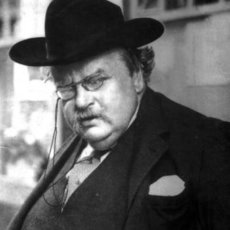
G.K. Chesterton: A Biography. Ian Ker. Oxford: Oxford University Press, 2011.
It is certainly a great thick square book (on a great thick round subject). A lot of work went into this book and we will spread our review over a couple of columns. This time we will speak about the book itself, asking, Is it worth reading? Is it worth buying? And in the next column we will reflect on the image of Chesterton as herein presented, asking the tougher question, What can we do with it?
This is not the first biography of Chesterton, of course, by a long shot. Maisie Ward Sheed published hers in 1944, and in later decades Dudley Barker (1973), Michael Finch (1986) and Michael Coren (1989) have had a go. Ian Ker, who teaches theology at Oxford and is an expert on John Henry Newman, has now written what the publishers describe as the “first comprehensive biography of the man and the thinker and writer.” It is certainly the longest (729 pages).
The theme of a biography–without a theme it is a chronology or a database–largely determines its form, and Mr. Ker is very upfront about his motive. In his introduction, he writes “. . . I came to realize that Chesterton should be seen as the obvious successor to Newman, and indeed as a successor to the other great Victorian ‘sages’ . . . specifically the other great non-fiction prose writers, Carlyle, Ruskin, and Arnold (the critic).”
Fair enough.
Such a theme suggests a book as much about ideas as about daily life and res gestae and, indeed, this establishes the book’s rhythm: by alternation, a stretch of life-of-Chesterton, then a block of “here is what book X is about, and why its matters,” another biographical bit, another stretch of explanation, and so on and on.
And it must be said that in each vein, Ker does a very professional job.
The prose is satisfactory and the material is researched right down to its toenails. This is no small thing–the Chesterton archives are not in terrific shape. Moreover, the analysis of this or that particular work seems sound, intellectually and morally, as far as I can tell. It tastes wholesome. Admirably cogent, and frequently repeated, is Ker’s central insight into Chesterton, that the man’s core message was the wonder, the unexpectedness, the bald weirdness of the universe in front of us. People say that Chesterton indulged in paradox, but not paradox as entertainment or wit, but as a tool, a pick-axe to smash open the frozen ice of our consciousness (to borrow a phrase).
You can hear a “but” approaching. Why then, do we experience mild irritation at this model of energy and erudition?
The biographical sections are detailed, but sometimes overly so. Chesterton, for example, made several lecture tours of America, and Ker tells us where Chesterton and Mrs. Chesterton went (by the end of this book the reader develops a strong admiration and affection for Mrs. C.). Every. Last. Stop. he tells us.Biographical details are poured out on the reader, but somehow not shaped. We might say it is more of a chronicle than a plot. Well, if its going to be a chronicle how about a few more dates as we go along.? How about more cross references as to what was going on at the same time? Could Ker not have included a detailed timeline in an appendix? If, that is, it is to be a chronicle.
If, on the other hand, the account of Chesterton’s life is to be a story, it needs more shaping and selection. And particularly it needs a better evocation of the world around its central figure. The events are there, no doubt about it–Shaw appears, Wells appears, and so on. But we miss the atmosphere.
An example–Chesterton was a Fleet Street Journalist. But there is little about what a newspaper of that time was like. It was not like today, and it wasn’t, I suspect, like the newspapers we see in The Front Page. What was the special air of that world? Dickens would have made us see it. Chesterton himself would have. But here, not very much.
Also, the pictures are skimpy. There are twelve pages of plates, which is not nearly enough for a here-comes-everybody story. For example, “Keith” Chesterton, who is as close to the villain of the piece as one would like, is not even pictured. If it is too expensive to print pictures, could not a web site have been set up?
As to the literary and intellectual passages, they are no bug, but a feature as Ker makes plain. The problem is, supposing that Chesterton is the last of the Victorian sages, do we need any more of this species? For example, what did Chesterton say about Carlyle? Very few people now care. To sell tickets to that bout, you would have to revive enthusiasm about Carlyle, which is, frankly, not going to happen.
Newman is revered, but not much read. Even Shaw is fading from the consciousness of our time–the local Shaw festival here in Canada at Niagara-on-the-Lake is showing this season . . . no Shaw.
Chesterton remains a player, but it is the Chesterton of popular journalism, stories, and poems. Ker acknowledges this side, but it gets much the smaller slice of pie. Ker, who has a sincere admiration and affection for his subject, would like to make Chesterton respectable among Ker’s own tribe of academics and among the nomenklatura. But the people reading Chesterton don’t care about his academic respectability. Nor, I suspect, did Chesterton.
Yet for all this kvetching, this is a very good book. It is worth reading, well worth reading, not the least for telling us how and where some of Chesterton’s most popular works were created. It gives a valuable sense of the day-by-day step-by-stepness of things, the process of generation that Giambattista Vico thought was the key to understanding.
Worth buying? For Chestertonians, certainly, and for others too, yes, even at close to sixty dollars. That is not, when you think about it, much more than four or five hours in a tavern, at today’s prices, and better for you. Though Chesterton himself probably would have chosen the tavern.
We have a bit more to add. As a biography, the book has solid virtues, not the least being thoroughness, and some weaknesses, chiefly a certain flatness of tone. Nevertheless, it is worth reading, and worth buying, especially if you can get the paperback edition.
One of the weaknesses that bothered this reader is that, considering the length of the book, Chesterton does not come across very clearly as a personality. Really. The facts are all there, but the presence does not make itself felt.
The great benchmark for this sort of thing, in English, is Boswell’s life of Johnson. After going through that book, readers are sometimes unsure whether they didn’t know Johnson personally themselves.
But this is not Boswell and as we will argue, it does matter, even if we make a couple of qualifications.
First, Ker professes no ambitions to vivid portrait painting. His theme is Chesterton as the intellectual heir of Newman, and ideas are at the core of the narrative. It is not meant to be The Life and Times of Mr. Chesterton by Mr. Dickens (actually, that would be worth reading).
Second, there are a good many details about about the man himself, especially on the private level, and for this Mr. Ker deserves our thanks. The most important correction to our previous image of Chesterton is the role of Frances Chesterton as the unsung heroine who kept the whole circus on the road. Without her, Chesterton would likely have died before the first world war.
Another is the story of his unhappy sister-in-law “Keith” Jones-Chesterton. If the life has a heavy, it is Chesterton’s sister-in-law, and the psychology behind the issues is worth some speculation.
We might add that for anyone who writes regularly, one of the most revealing bits was that of how GKC worked. His basic approach to a deadline was to delay, delay some more, delay again, then reluctantly sit down and think about the topic at hand. That done, he wrote or dictated the whole thing in one burst and sent it off.
This is the other extreme from a writer such as Mallarme, who gradually develops a piece through successive drafts, often ending up with something that surprises him as much as it does his readers. Chesterton’s way is, however very much the way Johnson seems to have worked. Chesterton came to any topic with a basic tool box of notions and a well practised technique, diagnosed it in his own terms and improvised the execution.
All of that said, Ker’s image of the public Chesterton is unfocused, and this is unfortunate.
When someone is a public figure, the history of his or her public celebrity is as much a part of the record as the individual deeds they did. And to the public of England, Chesterton was not only, or even chiefly, a person who trafficed in ideas but a representational public image, like the late Mr. Buckley or the current Lady GaGa.
People like this not only say things, they stand for things, although it is not always clear what those things are.
What did Chesterton mean to the British public? How deeply did the fact of his presence penetrate the general consciousness? Did they talk about him in pubs? Was his caricature often in the newspapers? We could use a little Chestertonian Publikrezeptiongeschichtsforschung (wissenheit) here.
The public image matters, historically.
Someone might answer by asking, “but is that historical interest of primary importance? Ought we not to concentrate on his ideas? Would not the Great Man, always a humble person, have dismissed interest in his person as trivial compared to the importance of what he had to say?”
Well, yes and no.
Chesterton did believe in the importance of what he was saying, but what he was directing the reader toward (and here is the crux) was not ideas, not notions or systems, but realities, truths, facts, and substances. His theme was: Look at the world. Look carefully. Isn’t it great? Isn’t it astonishing? He would have agreed with another great man that the truth of what he is saying is evidenced by the fact that he is saying nothing new at all. Chesterton was the antithesis of the philodoxer.
By and large, and outside of Harvard, the public seems to be of the same temperament. The public is interested in shoes and ships and sealing wax, cabbages and Prince William. If they consider ideas, it is instrumentally. Ideas are of interest only in so far as they illuminate substances. Mystics may draw on Plato, but down on the street they’re mostly Aristotelians. Rather than an ideal egg, they would prefer an egg.
It follows that the human race, the larger part of which is in the street, generally prefers people to the ideas those individuals promote, for the reson that it is in outstanding figures that ideas are actualized. They cannot define democracy, but they are pretty certain that Lincoln embodied it. This is why more people love Johnson than read his essays, because Johnson actualizes the wisdom he promoted. This is why it is so important that the figure of Chesterton be seen clearly and in context: a lot of people loved this man, real hard, as they say in Canada, and to discover why, and profit from it, you must study the man himself.


Related Posts