The Real Origins of Just War Theory
If you are a man who leads,
Who controls the affairs of the many,
Seek out every beneficent deed,
That your conduct may be blameless.
Great is just, lasting in effect,
Unchallenged since the time of Osiris.
In his 1967 essay, “Jerusalem and Athens: Some Introductory Remarks,” Leo Strauss famously wrote, “Western man became what he is, and is what he is, through the coming together of biblical faith and Greek thought.” It is difficult to underestimate the potency of these words or their effect on later conservative thought in the United States. Indeed, it would not be hyperbolic to label Leo Strauss as being one of the principal fathers of the twentieth century Renaissance in classical Christian education. At the same time, Strauss’s statement has drawn ire from both the radical left and, increasingly in the twenty-first century, the radical right. Much of left wing historical scholarship (as well as popular media production) has been spent attempting to prove that whatever is good (or at least most of what is good) about the West is derived from Asia, Africa, or the indigenous peoples of the New World. Among the increasingly vocal radical right, there are attempts to emphasis (the largely pagan) Germanic, Celtic, or “Indo-European” roots of the West. Living in a “post truth” world in which rhetorical outcome is more powerful and effective than truth value and much of the country has lost all trust in academic scholarship, it is difficult to make sense of most of these attempts topple Strauss’s celebration of Athens and Jerusalem. While the radical right rules social media, most of Western academia is still in the hands of the left, which since the advent of the Trump Era, has accelerated its process of revisionism of Western history.
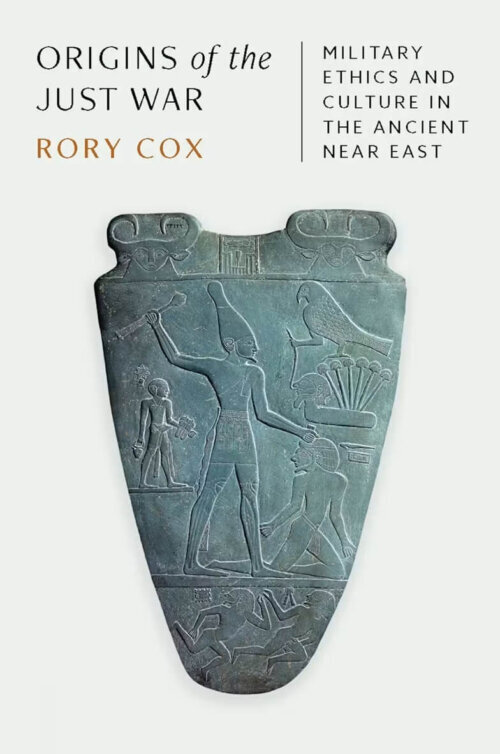
In his new work, Origins of the Just War: Military Ethics and Culture in the Ancient Near East, University of St. Andrew’s historian Rory Cox attempts to find deeper foundations of just war theory in the ancient Near East. Professor Cox’s work is part of a wider effort among scholars that, although having begun in the twentieth century, has excelled since the 2020s. These efforts are focused on attempting to dethrone the narrative of European and wider Western supremacy. These efforts have involved attempts to root ideas and technologies in African, AmerIndian, or Asia sources and/or attempting to prove that these ideas and technologies have at least partial origins in non-European individuals and movements living in the West. Right wing critics of these scholarly efforts have noted that many of these claims are unfounded and, even, at times, fantastical efforts to undermine Western history. Left wing supporters have noted that such efforts have a great deal of moral weight in light of the alleged damage done by Western colonialism.
In Origins of Just War, Cox attempts locate the origins of just war theory in the Egyptian, Hittite, and Israelite peoples. Certainly, even conservative advocates of the traditional narrative of the development of just war theory in the West would agree that the Bible has a great deal of influence upon Western just war thought, but the Egyptian and Hittite sources would, at least upon first glance, appear to be a little bit more nebulous. All three of these cultures, according to Cox, developed the distinction between ius ad bellum (the right to wage war) and ius in bello (right conduct in war). Cox does importantly note that notions of war are likely as old as war itself, and many cultures’ notions of just war are unavailable to us simply because these cultures were preliterate. However, a sense of the beliefs of these cultures can be gleaned from artefacts and iconography. In as much as Cox presents a thorough and detailed exploration of Near Eastern notions of war and the experience of war, his work is deeply enjoyable.
However, Cox makes the additional, somewhat contentious, argument that just war theory should be ultimately rooted in the Near East. Cox holds that just war studies ignores any thought prior to ancient Greece, and some just war scholars do not look any earlier than the emergence of Christianity. While some scholars may disagree, Cox claims that it is “Eurocentricism” and the tendency to be what he calls “Christian-centric” that is, in his view, preventing scholars from searching in other world traditions for just war theory. He notes that there are notions of just war through in Chinese intellectual traditions such ad Confucianism, Daoism, and Legalism as well as within Vedic works such as the Māhabhārata and Rāmāyana. Nonetheless, Cox argues that these cultures did not directly affect the nascent development of just war thought in the West, and thus he turns his argument to the Near East.
Cox begins his chapter on Egyptian thought with the reflection that the West has traditionally examined Egypt through an Orientalist lens, viewing it as a land of mystery, magic, and enormous structures. Cox notes that most of Western understanding of Egypt comes from the third century Egyptian priest Manetho’s work Aegyptiaca. Interestingly, the Aegyptica is the source of the long tradition of categorizing Egyptian history based upon dynasties. The Egyptians have traditionally thought of themselves as the people of the “Black land,” which refers to the soil nourished by the Nile. Cox sharpens the image of Egypt not simply as a place of pyramids and mystery, but as a regional superpower and geopolitical actor. Egypt was deeply reliant upon timber and copper and reached out to Crete, Lebanon, and Cyprus for trade. Egypt also reached out to Nubia for gold, ivory, and slaves. Such reaching out for resources led to war.
Egyptian thought was rooted in the concept of Ma’at or right order and law. The Egyptian king was likewise a divine figure, and, as Cox notes, the king’s divine aspect was linked to his martial activity. The gods likewise accompanied the pharaoh in war, and thus the pharaoh’s wars were by their very definition just. The pharaoh further waged a war against the chaos of the world. The struggle of Egypt versus her enemies was a struggle of good versus evil and order vs. chaos. There were similar ideas in Hittite and Israelite thought. The Hittites believed that authority ultimately came from God, and Cox curiously argues that within Hittite thought there was some question as to which side the gods were on. However, for the Israelites, it was Yahweh who was the source of order and the one who fought with Israel. The Israelite’s success was dependent upon Yahweh’s favor, and the Israelites were, as any reader of the Bible knows, punished by Yahweh at times.
In his 1981, Simulacra and Simulation, the French philosopher Jean Baudrillard crafted his theory of hyperreality or the notion that, in the electronic age, simulations have become more real than “flesh and blood” lived in life. During the 1991 Persian Gulf War, Baudrillard applied his notion of hyperreality to the war in a series of essays, which were bundled in the book The Gulf War Did Not Take Place, noting how the spectacular nature of the war (allegedly) did not coincide with the experience of many soldiers. On February 28, 2026, Operation Epic Fury began. The war has been very much a hyperreal war with AI depictions of violence have proliferated on the internet. This war has further accelerate divisions among conservatives who either support or disagree with the war. The war also has drawn President Trump in conflict with Pope Leo XIV, who has denounced the war. More than ever, people are confused about the question of just war. In Origins of the Just War, despite claims that some scholars and conservatives would disagree with, Rory Cox provides a fascinating portrait of Near Eastern war and Near Eastern thought.
Origins of the Just War: Military Ethics and Culture in the Ancient Near East
By Rory Cox
Princeton: Princeton University Press, 2023; 506pp


Related Posts