A Magical World of New Fables
Imagine yourself wandering through the forest on an autumn day. The air is crisp; the wind is howling. The subtle chirping of birds echoes in the background. The ringing of wonder and loneliness abound, but you are simultaneously captivated by a sense of warmth you gain when surrounded by nature and its magnitude, not to mention this experience alongside some of your closest (and smallest) friends.
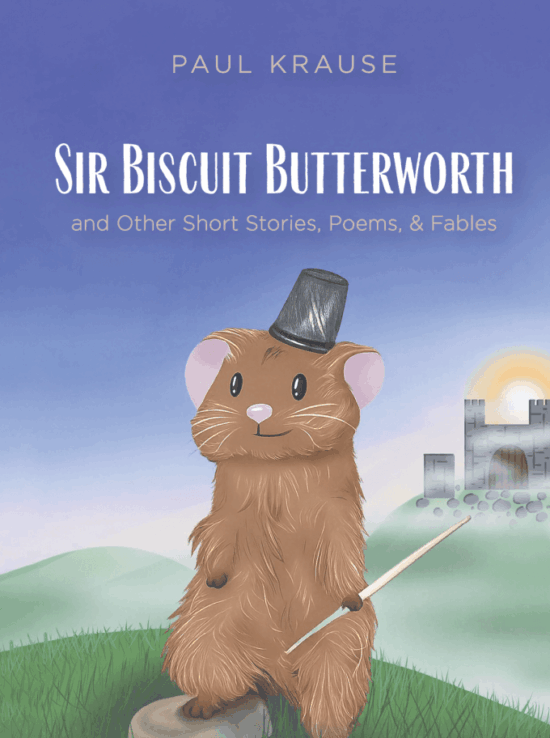
Sir Biscuit Butterworth and Other Short Stories, Poems, and Fables by Paul Krause encapsulates such details with refined creativity and child-like sense of whimsy, wonder, and awe. Sir Biscuit Butterworth is introduced as a loyal, honest, and genuine hamster who often finds himself filling his cheeks full of buttery biscuits. The reader’s hamster friend was provided this “foodie” name not only from his love for biscuits, but his involvement in storming a biscuit castle to escape Farmer Sleepsalot and Count Conrad the Cat and rescue the Buttermilk Biscuit Princess in the opening story, “Sir Biscuit Butterworth and the Buttermilk Biscuit Princess.”
At the outset, readers of Sir Biscuit Butterworth and Other Short Stories, Poems, and Fables are immediately hit by the playful and innocent names of each character. Their enchanting and silly alliterative nomenclatures are soothing music to the reader’s ears; it causes an easy and simple connection between the story and the audience, which ultimately allows each image to come to life in a tangible manner. Not many pieces in the twenty-first century cultivate classical fairytale tones and qualities through the character’s identity, but Sir Biscuit Butterworth takes this notion and transports readers back to their childhood memories.
Many of Sir Biscuit’s closest friends and confidants seem attached to these long-lost childhood memories, as if we had gone on the same adventures and heard the same stories together in another lifetime. The author strategically crafts what appears to be an unfinished dream that the audience re-enters. Such phrasing illuminates this possibility in “The Tall Tale of Slendertail’s Blueberry Tongue.” Krause writes, “As the sun came up over Gardenwall, casting its shiny rays over the watery bay, or what was really just a tiny little pond that Sir Biscuit called the Great Little Sea, causing a glittering reflection of light as the misty fog of the morning was chased away, Sir Biscuit and his friends embarked on their wooden boat and started sailing across the water.” Painted with extraordinary detail and precision, Sir Biscuit and his friends are now involved in something much more than an adventure beyond the sea line: it was a journey for personal growth and strengthening friendship.
Sir Biscuit Butterworth and Other Short Stories, Poems, and Fables reveal numerous underlying details to mental tenacity and emotional stability, providing motivation towards love and fullness of life. Sir Biscuit and friends complete their journeys as depicted in the form of short stories. Rather than the journey being the most impactful, the characters felt that being beside and supportive of one another carried more meaning. “Apart from Sir Biscuit, who was the most heroic and noble hamster to ever set foot in Gardenwall, Wily imagined himself every bit the hero as Nibbles the Mouse, the most famous mouse hero of all time. Wily knew that his fame was due to his friendship with Sir Biscuit and so accompanied him everywhere.” Thus, their gratitude is a light within the darkness of Wily Whisker’s dark black tail and Timmy Two Times’ thievery.
Like most fairytale stories, the battle between good and evil is prevalent, and Krause, mentioning the thievery of Timmy Two Times and focusing on Count Conrade the Cat—the nemesis to Sir Biscuit—gives us a glimpse into this evil. Yet to counteract evil as a stereotype in fairytales, Krause seemingly bridges the gap between good and evil through forgiveness and love: “[t]hat’s when Sir Biscuit and all his friends realized something deep within their hearts. Count Conrad was all alone. Sir Biscuit got up on his legs and walked over to Count Conrad. He nodded his head to his friends that everything was fine. The two enemies looked at each other, laughed, and then smiled. They embraced each other not out of hate but out of love.” Embracing was their first act of forgiveness, followed by the surrender of differences. All the four-legged creatures united together by “laughing, smiling, and eating as friends. That was the miracle they now wished to spread.”
When discussing Sir Biscuit Butterworth, there has been much talk about the curiosity, mysteriousness, and relativity of fairy tales in the lives of both adult and young adult readers. A fairytale is much more than a story that teaches a moral lesson or highlights an author’s creative nature to merge the natural and supernatural realms. While Sir Biscuit Butterworth and Other Short Stories, Poems, and Fables instills within readers a moral high ground and bravery through a little hamster and other creaturely characters to leave readers with a sense of encouragement, triggering their imaginative powers. The final essay of this collection does just that. “The Gift of Stories” epitomizes the necessary essence to keep stories alive. Without stories, many readers would not remember the idiosyncrasies of life’s minute moments. The best way to hold these memories is to write. It is the best medicine and binding power to memories, and “you never know when a silly story, a simple story, or a complex story will touch a heart and change a life.” If Sir Biscuit Butterworth and Other Short Stories, Poems, and Fables leaves you with questions, I encourage you to keep thinking and use your imagination. You will never know who or whom it may impact. And as you read this collection of short stories, smile will undoubtedly abound in this whimsical world of adventure and friendship.
Sir Biscuit Butterworth and Other Short Stories, Poems, and Fables
By Paul Krause
Eugene OR: Resource Publications, 2026; 66pp


Related Posts