A Certain Idea of Germany
The German experience has always been, though often reluctantly and unenthusiastically, in the avant-garde of Western history. From revolution to reaction, from the Reformation to the Counter-Reformation, from Romanticism to technological progress, German history is one of radicalism and contradictions, of catching up to, and simultaneously rejecting, the march of “progress,’’ all at once, fundamentally, with fervor and regret in equal measure.
Germany’s response to the French Revolution was not a Burke or a De Maistre but Hegel; a man who embraced revolutionary romanticism but who sought to moderate and build on it, thus providing a great example of Germany’s attitude towards all new developments. Germany’s curse has also been its blessing; being late to the party has encouraged greater rigor and sophistication in the attempt to match and surpass the achievements of the countries that had dominated most spheres of development hitherto, be it in science, philosophy, technology or military matters.
This, however, also led to German innovation and perfectionism into the adoption of elevated, more extreme forms of all the negative component parts of the progressive program. A most illustrative example is German colonialism. Akin to Belgian colonial expansion, by the time Germany was powerful enough to engage in this dubious endeavor, most of the world had already been colonized by Britain, France and Spain, inter alia. The few colonies Germany was able to secure were governed with extreme violence that exceeded the brutality of the colonial regimes of its competitors. Then, we had the two World Wars, where German military and technological ingenuity was admired and feared, but which produced untold suffering on an industrial scale never seen before.
After the defeat of the Nazi regime, and even more so after the end of the Cold War and the re-unification of Germany, many thought that at the moment of the “end of history,” Germany would no longer be the restless, reluctant innovator of old. Germany was supposed to have finally found a settled identity, that of being Europe’s economic and political leader, promoter of political stability and liberal democracy. In other words, a model for the calm, efficient de-politicized state of the inevitable (liberal) future of stability, prosperity and peace.
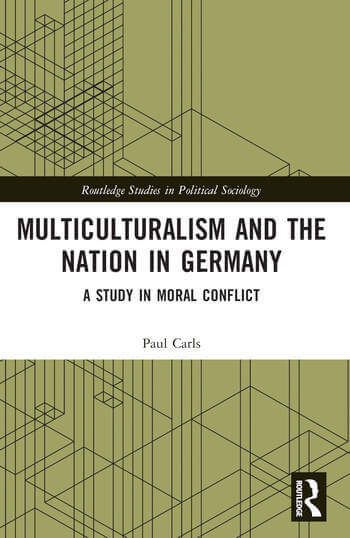
However, as Paul Carls shows in Multiculturalism and the Nation in Germany: A Study in Moral Conflict, at least from the Refugee Crisis in 2015 (though the signs could be said to have been there much earlier), Germany has found itself again at the forefront, and at the core, of the most fundamental debates that concern Western nations today. Far from it being a stable polity, Carls describes a Germany plagued by competing extreme visions of what the country should be, how to interpret its past and how this is to inform its future. As he points out in a manner which is both factually and theoretically sound, the ideologies competing for Germany’s moral identity are so manifestly intrinsically incompatible, that this strife has led to radicalism, societal fragmentation, increasing self- doubt on a national scale, and even, actual political violence on the streets.
Carls’ book is not your usual (and banal) study of immigration and integration, or some convoluted sociological take on contemporary controversies. It is, rather, a very deep and compelling analysis of what Germany is, how it sees itself, and of the ideologies competing for Germany’s soul. The refugee crisis served as a moment of existential crystallization, a conjuring up of repressed demons from the past, as well of entirely new ones.
Carls’ study of moral conflict is predicated upon Durkheim’s notion of socially determined morality involving “adherence to particular moral codes, involving deference to a particular moral authority and the attribution of particular moral values.” This definition brings with it repressive and positive elements, above all, an obligation “to act in accordance with a specific pre-conceived norm,” whilst, at the same time, “working towards some higher end.” This combination of obligation and desire is “anchored in an authority that transcends individuals and that they see as legitimate.” This moral authority is to be found in what Durkheim terms “the idea of the sacred,” which is created via. social rituals. When these are carried out “individuals express thoughts and feelings in common and perform the same gestures, generating what Durkheim calls collective effervescence, or a sui generis ‘emotional energy’ that transcends and is shared by participants and that Durkheim compares to electricity.”
Arguably, the most essential aspect of this notion is the distinction between the pure an impure sacred. The impure sacred is to be distinguished from the merely profane which is more akin to that which is typically ordinary and thus incapable of any electrifying effect. The ritualistic impure sacred causes a radical, electrifying response of extreme disagreement and revulsion. Whereas the pure sacred could be the celebration of a national holiday that brings people together emotionally in a positive manner, the impure sacred is a form of sacrilege, evil and disorder. As Carls points out, this is the essence of moral conflict that leads to inter-group violence, namely, a struggle between the two competing forms of the sacred.
Bound up with this competition is the notion of moral truth. Statements such as “meat is murder” or “hate speech is not free speech” are moral truths in the Durkheimian sense, they are “types of moral judgements, which evaluate the rightness and wrongness of particular actions, but the judgement remains abstract and broadly applicable.” This is then applied to actions and their interpretation. For Durkheim, society operates by interpreting actions within the meaning of such moral truths or facts. For example “killing a person does not result mechanically in blame or punishment…rather, a moral fact projects the blame and punishment on the act.”
Finally, and most pertinently to this study, Carls explains the significance Durkheim placed on punishment and the positive effect it has on group solidarity. According to Durkheim “crime is an affront to collective beliefs and punishment is done to expiate an ‘outrage to morality…and intense affair that involves ‘passionate emotion and ‘collective vengeance for something sacred which we vaguely feel is more or less outside or above us.”
It is this almost transcendental outrage towards matters that are, by definition, social constructs of a purely secular kind, that is used to explain the intensity of the ideological struggle in Germany.
As one can expect of a German existential crisis, the ideologies vying for dominance over German institutional thought and identity are rather abstract and, at first glance, at odds with reality on the ground.
The first is that of constitutional patriotism- Germany is to be viewed as a society of civic values, which need not refer to any religious or ethnic identity. To resolve the issue of the refugee crisis, this ideology expects of all newcomers to swear allegiance to democratic values and liberal procedures. From all the ideologies explored in Carls’ book, this one, undoubtedly due to its extremely abstract and detached nature, does not lead to a mass outrage when rejected or challenged. It may be the ideology of the state and the authorities, but it is not one to which a truly passionate group can relate. This is not surprising, considering it implies an absolute adoption of secularism and a rejection, or suppression, of any cultural identity.
Deconstructive multiculturalism, on the other hand, seeks to neutralize all forms of domination and oppression. Deploying Derrida’s deconstructivism and Said’s critique of imperialist and Eurocentric meta-narratives, this view sees the imposition of any values or norms on those newly arrived in Germany as a form of oppression and a perpetuation of Eurocentric discourse and domination.
The ethno-cultural nation, in contrast, presupposes the existence of a culture and a people, thus establishing an allegiance and identity that go beyond what are merely political values. This understanding has been criticized as representing “a form of tribalism, exclusionary ethic chauvinism and that is opposed to a universal understanding of humanity.” The most primitive version of the same is the biological state, popular among some far-right groups. That is, the nation is based entirely on belonging to a particular race.
Carls provides both the historical and intellectual backgrounds to the development of these concepts in Germany. However, what is truly unique, and also highly relevant, to these discussions is how the refugee crisis brought all of these ideologies to the fore, and gave them the electrifying intensity of moral facts. Their proponents, facing what appeared to be an existential challenge and competition to their worldview, started to perceive, with ever greater intensity and commitment, their own views as a form of the pure sacred, and those of their opponents as a form of sacrilege or a crime, an impure sacred deserving of the harshest punishment.
In this context, it is unsurprising that the paragons of the constitutional state saw fit to use state repression against their detractors (be it Police action or restricting freedom of expression), both against the newcomers who, unsurprisingly, did not want to sacrifice the entirety of their cultural and religious identities and the altar of liberal constitutionalism, and the nationalists, who, in turn, began to perceive both the state and the refugees as threats to their own understanding of what the German nation should be.
The most extreme reactions, however, came from the far-left and the far-right, who, either completely unrepresented politically or only marginally so, expressed their hatred of the impure sacred by means of ritual street violence. Carls’ meticulous analysis of the ritual violence of extremist groups is not merely interesting in an academic sense, but also provides a guide to how radicalization develops in practice and leads to violent outcomes.
The notion that these groups operate on a collective basis, bound by hatred of what they find to be morally repugnant and deserving of punishment, and that this hatred needs to be reinforced, deepened and intensified by collective rituals of punishment, is persuasive not merely in the narrow German context of the book, but also seems to be universally applicable.
Multiculturalism and the Nation in Germany: A study in Moral Conflict is an important book, which, with the passage of time, will become evermore relevant to the elucidation of processes that are becoming widespread. In light of recent events in Germany and elsewhere, in an increasingly unstable world plagued by war, conflicts and tectonic societal changes, the search for meaning and plausible explanations in what appears to be an uncertain, indifferent world in the face of its own collapse, will not abate. In such a world, the most popular narratives are likely to be those that bring with them the intensity of moral truths, with their inherent potential to lead to radicalization. Carls’ work is certain to enhance the understanding of anyone interested in these processes, and in particular, the application of Durkheim’s theoretical framework to what are some of the most fundamental issues faced by modern societies today.
Multiculturalism and the Nation in Germany: A study in Moral Conflict
By Paul Carls
Routledge, 2023; 204 pp


Related Posts