A Darkly Beautiful, Almost Epic Masterpiece of The Odyssey
“Cleverness will get you in trouble.”
When teaching Homer’s Odyssey, students will often ask questions about the unexpected character of Odysseus, the hero of the epic. They question whether he actually cares about his men, all of whom die before Odysseus makes landfall on Ithaca, especially when he deliberately puts them in harm’s way. They question his place as a hero—to which I respond that ancient heroes are individuals who overcame great obstacles and challenges, accomplished great deeds, and won glory (kleos) for those deeds; the hero as a morally pure “good guy” doesn’t apply to the ancient world. Odysseus is a fascinating portrait of a man of many “twists and turns” that allows for many twists and turns in discussion. Sir Christopher Nolan’s Odysseus, though, a man who is definitely conflicted, is a man who wants his men to get home: “I wanted you to live.” He is a hero whom we come to sympathize with especially when it becomes apparent that the trauma of war and the devastation caused by Odysseus’s cleverness forces him into a reckoning of who he is, who he can be, and how he will be remembered (or forgotten).
The genius of Homer’s Odyssey is that it is a song, a monumental work of art, not a historical document. Despite people wanting it to be a historical document and despite many having believed it to have been, the grandeur and endurance of Homer’s epic isn’t in its antiquity but in its universality as a poetic song; its antiquity adds to its arresting enchantment. As a great work of art, the Odyssey transcends historical parochialism despite being a parochial work. This is a paradoxical feature of all great art: it is inextricably bound to a particular time, place, and people, but the work gloriously explodes beyond those constraints in its universalism of themes, emotional evocativeness, and ability to consume an audience in its story. Anyone can find themselves, their mind, their heart, their desires, their struggles, in a timeless masterpiece. And find ourselves we do.
The Odyssey is an epic about a man’s journey home and his retributive justice against the suitors who despoil his home and sought to crush his family, a gross violation of xenia (guest-friendship) which Homer implicitly upholds as the heart of civilization. The work also explores the complex relationship between time, identity, and persons. Penelope knows herself to be Penelope, wife of Odysseus and mother of Telemachus, but especially as wife of Odysseus. Telemachus knows himself to be Telemachus, son of Odysseus and Penelope. Odysseus remembers himself to be Odysseus, husband of Penelope, father of Telemachus, and King of Ithaca. Other important characters like those faithful disciples of Odysseus, the most important and moving of which is the pig-farmer Eumaeus, who knows himself as a faithful servant of Odysseus, cannot escape this reality. Our identities are bound up in time, memory, and relationships. Odysseus knows himself, in the aftermath of the trauma of the Trojan War, only in memorial relationships which drive his determination to return home so he can know himself once again once he remembers who he is.
Nolan has achieved exactly that in his film adaptation of the Odyssey, the creation of a transcendental work of cinema that loves its historical source material but transcends narrow historical parochialism. The “law of Zeus” so often referenced in the film is parochial, but its message is universal and applicable across time, space, and culture.
Nolan’s cinematic tour-de-force honors these seminal pillars of Homer’s work while expanding these same pillars and themes for a modern audience. This is the genius of Nolan’s artistry as director and the artistry of the actors and actresses in the film. Xenia as the basis upon which civilization is built and the role of self, memory, and identity come crashing together in an aesthetically sublime presentation that attempts to rival, but ultimately fails, the epic scale and grandeur of films like Gone with the Wind, The Ten Commandments, and Lawrence of Arabia, not to exclude Sergei Bondarchuk’s War and Peace (especially in its full composition). Nevertheless, Nolan’s commitment to making an epic in the twenty-first century, and the 2020s in particular, where CGI and “AI-slop” now assault the eyes of movie-goers, the Odyssey truly is an aesthetic triumph.
The film is a dazzling, darkly beautiful, masterpiece. It is a visual triumph. To quote Edmund Burke, the film is both sublime and beautiful—perhaps, though, much more sublime than beautiful in its gravitation to dark dread. To new viewers, this is a magical part of the film. However, readers of Homer’s Odyssey will feel less suspense at the reimagined horror scenes, the most famous being Polyphemus, Circe, and the Underworld. The sequence with Polyphemus is a graphic triumph, but it drags for 15 minutes; readers of the poem will know what will happen and therefore not be as gripped as viewers who are encountering Homer for the first time. To address the obvious issue of some in the audience already knowing what will happen, Nolan turns to a reliance on visuality and body horror to add shock to the audience. While he succeeds in creating spectacular visual moments, he couldn’t create suspense for the acquainted viewer who may otherwise believe the film is half an hour too long. The same is true for the visually horrifying transformation of Odysseus’s crew into pigs by Circe. The scene was stunning, but for those who know what happens, the horror is less horror even as we are gripped by the graphic transformation on scene. The one scene that truly succeeds as horror and subverts expectation is the horror of Odysseus visiting the realm of the dead. That scene was spectacular and captures the horror best among all scenes.
On the topic of horror, Nolan understands what the Odyssey really was, not what it is has been turned into by two millennia of allegory and philosophizing. The film brings us back to what Giambattista Vico recognized about Homeric myth: Homeric storytelling is a dark, brutal, horrifying narrative. The film de-allegorizes the worst aspects of the philosophical stranglehold that hold Homer’s epic captive while trying to restore what many scholars have been trying to assert since Vico—Homeric myth is bloody, dark, and barbaric. Per Vico, the bloody, dark, and barbaric nature of Homer’s poems are what make them great, not the de-sanitized philosophical interpretations which strip away trauma, hardship, and sensuality. And this is a visual core the film communicates. Perhaps Nolan’s own cleverness got him into trouble with shallow critics complaining about a film they haven’t seen and are now convinced to hate, but if you truly are involved in Homeric scholarship and interpretation, understanding myth, and have familiarity with Vico’s New Science, the clever actions of Nolan’s film are its best qualities. The film is a de-romanticized (de-allegorized) but re-mythologized story. Menelaus speaking about the fall of Troy from “inside the horse” communicates this reality. We do have romanticized notions of the Trojan War completely detached from the terrible brutality of it, especially the sack of Troy which becomes the pivotal transition for Odysseus as he confronts what his actions have caused. Odysseus becomes a traumatized hero whom we can sympathize with as his story is told.
Nolan leaves his stamp on the enduring legacy of the Odyssey: hospitality to the stranger, concern for the veteran of war, and the need to a new generation to take political leadership. The film’s exploration of xenia, so central to the poem, becomes a commentary on today’s political-cultural climate that often veers on xenophobia while also reminding guests that they are guests, not despoilers. The psychological torture of Odysseus is clearly a commentary of the crisis facing veterans of the War of Terror, who, like the Achaean warriors of the epic, have returned home wounded, scarred, and feeling betrayed. Lastly, the finale where Odysseus hands over his reign to his son after brutally killing the suitors is a clear nod to the need of the Boomer generation to let go of the keys of political power to a new generation. Nolan’s Odyssey goes further than Homer’s, it draws on extra-Homeric source material both in the depictions of some of its characters and in Odysseus setting sail for another journey at the film’s close.
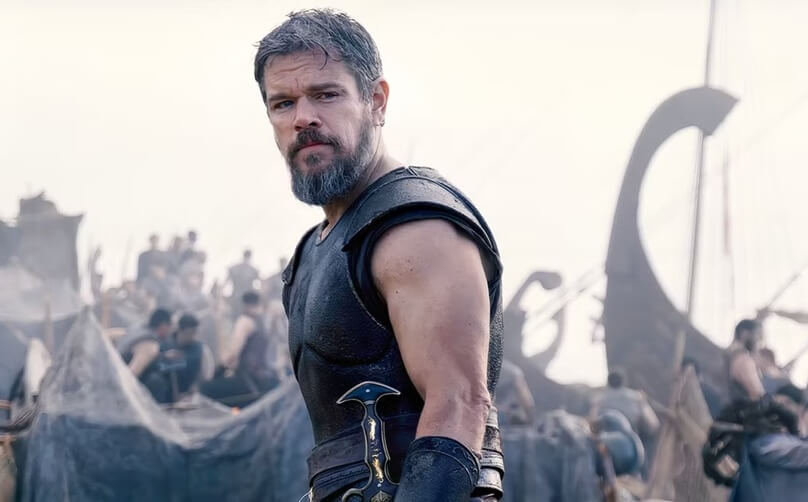
What Nolan’s film has achieved is a homecoming hope for filmmaking, epic filmmaking in particular. There was a time when Hollywood wasn’t afraid to make grand epics and take big risks. In a world that is quickly embracing repetitive sameness, Nolan launched out on his own odyssey with Homer’s Odyssey, trying to create an epic of such vast scope and purpose so as to bring filmmaking home. One can pat Nolan on the back with the colloquial language of Matt Damon’s Odysseus, “Let’s go home.” Perhaps Nolan didn’t take us back to the home of the epic film. Yet he has tried in what is one of the greatest epic films of the twenty-first century, a film that is, nevertheless, still somewhat behind the epics of the past century. We can still hope, however, with this brilliant and unforgettable adaptation that will be the favorite for Best Picture that another generation of filmmakers will launch out on their own odyssey to bring filmmaking back home to big, vast, epic storytelling and visual tour-de-force that characterizes immortal films.
Nolan’s Odyssey wants to be an immortal film. Maybe it got close. And you know what, we can be happy with almost. It is now the undisputed artistic rendition of Homer’s epic journey. In the end, it is a great film—a darkly sublime, beautiful, de-allegorizing but truly mythological masterpiece. There is light in the darkness, and the final act, Odysseus’s homecoming (nostos), is the best hour of the film. It ends with hope. Let’s hope there is still a future for epic filmmaking in the aftermath of this great, almost epic, masterpiece.


Related Posts