God in the Secular World
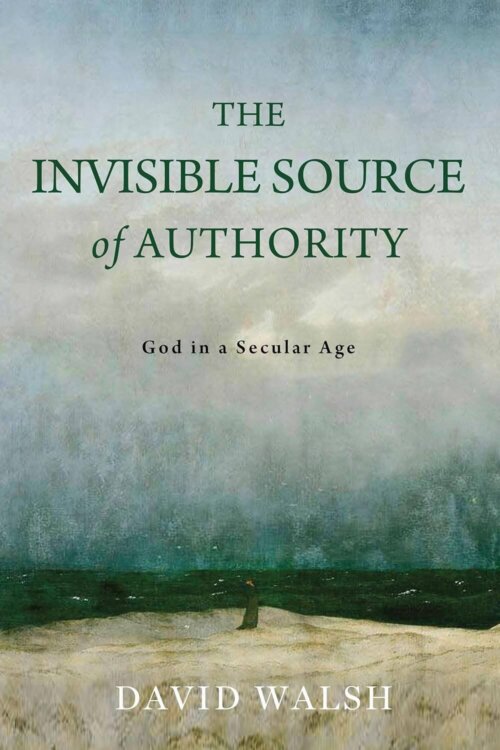
The long march to secularity has been one of the most widely discussed and debated topics in both the popular imagination and academic discourse. While a major divide exists between the popular imagination of a radical break with the past, usually starting around early modernity with the so-called “Enlightenment,” academic contention is far more nuanced and ancient: Judaism’s transcendent deity and then the Christian defeat of the pagan gods also play a role in this slow march to secularism. Two of the greatest works of recent memory deal with this topic, Marcel Gauchet’s The Disenchantment of the World and Charles Taylor’s A Secular Age. It is in the latter camp that David Walsh fits with his work The Invisible Source of Authority.
Walsh reframes our understanding of secularity politics with its commitment to the “inflexible demands of justice and truth” and how these are, intellectually, historically, and philosophically deeply theological concepts. We speak the language of theology even as we have banished God, by and large, from political discourse. This, too, is seen in our insistence on “love” in recent decades, a word that—while having some philosophical provenance—is largely an inheritance from Christianity, and Augustinian Christianity in particular with its maxim dilectio Deus est (Love is God, or literally from Augustine’s Latin rephrasing of the Johannine epistles: love God is).
The want for a more perfect world, and the acknowledgement of the limits of the politics of achievement in this world (due to the disappointment of the “End of History”), also point to a secularized theological imagination. As Walsh notes, “In other words we are back at an acknowledgement of the imperfection of political life that Augustine identified as its permanent condition.”
Even as our secular world retains the theological vocabulary of the past, it serves to enhance our understanding of the transcendent God of orthodox and philosophical theology. The heart of the theology of Transcendence is that God is not part of this world. And this is exactly what secularism guards, even if sometimes very viciously. The secular age, while drawing its authority from theological language and commitments: truth, justice, and love, it also ironically affirms orthodox theology: the transcendence, or other worldliness, of God.
Our secular democratic ideals which rest on moral intuition and sentiment (see, in particular, Adam Smith on this point or even Anthony Ashley Cooper, the third Earl of Shaftesbury) point to something greater than ourselves. In resting and relying on the individual to be the basis of moral pursuit and engagement, the desire for goodness, the desire for beauty, the desire for justice appears more than just an evolutionary and materialistic outgrowth. Our own self-sentimental approach to moralism and politics pushes the thinking individual to consider more than just the self as the basis and grounding for these important philosophical ideas that underpin civil and political society.
By Chapter 3, Walsh investigates symbols and what symbols say. This is an important Voegelinian contribution to secular studies. Voegelin identified the spiritual heart of humanity as this need and organization around symbols. We live and organize around symbols, and these symbols point to concepts and ideas that are higher than ourselves. The irony of secularity, Walsh again notes, “is [that] the secular age is perhaps most hospitable of all to the divine.” Why? Because self-critical and thinking individuals must contend with the symbols that move modernity as pointing to a beyond. Unless you’re a dogmatic atheist, and there are plenty who pollute popular discourse, who chucks theology aside (which is actually a very close-minded approach, so much for rationality), the investigation into love, justice, truth, hope, etc., necessarily lead one back to the investigation of the divine.
At the close of the book, Walsh brings us back to what many already intuit, “A secular state cannot, in other words, be atheistic. The invisible source of authority on which it depends cannot be concealed, even if such concealment could guard against its own undoing. The absence of God does not mean the disappearance of God.” The transcendence of God, once it had taken hold in the consciousness of the world in large part due to Christianity, which unintentionally brought forth the secular revolution of modernity (often aided by self-professing Christian philosophers like Grotius, Locke, and Pufendorf), has won. The secular age is, itself, the triumph of the orthodoxy of transcendence.
In the important and seemingly never-ending discussions over the nature of secularity, David Walsh has made a brief but deeply insightful and important contribution. For those daunted by the scope and size of Charles Taylor’s A Secular Age or the often-impenetrable jargon of French philosophy (to which Gauchet is still guilty of even in translation), Walsh’s The Invisible Source of Authority is splendid alternative. Religious faith will likely only grow stronger in our secular world. And this, God willing, will strengthen both faith and the secular world we live in.
The Invisible Source of Authority
By David Walsh
Notre Dame: Notre Dame Press, 2025; 188pp


Related Posts