A Dreamy Sort of Fatherland
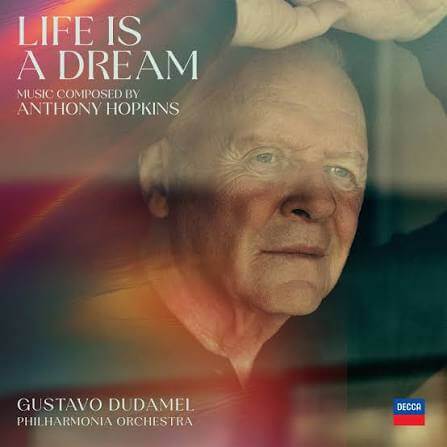
When Bedrich Smetana composed his symphonic poem Ma Vlast (“My Fatherland”) in 1874, he was tapping into a long lineage of nationalist works stemming back to the early Romantic era. Franz Liszt pioneered the form with his celebrated Von der Wiege bis zum Grabe, but he was soon joined by Smetana, Dvorak (Slavonic Dances), Richard Strauss (Symphonia Domestica, Alpine Symphony), and others. Two centuries later, these men have been joined by a most unlikely figure: the actor Sir Anthony Hopkins, whose recent debut classical album Life is a Dream carries on the nationalist tone poem tradition from the perspective of a devoted Welshman.
The country of Wales—or, rather, the small corner of Wales in which Hopkins was raised—is the predominant theme of the album. Hopkins aims to convey a sense of the serenity and tranquility of his fatherland through musical representations of people and places that feature prominently in his memory. For instance, Bracken Road for piano and orchestra is a depiction of the meadows and farmlands that surrounded the Hopkins family home in Margam, South Wales. My Fatherland is a lovely choral work built on fragments of Welsh folk melodies. Of this piece in particular, Hopkins says: “I am the son of my father, the baker.” But perhaps the most explicitly nationalist composition on the album is Tara. In this piece one can hear the unmistakable influence of Hopkins’s British forebears. Melodic lines rise and waver like the violin part in Vaughn Williams’s The Lark Ascending, and the lower strings have the weight and intensity of late Elgar. Of all the works on the album, this is the one that seems most representative of Hopkins’s beloved fatherland.
As the album title suggests, there is a dreamy, atmospheric, almost movie-score feel to most of the pieces in the collection. Hopkins’s compositional style is melodic and lyrical, and it displays the unmistakable influence of a life spent in the film industry. Many of the works contain dramatic surges and background-music qualities that feel as if they were pulled from a film score. Hopkins has a few tricks up his sleeve, though. The second movement of the three-movement suite for piano and orchestra is a smooth, almost jazzy piece that is simply delightful. For me, this was the highlight of the album. Hopkins follows it up with a third movement that is hysterically energetic – a bizarre blend of film, classical, and jazz that feels as if it is about to come apart at any moment. Later in the album comes Stella Aria, a piece for solo cello and orchestra. The naturally mellow, reflective sound of the cello is the perfect complement to Hopkins’s slow and lyrical style. Cellist Gregorio Nieto presents the cello line with taste and sensitivity.
To be sure, Hopkins is not a trained composer, and there is a certain amateur simplicity to the pieces that is both endearing and unsatisfying. The music can often veer into heavy monotony, relying too much on overly simplistic base lines and harmonic structures that remain static for too long. Other times, Hopkins is perhaps a bit too cavalier about the musical quotations he includes. At one point, I looked up in surprise thinking the orchestra had suddenly begun playing Ravel’s Bolero, so obvious was the quotation from that work. The same is true for And the Waltz Goes On, which, for the average listener, would be virtually indistinguishable from almost any of Strauss’s waltz tunes. Despite these flaws, however, the album is an enjoyable and easy listen, one that is sure to appeal widely and convey Hopkins’s love for music. As he says: “Music was my first desire, my first wish.” If for no other reason than that it conveys that desire with purity and openness, this album is a success. Taken together, the pieces offer a kind of timeline for the listener to follow, a story of home told by one of our time’s greatest storytellers.


Related Posts