Michael Lockshin’s Master and Margarita: Bulgakov Reduced to Walter Mitty
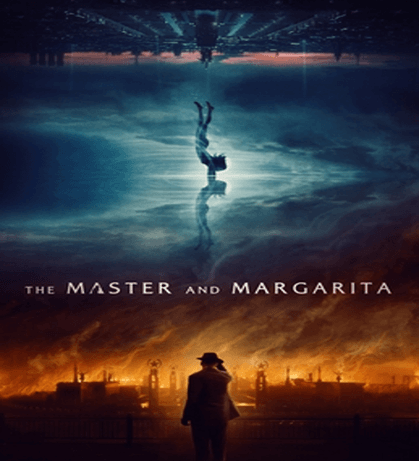
Mikhail Bulgakov’s The Master and Margarita is at once a pointed satire of the venal and corrupt literary establishment of 1930s Moscow and an artistic re-envisioning of Christ, the Devil, and man – deeply influenced by Mephistopheles’s self-description in Faust. The novel explores themes of universal human significance, emphasizing forgiveness and reconciliation on a grand scale. By contrast, Michael Lockshin’s 2024 film adaptation of the novel reduces this expansive vision to one man’s private unhappiness and his compensatory fantasies in response to it.
Bulgakov was censored and repressed by the Soviet Union’s writers’ union, giving him more than enough reason to resent and hate it. Stalin happened to like one of Bulgakov’s plays, The Days of the Turbins, attending it several times and allowing it to be performed. But, all other plays written after 1927 were suppressed. When Bulgakov wrote a letter to Stalin saying he would like to emigrate, Stalin personally telephoned him and they conversed. Afterwards, Stalin organized a job for him at the Moscow Art Theater earning a meager living, but he was still unable to get any plays performed. Bulgakov took his literary revenge on the writers’ establishment by having a fictional member of their coterie beheaded by a tram at the outset, and by having the Devil’s henchmen burn their club and restaurant to the ground at the end of the novel.
The opening scene is set in Patriarch’s Ponds. Mikhail Alexandrovich Berlioz is the chairman of MASSOLIT, which is Bulgakov’s satirical stand-in for the real-life Soviet Writers’ Union. With him is Ivan Bezdomny whom Berlioz had commissioned to write an anti-religious poem about Jesus Christ. Together, they articulate the expected philosophical position of the Soviet regime – atheistic materialism. Berlioz stoutly declares that the historical Jesus did not exist and Bezdomny heartily agrees. It can be imagined they would instead pray on their knees at a Russian Orthodox church if that had been how loyalty to the regime was demonstrated.
Depending on one’s religious proclivities, there can be an enjoyable sense of schadenfreude when the Devil himself turns up, going by the name of Woland, professor of black magic, and contradicts their claims. He says that he was there himself when Christ met Pontius Pilate and can confirm that it all took place. He even debated with Immanuel Kant about the five proofs of God’s existence and Kant’s sixth proof. When Berlioz and Bezdomny deny the Devil as well, it is too much for Woland, who prophesies Berlioz’s beheading that very night. This, he claims, will be the seventh proof.
Bulgakov was influenced by Goethe’s Faust and by taking the Devil seriously as a protagonist, along with other factors, that could be described as magical realism, the novel peaks the reader’s interest, if he is sympathetic to such a subject matter. Lockshin’s movie demotes any non-naturalistic, non-materialist elements to the imaginary with multiple consequences – religious, philosophical, aesthetic, and political.
Woland can be thought of as an anti-Stalin, but one with Stalinesque capacities. His very existence is a finger-in-the-eye for State-sponsored atheism and he is no friend of religious skeptics. His ability to instantaneously transport the head of the Variety Theater to Yalta in the Crimea, to change rubles into foreign currency, etc., demonstrate his superhuman powers. He is an unsympathetic character in Book I as he systematically punishes the greedy, but becomes much more attractive in Book II. If punishment predominates in Book I, forgiveness is a major part of Book II.
The novel takes its epigraph from Goethe’s Mephistopheles in Faust: “I am part of that power which eternally wills evil and eternally works good.” Bulgakov takes that as his philosophical starting point and develops it. The character known only as “The Master” is writing a novel about an alternate version of Jesus he calls Yeshua Ha-Notsri – Jesus of Nazareth. Yeshua Ha-Notsri’s teaching likewise denies that evil is final. For him there are no evil people, only unhappy ones. He emphasizes forgiving love rather than condemnation, and a future in which the violence of authority gives way to a kingdom of truth and justice. Cruelty is real, but on this view it stems from someone’s own misery and mistaken ideas, rather than due to an inherently evil nature.
When Plato has Socrates say, “To know the good is to do the good” he is claiming much the same thing. The tyrant thinks that he will be made happy by acting immorally – unjustly killing, exiling and/or stealing the property of anyone he pleases – but he is wrong. The wise know what is good, the unwise do not. Thus, ignorance is the enemy of the good. On this view, evil is primarily an epistemic issue. To make Socrates’ case as strong as possible, it can be added that “knowing the good” in this context means to know it emotionally as well and not merely rationally. People suffering from a pathology that deprives them of access to their emotions can be stuck in a state of chronic indecision. In an instance of partial knowledge, someone can assent to a claim without believing it in a way that results in action. You can “know” that exercise is “good” without actually desiring to do it without the appropriate associated feelings. However, real knowledge is a union of head and heart, and knowledge of the good is incompatible with not seeking to attain it. We want the good because we want to be happy. If someone ends up unhappy, they have not attained the good.
Consistent with the idea of a coming kingdom of truth and justice, Woland states, “Everything will be made right, that is what the world is built on.” Traditionally, in Christianity, there is an end to suffering and injustice only in the life to come, and that is what Bulgakov’s novel depicts, though it cannot be determined from the text whether Yeshua Ha-Notsri envisioned an eventual earthly end to all power and injustice, or just the heavenly justice he helps procure.
Woland’s authenticity as an eyewitness to the truth gives special weight to the Yeshua Ha-Notsri and Pontius Pilate scenes. In the context of the novel, we can trust that these interactions happened as they are depicted partly because of Woland’s testimony, though, not everything rests on Woland’s shoulders. Other confirmations regarding Jesus’s historical reality include a message communicated by Levi Matvei, and the final moonbeam scene with Pontius Pilate.
In Chapter 29, “The Fate of the Master and Margarita is Decided,” Woland and Azazello sit on the stone roof of “one of the most beautiful buildings in Moscow.” They see the MASSOLIT headquarters, nicknamed Griboyedov, burning, thanks to the actions of Koroviev and Behemoth. Levi Matvei then appears on the roof on Yeshua’s behalf. Levi Matvei is the person who has been dogging the steps of Yeshua, writing down everything he says inaccurately – misquoting him in a way that Yeshua really wishes were otherwise. (This unreliability hints that the Master’s version of Jesus might be more correct than the canonical Biblical Jesus with whom we are already familiar.)
Matvei says, “He has read the master’s writings…and asks you to take the master with you and reward him by granting him peace.” Woland asks, “Why don’t you take him yourself, to the light?” “He has not earned light, he has earned rest,” said the Levite sadly. He adds, “He asks you also to take the woman who loved him and who has suffered for him.” Woland replies, “Do you think that we needed you to make us think of that? Go away.”
In the next chapter, “Time to Go,” Azazello gives the Master and Margarita poisoned wine to start them on their journey to eternal refuge.
On Woland’s final flight from Moscow with his retinue and with the Master and Margarita, they spot Pontius Pilate who has been sitting for two thousand years suffering from insomnia and guilt. He let an innocent man be condemned out of cowardice. Margarita thinks the punishment is too harsh, saying, “Twenty-four thousand moons in penance for one moon long ago, isn’t that too much?” but Woland says that pity is not enough. But, now that the Master’s novel is complete, Woland says the Master may end Pilate’s story. The Master proclaims, “You are free. He [Yeshua] is waiting for you.”
These scenes represent forgiveness, reconciliation, and redemption. They are in line with Yeshua’s and Woland’s eschatology, rather than more retributive views. These scenes read naturally as Bulgakov’s own hope, as he was dying, that good might still be drawn from intended evil.
Michael Lockshin’s film collapses the ontology of the novel by making all supernatural, magical realist, elements of the story be merely part of the Master’s fantasy life. The Master’s reenvisioned role invites comparisons to Walter Mitty. The Secret Life of Walter Mitty had him merely doing the shopping and buying overshoes, but fantasizing about being a navy hydroplane commander, a brilliant surgeon, an expert marksman, a heroic pilot, and a condemned man bravely facing a firing squad. It is the equivalent of Neo just dreaming that he was being pursued by agents in The Matrix. This severely reduces the aesthetic enjoyment of the movie.
The pathos, brutality and interest of the theater scene where Woland puts on a demonstration of “black magic” is intriguing and powerful as real, and of no particular significance as fantasy. By offering free clothes, shoes, and money, Woland is testing the greed of contemporary Muscovites compared to the last time he was on earth. As the Master’s daydream there is no experiment and no conclusions to be drawn. Reading of Behemoth removing the head of the emcee and then later reattaching in front of a real-life audience produces a satisfying sense of horror and elevated emotion in a way that imagining it as the private thoughts of the Master do not.
The changes to the books metaphysics and ontology also means that many lovely scenes from the book are omitted. Yeshua does not agree to the Master being sent to a pleasant afterlife and Yeshua does not reconcile with Pontius Pilate. There is no seemingly doomed, lonely Pilate, and no rest waiting for the Master and Margarita in a spiritual realm. In the novel, we find out that Woland’s helpers look and behave the way they do due to a kind of curse put on them as punishment which is lifted as they ride away, revealing their true forms. These poignant scenes are nowhere to be found in Lockshin’s account.
Other changes in the movie include the Master jumping to his death from the mental asylum he never leaves and Margarita poisoning herself when she finds out that he is dead, reading the finished manuscript while she dies. In the novel, they briefly return to their basement apartment, but it seems clear that that is not going to work out. Azazello is sent to poison them, without their knowledge. They are then reunited in the afterlife and the story continues. In Christianity, the injustices and sufferings of this life are made up for in the afterlife. There is no expectation of earthly justice. But, the Master’s suicide in the movie is final. His memory only lives on in the film long enough for Margarita to finish reading the manuscript before dying herself. Satan’s Ball and the lovers’ reunion is now purely imaginary. Woland and his demons do not exist, so their destiny is irrelevant. If they seem more benevolent later in the story, then this has implications for the lovers alone. They were never there in the first place.
Having the Master and Margarita commit suicide puts quite a different spin on things. Bulgakov died from natural causes, not suicide, and the novel contains what seems to be a very beautiful reflection on his approaching death from kidney disease that Bulgakov did not have a chance to integrate better into the novel. He made major editorial revisions to Book I, but was unable to do so with Book II. Bulgakov writes in Chapter 32, Absolution and Eternal Refuge: “How sad, ye gods, … the world is at evening…You will know it when you have…suffered greatly before dying, when you have walked through the world carrying an unbearable burden. You know it too when you are weary and ready to leave this earth without regret…ready to give yourself into the arms of death with a light heart, knowing that death alone can comfort you.”
Given his suffering and the horrible headaches his disease caused – like those of his Pontius Pilate – the “light heart” referred to seems to be his own. This is far away from the negation and nihilism of suicide. The latter fits only into the film’s godless frame.
By rejecting a two-world structure: real supernatural events in real worlds, Lockshin’s film trivializes the ethical and theological implications of the novel as the fantasies of a suffering individual.
The movie ends with Woland and the rest, watching Moscow burn. In the novel, Woland, his retinue, the Master and Margarita, leave the city intact. With no other world to counter this, the scene in the film is in line with nineteenth-century Russian nihilism which proposed that all earthly institutions must be destroyed in order to create their perfect replacements. Of course, the new pseudo-heavenly institutions never appear. Nor is there even a realistic vision of what they might look like. Nihilists were notorious for lying and personal betrayal for their “good” cause, but only succeeded in making life worse. When combined with the suicide of the main characters, the movie risks drifting towards such an attitude.
Without magical realism, there is no Woland and no Jesus. Berlioz and Bezdomny are demonstrably wrong in the novel. There was a historical Jesus and the Devil exists. In the movie, they are possibly right. The director Lockshin is therefore in the same existential and epistemic position as Berlioz and Bezdomny; deniers of supernatural realities, at least in the context of the movie.
Did Lockshin himself find the magical realism hard to stomach when he read the novel? Or, is he worried about his audience’s vulnerability to metaphysical propaganda (from his point of view)? In moving from supernaturalism to naturalism, one certainly hopes that he did not think that his film audiences just would not be able to cope with other-worldly themes on their own terms.
Michael Lockshin is not pro-communist, so he will not be a fan of the politics of 1930s Soviet Union, but the film’s naturalizing frame has atheistic implications in line with the Soviet promotion of anti-religious materialism. The novel’s explicitly spiritual stance adds an additional layer of criticism and rejection of the Soviet position, giving the real-life authorities added ammunition for the censorship Bulgakov justly feared.
Some might think that getting rid of this vitally important aspect of the novel, an ontological Satan and metaphysical reconciliation, is an aesthetic and philosophical improvement, transforming the non-naturalistic elements into something that could happen from something that could not.
Without the Soviet regime’s censorship of Bulgakov, preventing him from continuing his vocation as a playwright, it can safely be assumed that there would be no The Master and Margarita which prominently features precisely this persecution. This would be an example of something “good coming from the evil that is willed” mentioned in the epigraph.
The actor and actress playing the titular characters are married in real life, and like Bulgakov and Elena Shilovskaya, they were married to other people when they met and divorced their respective spouses in order to be together.


Related Posts