The True Knight: Arthurian Romance in the Shadow of Dante’s Divine Comedy
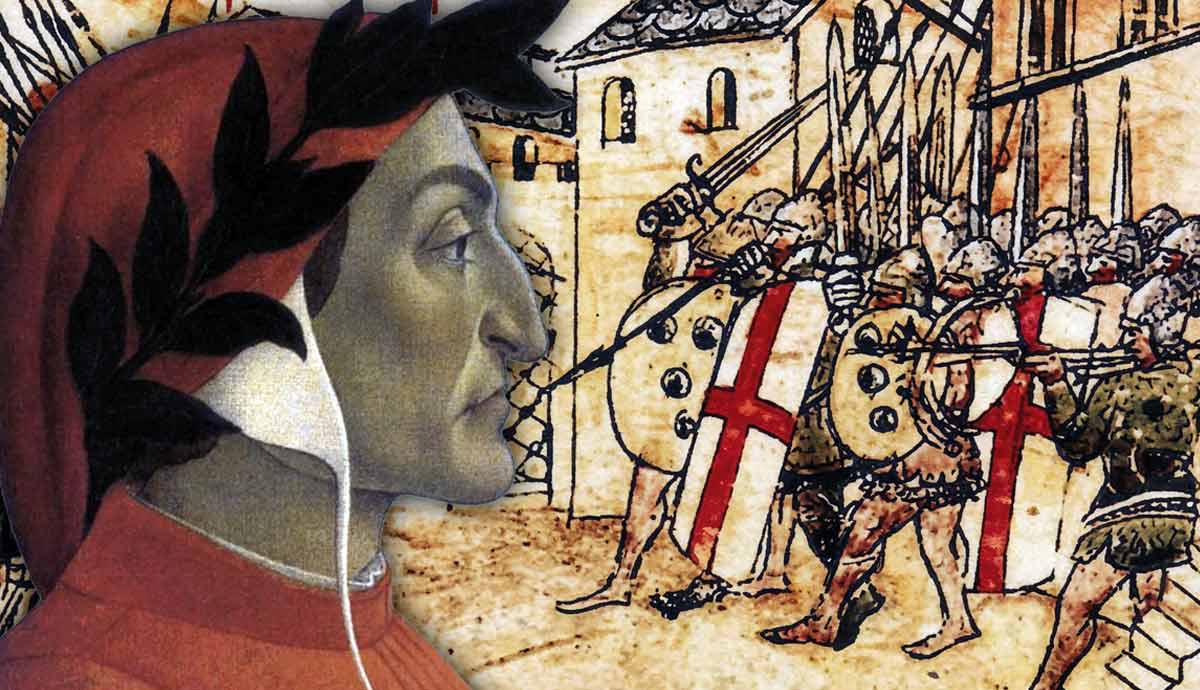
The knight puts on his armor and readies to mount his steed. He has heard of a faraway land that is tyrannized by a dark evil and he is preparing to venture off into a new world to battle the darkness and rescue the princess. He will fight for a just cause, show mercy to others, and treat ladies kindly on this adventure and eventually win the princess in love or marriage. These are basic motifs that dominate Arthurian Romance. Now imagine this picture: The ladies of the royal court sense the knight is in danger, they have heard that a faraway land is tyrannized and the knight needs help and renewed courage on his quest, and through their showing of mercy and revelation of justice the knight will win an even greater prize: God. That’s how Dante subverts and sanctifies Arthurian Romance in the Divine Comedy—by drawing upon all the Arthurian motifs and tropes we know but reversing the norms by which they operate.
Arthurian allusions abound throughout Dante’s epic. While the establishment of a new, subversive, engagement with Arthurian poetry and storytelling begin as early as the second canto of the Inferno (which I will return to very soon), it is patently clear that Dante is engaged in Arthurian criticism by the fifth canto when he enters the circle of Lust and famously converses with Francesca. As Dante and Virgil enter the circle of love turned lust, innocence turned to guilt, sharing turned to taking, Dante observes the many souls that populate this realm which include great warriors who “lost [their] life to love” (5.66) which includes the Arthurian character of Sir Tristan (5.67). Tristan and Iseult’s story serve as a cautionary warning for the knightly reader since Sir Tristan, in escorting Princess Iseult to her marriage, falls in love with her and the two carry on an illicit romance ending in Sir Tristan’s death. After seeing this fallen Camelotian knight, Dante learns from Francesca how she and Paolo fell into sin, reading about “Lancelot [and] how he fell in love” (5.128) which led Paolo to “kiss [Francesca’s] mouth” (5.136). From there, all innocence and the sharing of art was lost to lust and Francesca blames “that book and he who wrote it” (5.137) rather than accepting her own sin.
This episode serves as a mirror in the abyss for Dante and the reader. The obvious mirror to the reader is that what starts in goodness and innocence can quickly turn to sin and destruction—and like Francesca, we often romanticize our sins to be a reflection of Love not realizing that we are blaming Love itself (God) for our own descent into sin. For Dante, the first story he hears from a sinner is how a story led them to hell. Words and stories, poetry, have power. While it is true that Francesca bears her own responsibility for her fate (which she never accepts by blaming Love and Arthurian storytellers), Dante underscores an equally true reality bound up with Francesca’s eschatological destination: art is imitated by others, and the artist therefore also bears responsibility for direct souls to heaven or hell. Dante, looking back on the Arthurian troubadour tradition, is greatly troubled. He is a poet-artist and former knight, has his poetry been implicitly leading others to hell? This great tradition of song that has enamored the world, can it be sanctified to lead souls to heaven rather than to hell?
*
In the Arthurian tradition, the male knight initiates his quest to journey into faraway lands, overcome temptation, fight evil, and win the fair maiden. That’s the foundational trope of Arthurian knighthood. Yet from the beginning of Dante’s reimagination of Arthurian storytelling within the Divine Comedy, he starts with a subversion of these expectations in order to sanctify the very art of Arthurian Romance.
When Virgil tells Dante why he has appeared, Virgil says, “I was among those dead who are suspended, / when a lady summoned me. She was so blessed / and beautiful, I implored her to command me” (2.52-54). From here, Virgil goes on to state that Lucy and the Virgin Mary, Queen of Heaven were also involved in the movement to save Dante’s life. The women of the court of heaven need not saving, rather, it is the knightly Dante who needs saving and this new quest for salvation is initiated by women. Virgil upbraids Dante:
So what is wrong? Why, why do you delay?
why are you such a coward in your heart,
why aren’t you bold and free of all your fear,
when three such gracious ladies, who are blessed,
watch out for you up there in Heaven’s court,
and my words, too, bring promise of such good? (3.121-126)
The fact that Virgil also calls Dante a coward subverts knightly expectations. The knight, in Arthurian stories, is courageous. If given such a revelation by an angelic herald (as Virgil acts in the early stages before the journey truly commences), the Camelotian knight would leap into action, spurred on by the knowledge that such “gracious ladies” are on his side. Dante, though, hesitates. He is cowardly and not yet filled with courageous conviction.
Let us recognize here what Dante has done to subvert Arthurian expectations and the primacy he has given to women in this new Arthurian tale told within the pages of the Divine Comedy. It is not the male knight who initiates the quest but the ladies of the court who do and befitting the transcendental and heavenly aim of this new Arthurian epic, it is the ladies of the court of heaven who begin the quest since heaven is the ultimate prize to be won by the newly reinvigorated knight. However, rather than the male knight leaping into action at the revelation of this knowledge, Dante marks himself as a coward still needing bravery and courage to advance as he is not yet “free of all…fear” (3.123). Dante presents himself, the new knight, as secondary in movement, still cowardly and fearful, and not yet ready for the war that he must wage to save himself rather than save the already saved maiden. The quest is for his spiritual salvation rather than carnal fulfillment.
These early allusions to Arthurian motifs and tropes bring Dante to Francesca and Paolo, where, if the reader had yet to pick up on this new Arthurian epic Dante is telling, the story of Francesca and Paolo bluntly reveal the Arthurian spirit of the Florentine poet’s construction. As hitherto mentioned, one of the souls that Dante names upon entering the circle of Lust is the Arthurian knight Sir Tristan. Upon talking with Francesca, he learns that she was imitating the illicit love affair of Sir Lancelot and Queen Guinevere. Francesca then blames the Arthurian stories for her misery.
The episode with Francesca, though, offers Dante the first test of his new knightly duties. Camelotian chivalry demanded three ideals: fighting for a just cause, acting mercifully toward others, and treating women well. Dante is now embodying all three within the levels of hell. First, he is fighting for the most just of causes: the love of heaven and the salvation of his own soul. Second, he takes pity on Francesca and this doubles to fulfilling the chivalric demand that knights treat women kindly, ‘Francesca, the torment that you suffer / brings painful tears of pity to my eyes’” (5.116-117). Dante goes on to reiterate his merciful pity for Francesca when her story, when finished, causes him to feel such great a “pity [that] blurred [his] senses” (5.140-141).
Additionally, the encounter with Francesca reveals a new failing for Dante as the spiritual knight—he cannot save her! The normative encounter of knight and maiden in Arthurian legends would have the knight attempt to save her while falling in love with the “damsel in distress,” but this is not possible for Dante. Rather, in an ironic and paradoxical way, it is Francesca who is rescuing Dante by relating her story so he doesn’t fall into lust for Beatrice (which will become a major motif in Paradiso) and it is she who initiates the resurrection of Dante’s heart insofar that he has pity for her through her telling him her story. This pity and mercy that Dante will show various souls in hell, especially Pier della Vigna and Ser Brunetto Latini later on, serve to resurrect the spirit of merciful, charitable, love that Dante needs in order to ascend to paradise. Just as Beatrice, Lucy, and Mother Marty initiate the quest for Dante, Francesca can be credited with starting the resurrection of Dante’s heart and his fulfilling the chivalric virtues of showing mercy and treating women well despite being the prime mover in hell! Dante also implies that God allowed Francesca to come to him, thus she is a paradoxical vessel for God despite her being damned, “[T]he wind bent their course in our direction” (5.79).
As Dante now battles against the spiritual darkness and evil that governs hell, he draws upon militaristic, war-like language and imagery as he descends deeper into the underworld. Approaching the city of Dis (city of Satan) with Virgil, Dante describes the city like a castle defended by “deep moats” (8.76) with “walls…made of iron” (8.78) and “heavy gates” (8.115). Dante must gird his loins and storm the evil castle, besiege hell itself, and emerge victorious. This starts the knightly warrior motif of associating hell as a city needing storming and he, the novice knight of goodness and love, proving himself worthy of being this new knight of heaven.
When Dante and Virgil land in the eighth circle of hell, the Malebolge, he vividly describes the scene in very Arthurian, soldierly, language and imagery:
That belt of land remaining, then runs round
between the well and cliff, and all this pace
is divided into ten descending valleys,
just like a ground-plan for successive moats
that in concentric circles bind their center
and serve to protect the ramparts of the castle.
This was the surface image they presented;
from moat to moat to reach the farthest bank,
so, from the great cliff’s base, just spokes of rock
crossing from bank to bank, intersecting ditches
until the pit’s hub cuts them off from meeting. (18.7-18)
In no stark terms, this is where Dante must become a knight of courage if he is to succeed. Storming the castles of hell and fighting a spiritual war is now his task. Where other knights have failed, Dante will succeed with newfound bravery and courage. As he continues on, Dante begins to blend more explicitly his military service in the Guelph-Ghibelline War with the Arthurian imagery and language that is now fully apparent:
I have seen troops of horsemen breaking camp,
opening the attack, or passing in review,
I have even seen them fleeing for their lives;
I have seen scouts ride, exploring your terrain,
O Arentines, and I have seen raiding-parties
and the clash of tournaments, the run of jousts—
to the tune of trumpets, to the ring of clanging bells,
to the roll of drums, to the flash of flares on ramparts,
to the accompaniment of every known device;
but I never saw cavalry or infantry
or ships that sail by landmarks or by stars
signaled to set off by such a strange bugling! (22.1-12)
Just as the culminating destruction of Camelot comes in battle, the culminating metamorphosis of Dante, his christening into a Knight of Christ—his destruction as purely a Camelotian knight of earthly desire—is occurring on the same path that Christ treaded during the Harrowing of Hell and is necessary for his battling spiritual evil which the Camelotian knights often did undertake but failed in sustaining as the ultimate and highest calling of the chivalric soldier.
The Arthurian imagery and direct references of Arthurian characters come to a culmination as Dante and Virgil enter the final circle of hell. When confusing the giants for a ringed fortress of “towers” (31.20) and a “city” (31.21), it is as if the final castle, the final city, needing stormed now presents itself to the knightly Dante. In the circle of traitors, Sir Mordred, the bastard son of King Arthur, is pointed out as belonging to those souls frozen in the lake of ice. Other prominent knightly traitors are pointed out to Dante including those from the Song of Roland like Ganelon as well as historical treacherous warriors like Tebaldello from the Guelph-Ghibelline Wars.
Dante is now among his own companions, fellow knights, but knights that failed whereas he is now the knight who is succeeding.
As Dante fights through the lowest circles of hell, and as he fights through the final circle of hell itself, he brings to fruition an overlooked class of souls that he met in Limbo. We tend to remember the poets and philosophers in Limbo as they receive the greatest number of lines in Dante’s song. The poets welcome back Virgil, Dante gives laudatory praise to Homer, and Dante is also welcomed into the company of the great poets. Then, as he is about to leave Limbo, he rattles off the names of the great philosophers and philosophical conversation will become a recurrent motif between Virgil and Dante in both the Inferno and Purgatorio. However, sandwiched between the poets and philosophers are great warriors: Hector, Aeneas, Caesar, Lucius Junius Brutus, and Saladin (4.122-129). Earlier, Dante had humbly said he was “not Aeneas” (2.32). Dante was, of course, foreshadowing the fact that he is the new Aeneas and the new warrior of liberty and chivalry in service to the only truth that warlike virtues are to be directed: God. He has become the brave, not cowardly, spiritual, not carnal, knight he was called to be by Virgil when informing him of how the ladies of the court of heaven had come to him to help find Dante and begin this new Arthurian journey they have been on. Dante’s war through hell entails him becoming a new knight.
*
That Dante is now a new knight in the service for spiritual truth and must even overcome his carnal desire for Beatrice is the subject of the Arthurian revision of Paradiso. The Arthurian knights had failed because of their illicit love for earthly women rather than God; that is what Dante comes to recognize and critique in his simultaneous criticism and sanctification of Arthurian Romance within the Divine Comedy. Sir Tristan fell for Iseult and died. Sir Lancelot sinned for a decade with Guinevere, and their sin helped hasten the ruination of Camelot. Even King Arthur’s sinful incestuous relationship with Morgause comes full circle with Sir Mordred and Arthur’s death at the hand of his bastard son when all illicit relationships cataclysmically collide bringing forth Camelot’s destruction.
When in heaven Dante constantly remarks about how beautiful Beatrice is, thereby failing to understand that her beauty and loveliness is because God is Beauty and Love. Already in the first canto Dante says, “And Beatrice stood there, her eyes fixed / on the eternal spheres, entranced and now /my eyes, withdrawn from high, were fixed on her” (1.64-66). Beatrice upbraids him and reminds him, ‘Among all things, however disparate, / there reigns an order, and this gives the form / that makes the universe resemble God’” (1.103-105). After Dante nearly faints from gazing into Beatrice’s beautiful eyes, she says, ‘If, in the warmth of love, you see me glow / with light the world below has never seen…you should not be amazed, for it proceeds / from perfect vision which, the more it sees, / the more it moves to reach the good perceived’” (5.1-6). This motif is replayed repeatedly, the signification being that Beatrice is a mirror of Divine Light, Divine Love, Divine Beauty. Dante must come to know this through her.
The knightly Dante who has overcome hell must now overcome the temptation of idolizing Beatrice over God and Beatrice; the fair maiden of the court of heaven, rather than embracing the male lover, lovingly reprimands him and acts as spiritual teacher. Here, too, is another subversion of Arthurian expectations: Beatrice, the feminine divine, instructs the still lustful Dante on matters pertaining to spiritual wisdom and salvation. Rather than the male knight who saves the woman needing rescued, it is the pious woman, the angelic female (donna angelicata), that saves the impious and sinful man who is need of rescue.
Additionally, Dante’s battle with the Light of Heaven (the Love of God) is described in martial terms and language reminiscent of the knight preparing for a joust and after being defeating in a joust:
Just as a bachelor arms his mind with thoughts
In silence till his master sets the question
To be discussed not decided on,
So did I arm myself with arguments
While she was speaking, that I be prepared
For such a questioner and such a creed. (24.46-51)
And
Just as a sudden flash of lightning strikes
The visual spirits and so stuns the eyes
That even the clearest objects fade from sight,
So glorious living light encompassed me,
Enfolding me so tightly in its veil
Of luminance that I saw only light. (30.46-51)
In heaven, Dante’s arming himself and being encompassed by Divine Love and therefore, in humility, “admit[s]…defeat” (30.22). In defeat, the knight is victorious in one of the most spectacular uses of irony within the epic. Why? Because it is not earthly beauty the knight fights for but transcendent beauty. It is not the knight’s own strength that leant him to victory but God’s strength in him that made him brave and courageous. Once the knight humbles himself he is victorious.
In the Divine Comedy, Dante tells his own Arthurian Romance to undo the sin of Francesca and the danger of romanticizing the illicit relationships that are commonplace to the Camelotian tradition. It is the women of the heavenly court who start the quest for the male knight, not the male knight initiating his own quest for the maidens needing rescued. It is a woman who rescues the floundering male knight, not the male knight rescuing the maiden in distress. It is the fair maiden who instructs and saves, not the male soldier. Yet Dante also spiritualizes the good virtues exhibited by male knights in the Arthurian tradition. Dante spiritualizes the war with evil, thereby making the confrontation with evil even more important. Dante exhibits great bravery in storming hell wherein he embodies the chivalric virtues of the Camelotian knight. Dante’s quest reveals what the true knight must fight for: God. In this, he sanctifies the Arthurian tradition by subverting it. In revealing the shortcomings of Arthurian songs, he created the greatest Arthurian song and presents what the true knight should be like. The Divine Comedy is the penultimate Arthurian Romance.
NOTE: Translation is by Mark Musa.


Related Posts