A New Odyssey Through “The Odyssey”
Homer’s epic poem The Odyssey is an ancient piece of literature that nevertheless remains widely studied, translated, and read (both academically and recreationally) by modern audiences. Wily Odysseus schemes his way into victory rather than using brute force, and in The Iliad, he stands as a counterpoint to Achilles’ reliance on martial strength to bring about the downfall of Troy. The Odyssey is a sequel to The Iliad, describing Odysseus’ long, circuitous, and oft-interrupted journey home after the Achaean victory at Troy. It is only after he loses all of his companions, all of the twelve ships he led out of Ithaca, and a seven-year sojourn with the nymph Calypso on the island of Ogygia that he at last finds the right path and makes it back to rid his home of a band of suitors who had spent the intervening years vying for his wife and plotting against his son. The epic poem is filled with adventure, misadventure, vengeful gods, and a very loyal dog.
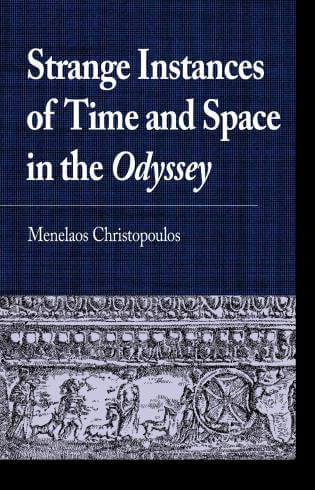
While The Odyssey can certainly be enjoyed as a straightforward narrative, it bears layers of history and mythology, making it a subject for deep study and observation. Strange Instances of Time and Space in the Odyssey by Menelaos Christopoulos adds several insights to that body of work, but it does so more by asking questions to drive the reader into further study rather than drawing straight conclusions. This slim volume is broken down into six chapters that almost function as standalone essays. Each tackles a “strange instance,” drawing on the poem and other extant texts to point out its significance, map out some possible explanations, and provide the reader with resources to continue to dig further.
The first chapter focuses on the ships and helmsmen. He notes that, for a poem popularly known for being about a seafaring journey, it takes place mostly on land. In fact, it focuses frequently on a lack of ships or forward movement. This contrasts heavily with the other great sea-faring narrative. In The Argonautica, the focus is given to the ship and her crew, and indeed, the name of the poem is drawn from the ship. In The Odyssey, the character Odysseus is central, and it is from him that the name of the poem is derived. Out of twelve ships full of men, neither one of the vessels nor Odysseus’ crew survives or completes their homecoming.
Chapter two focuses on elements of Odysseus’ homecoming or nostos. Here, Mr. Christopoulos digs into four instances of the hero being dragged back and forth, forced to return to a point of beginning before carrying on with his journey, and each time setting out in worse condition than the first, until he finally sets out from Ogygia, alone and shipless. It also draws tight parallels between Penelope’s story and that of her husband, as well as finds common threads between Telemachus’ story and that of his father. Many of these sections are also told out of chronological order, being recounted by the character after the events have already unfolded. The twisting, out-of-the-way style of narrative in The Odyssey matches the deceitful, trickster nature of its protagonist. In similar ways, the more linear stories reflect their more straightforward heroes.
From here, I will let the reader make their way through the details of the remaining chapters and make a switch to more of my overall impressions.
As I noted earlier, Strange Instances of Time and Space in the Odyssey functions more as a collection of observations and ideas. Points and possibilities are thoroughly laid out and given weight by excerpts from the epic poem and other extant texts, but I noticed that conclusions were generally avoided. After the first chapter, I wondered if the lack of conclusion was a feature or a flaw; as I got further in, I noticed that the pattern was too deliberate to be accidental. This was further confirmed upon reaching the Epilogue, where Mr. Christopoulos stated plainly his belief that poets and their works rarely care about what set conclusions could be drawn. As a poet myself, I appreciated this stance from a clear academic. I hold the stance that the study of poetry is important but open-ended. A great poem allows for the continual unfolding of mystery that leads to new ideas, questions, wisdom, and further mystery. The author seems to agree and pursues the goal of opening avenues of inquiry to readers of The Odyssey, rather than closing them.
At a technical level, this book is very much an academic work. It is written with trust that the reader is well acquainted with The Odyssey itself and familiar with its history. It is also written with liberally sprinkled passages in Greek. Some are translated, though many are not. This could be something of a hindrance to a casual reader. However, the layout and approach, following the order of events laid out in the poem, make it accessible to someone who loves literature but lacks formal training. That was certainly my experience of it. The longer or more complicated passages in Greek were given translation. The instances of Greek that were not directly translated were usually single words spoken in context. Even if I could not pronounce the word or give a dictionary-level definition of it, I did not need to understand the points being made.
Menelaos Christopoulos stated that his aim was to promote further dialogue with this ancient poem that he clearly and dearly loves. I believe that it very much succeeds at that task. Even for lay readers, it serves as a guide, shows how to do a close reading, and how to form questions that are worth asking. At the very least, I look forward to my next reading of The Odyssey in which I might take these observations and dig even further to find what else there is to glean from the work.
Strange Instances of Time and Space in the Odyssey
By Menelaos Christopoulos
Lanham, MD: Lexington Books, 2023; 102pp


Related Posts