Euphoria and Symposia
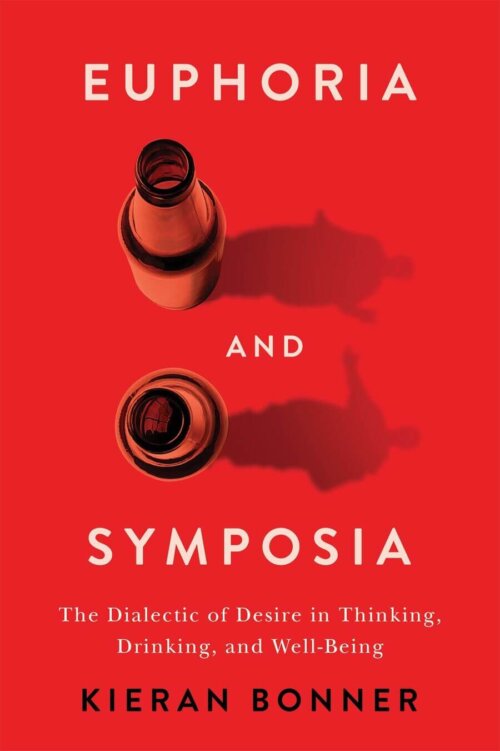
Euphoria and Symposia by Kieran Bonner addresses the ‘grey zone’ of health and illness, illustrated through the examples of drinking and thinking – two activities that can contribute to health in a broad sense, be rewarding, and indeed euphoric, but which are dangerous, with the twist that not drinking or thinking can also be a dangerous form of intoxication. Thus, good health and well-being is shown to be a complicated matter, and much more complex than the hegemonic WHO definition of health: “a state of complete physical, mental and social well-being and not merely the absence of disease or infirmity”. We are shown this through how, following William James, alcohol is an avenue to mystical experience, but is equally an addictive drug. Thinking can be euphoric, producing moments of flow and connection. Equally, thoughtlessness can enable a reckless intoxication in taking action. Thinking has been feared due to how it can undermine all convictions and lead to a dangerous relativism, as in sophism. Thinking can be overwhelming and disturbing, causing many to resist incitements to think, seen in the hatred toward gadflies like Socrates. It can detach one from reality, and can lead to hubris, where a person believes their truth trumps all others, and to fantasies where one’s schemas, if followed, can create heaven on earth.
We are shown how the dangers of drinking and thinking have led many to emphasize the will, where the emphasis comes to be on a tough dedication to commandments and steps to follow instead. Bonner notes how this has its own problems, as it can create cult like groups where authority and doctrine take over. Indeed, tough commitment to a path can be like an addiction to something that promises to be an antidote to the risks of addiction. Disciplined asceticism is an associated response to the intoxicating possibilities of drinking and thinking. But denial is not necessarily health or flourishing and can rather be anaesthetizing and involve the sublimation of desire into the alternative intoxication of talking about and imagining sin and wrongdoing. While thinking can be euphoric, not thinking can equally be intoxicating, as it can allow one to be detached from reality and responsibility.
Thinking and drinking are entwined of course also – as in symposia – where each act as a stimulus to the other. They, by themselves, and especially when combined, can produce euphoric moments. Such moments may be where people feel truly ‘well’ and ‘healthy’. But it is again shown to be a complicated issue. Well-being could be said to be based on fulfilling desire – the desire to achieve such feelings of euphoria. But the work helpfully shows that desire is relational and thus not subject to control, despite what modern individualism might suggest. Desire reaches out to ideal conditions, such as euphoria. But it is uncertain if they will ever be achieved, and if they are, it will be temporary. Fulfilling desire is also disruptive to equilibrium, causing hangovers and depression. Desire can become a trap and separated from wellbeing in addiction. Fear of the dangers of desire can cause some to embrace various forms of asceticism, but that has its own life-denying problems. We are thus led to see how there is no way out of the ambivalent and incomplete nature of human experience, and that perhaps the best we can do is embrace an ironic enjoyment in this condition of irresolution and irresolvability.
Rather than being trapped in the complexity of the issue, which could lead to cynicism, Socrates plays a role throughout the book as a guide to a useful approach. There may be no easy answers, but the approach to being and acting that Socrates exemplifies shows what a good orientation to this complex state of affairs could be. Driven by his daimon he pursued honest dialogue with himself and others, seeking to not contradict himself, and thereby to not do what is wrong. He was also animated by desire – being driven by eros and having loveable things (like good company and dialogue – the themes of this book) as the objects of thought – while not being trapped by desire. But we are shown how we need to be careful here again, as the Socrates we can come to know, is of course not a real person but a character, who is a representation of an approach to learning and acting. Plato’s dialogue Symposium has an important place in the book, and the way it is framed by Bonner shows this well: it is a second-hand story relayed by a disciple of Socrates to a fan, in a representation of the party by a student of Socrates who was not at the party themselves. Thus, irony abounds, reflecting the necessarily provisional nature of any conclusions. We see how even when presented with a model such as Socrates, risks exist, as there is always the temptation to heroize Socrates rather than realizing the true value is in what his representation represents – an approach towards learning and acting.
This insight comes out of the method of Reflexive Analysis, pioneered by Alan Blum and Peter McHugh, with Plato the foundational figure in the background. Through this we get an example of a Socratic approach to the practice of sociology. The interpretive sociologist is challenged to grapple with the “impossible problem of seeking answers to impossible first questions” (Bonner 2025: 271). Thus, it is not an approach that wants to offer satisfyingly definite answers but rather indicates the complexity of the topic at hand. But the emphasis on complexity is not to set the reader hopelessly adrift into the mire of confusion, but rather, following Socrates, to seek to shake the interlocutor out of pre-reflective ignorance, or hubristic overconfidence about one’s method, theory and conclusions. Truth is shown to be provisional, relative, mediated and dialogical, through the method of tackling the topic in multiperspectival way, by introducing the lessons of different biographical moments, the lessons of various teachers, intellectual guides, studies, and historical figures; all put into conversation with each other.
Therefore, alongside a discussion of spirit and method, we get an analysis, where Bonner shows how we could think about drinking. In an appropriately reflexive manner, this is portrayed autobiographically. Just as Socrates cannot be separated from his rootedness in Athens and its times, Bonner helpfully gives some revelations of biographical moments, which offer some of the clearest and convincing illustrations of his case, as well as making the work highly reflexive. These outline transformative experiences of pleasurable sociability that the author experienced, where social connections were developed, resulting in leaps in understanding their place in the world, in shaping new horizons for action, and shaping their world, while being shadowed by risks.
The spirit and method are put into practice also through staging a dialogue between different positions on drinking, health and well-being. Like in a Socratic dialogue, different characters – in this case disciplines, sciences and theories – are put into conversation. We have discourses focused on health from medicine and public health, discourse emphasizing pleasure as a value, discourses arguing for various degrees of control from temperance, abstinence and prohibitionism, and anthropological discourses focused on community, social solidarity and sacred experiences from anthropology and Jamesian psychology. The dialectic offered reflects how knowledge about the grey zone of health and well-being is necessarily provisional and contested, with a wise orientation possible only through an ongoing dialectic between different positions, in pursuit of an equilibrium that will always be provisional. Thus, a good intellectual approach reflects a good approach to life in pursuing balance, and comfort with ambiguity, through the practice of sociable dialogue. I did wonder however if everyone had been invited to this particular symposium, as I would have liked to have heard more from some actors and discourses that have a great deal of power in shaping the nature of drinking. The alcohol industry and the tax-hungry modern state, who have done the most to define contemporary drinking culture are not strongly represented. Addiction is voiced strongly, but victims of alcohol-related harm and the criminal justice system less so. Public health is in places presented as a powerful, agenda-setting force, when it is in my view lamentably weak and reactive to the agenda setting of the alcohol industry.
Despite these moderate reservations, the book has mainly inspired me to borrow the method of Reflexive Analysis to explore the question myself – though I would invite ministers of finance and justice, alcohol industry executives, and victims of alcohol-related harm to my personal symposium also. The book is a tocsin against the blindness created by specialization, weddedness to a single theory, obsession with a particular social project, and rather counsels embracing the middle path of uncertainty, an effort to find balance, and the pleasure of interacting with others in an ongoing and irresolvable dialogue.
Euphoria and Symposia: The Dialectic of Desire in Thinking, Drinking, and Well-being
By Kieran Bonner
Montreal: McGill University Press, 2025


Related Posts