A Roman World at War
“The corpse was lying where Caesar fell, covered ignominiously in the blood of the man who had marched as far west as Britain and the Ocean and who was planning to march east against the realms of the Parthians and Indians so that, when they were subjugated, sovereignty over all land and sea should be combined into one empire—this man’s corpse was lying there, then, no one having had the courage to say and carry it off.”
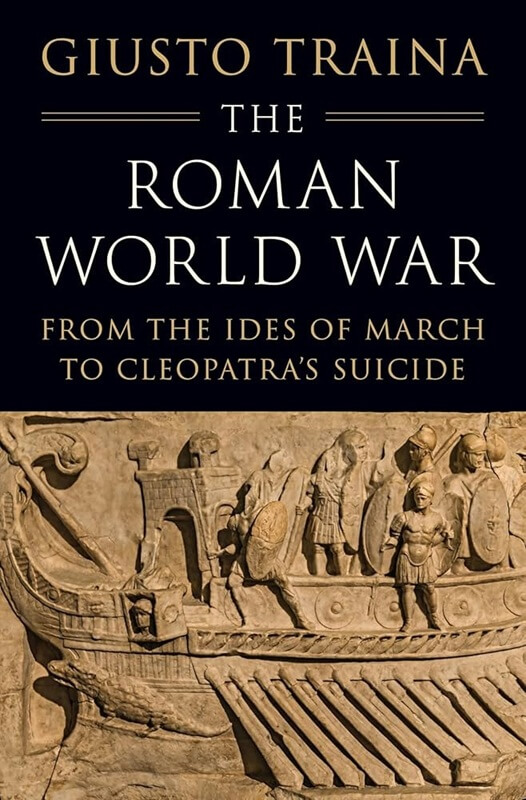
There is a running TikTok meme on the internet that recently drew the attention of the ABC television program The View. In TikTok interviews, women propose to the following question to men: “How many times a day do you think about the Roman Empire?” In the TikTok the males seem to pause for a second and give a genuine answer and sincere answer. As this humorous phenomenon demonstrates, the Roman Empire has, for the past two thousand years, been very much on the minds of Westerners and especially on the mind of Americans. One of the key periods of Roman history is the long Roman Civil War. In his recent work, The Roman World at War: From the Ides of March to Cleopatra’s Suicide, Sorbonne University historian Giusto Traina chronicles the much rehearsed Roman Civil War, providing a simultaneously more global as well as “boots on the ground” close up perspective.
As Traina notes, in traditional discussions, the long Roman Civil War begins with Sulla’s conflict with Marius and ends with the triumph of Octavian, who more famously became known as Augustus. Beginning with the propaganda efforts of Octavian, those studying the civil wars were taught that the wars were primarily by Romans fighting Romans with only occasional Roman conflicts with barbarians. However, Traina’s originality is to frame the Roman Civil War as a global conflict, stretching from Spain to the Parthia. Traina also places the civil war within the context of the (ultimately failed) attempted Roman expeditions to the East to defeat the Parthians, whom Traina also gives a more detailed and thorough treatment than many histories of the long Civil War. Traina’s research seeks to correct or at least amend the traditional historical view, represented by Ronald Syme’s famous 1939 The Roman Revolution, which largely dismisses the effect of the Civil Wars on barbarian and Parthian peoples. Traina’s work is very much in dialogue with contemporary politics. He explicitly states that it is goal to make classical studies “inclusive.” He also notes that he is following the “global approach” of scholars such as Kristina Sessa who has called for “keeping Late Antiquity weird” as well as Sanjay Subrahmanyam’s notion of “connected histories.” For better or worse, much of contemporary scholarship is responding to the contemporary rise of (ethno-)nationalism and populism, which seeks to created purified national histories and mythologies.
The Roman World War begins with the death of Julius Caesar. Traina notes that Julius Caesar’s death prevented the Eastern campaign he had been planning in March of 44BC. Caesar’s plan was to avenge the loss by Marcus Licinius Crassus one year earlier. The Parthians, as Traina argues, played a role in the civil wars between Pompey and Caesar and invaded Syria. In response, in 50 BC, the Senate ordered Caesar to lend his troops to the war against the Parthians. Pompey held the legions in Italy and garnered the support of the Parthian King Orodes II. After he was defeated as Pharsalus, Pompey did not take refuge with king Orodes due to the alleged inability to trust him—Pompey’s ambassador had been held by the Parthians. Thus, things were much more complex than simply Roman generals fighting each other. The Romans were the dominate power in the Mediterranean. In 53AD, there were a number of triumphs forming four ceremonies built around the four parts of the world, including Gaul, Africa, Pontus, and Egypt. Prisoners including Juba, Cleopatra’s sister Arisone, and the Gallic prince Vercingetorix. The Romans largely framed their struggles as internecine fighting and definitively Roman triumphs, but Traina argues that the reality of the struggles was much more complex.
Traina notes that as the triumvirate rose, the Roman Empire, maps of which have fascinated the world for millennia, not all of the Empire was subdued, Germania was largely free and Iberia was not completely subjugated. The map in and outside the empire was complicated. The Parthians had potential sympathizers in Cappadocia such as Antiochus of Commagene and Artawazd of Armenia, who despite a Hellenistic education was sympathetic to the East. Traina makes special note of these seemingly minor client figures, including Quintus Labienus, who minted a coin of himself, declaring himself Quintus Labienus Parthicus imperator, which as Traina points out, had defected to the Parthians, but had formerly supported Brutus and Cassius. It is uncertain where Labienus’s loyalties ultimately lay. Anthony engaged Labienus in battle, who despite his title as a Parthian general commanded Roman troops. This is one of Traina’s key strong points: the ability to depict the complexity of the situations behind the standard East vs. West or Romans vs. the world narratives.
As war arose between Caesar’s two most powerful defenders, Anthony and Octavian both utilized propaganda and religion to further their political interests. This is one of the most curious elements of contemporary classical studies: the use of religious elements by leaders to manipulate their peoples. Even for those writers and readers of a religious background, such a view has become a standard trope of twenty-first century scholarly and popular consciousness. Traina makes special note that Octavian relied upon his allies in the Near East as well as from Africa, Gaul, and Sardinia. Despite his Eastern allies, Octavian attempted to market the war as a battle between East and West—a marketing enhanced by Virgil’s Aeneid, which would come to define much of Western self-consciousness for millennia. Traina is thus not wrong to expand the war as a global war. Despite the assistance Octavian received from his allies, it was critical for him to distance himself from Anthony as a traitorous Easterner. Antony only aided this perception with his repudiation of his wife Octavia. Traina notes that while the war was being presented as a war against the notorious Eastern woman Cleopatra, it was, in fact, a civil war in which Romans and other Italians cynically attempted to choose the winning sides. Traina further makes the key observation that Roman victory would enable the Romans to eradicate the Hellenistic kingdom and establish Rome as the gold standard of historical reference. Rome did triumph and was able to write its own history of the war, which favored Roman interest.
It would be very difficult, if not impossible, to write a non-prejudiced a historicist history. Each work of history is affected by the political and religious beliefs of the historian as well as the time in which he or she lives. The argument that Roman History should be part of a wider global history is reasonable and solid. Indeed, one of the best books on the Reformation in the past ten years is Carlos Eire’s Reformations: The Early Modern World, 1450-1650, which places the Reformation as a global phenomenon. At the same time, there is clearly a need to expand beyond the national vision, there is a question as to what point history is superseded by ideology.
The Roman World War: From the Ides of March to Cleopatra’s Suicide
By Giusto Traina, translated by Malcolm Deveboise
Princeton: Princeton University Press, 2026; 226pp


Related Posts