An Introduction to the Thought of Owen Barfield
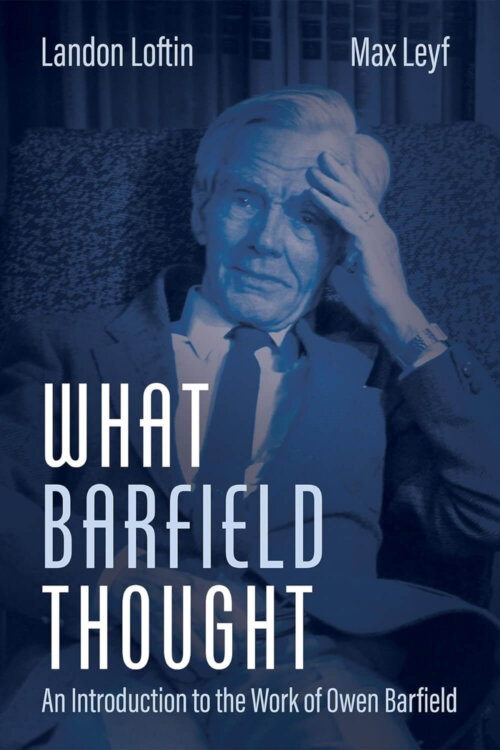
Owen Barfield was a member of the Inklings, the famous literary group that included J. R. R. Tolkien and C. S. Lewis. Barfield wrote the first “fey” novel that influenced the two other writers to pen their works of fantasy. He also was instrumental in Lewis’ conversion to Christianity after many years of the “Great Debate” engaged in on long walks. Lewis’ Surprised by Joy mentions him by name, and many of the speaking engagements Barfield had in the U.S. were from Lewis fans, thanks to Lewis’ endorsements. He had more of a popular audience than an academic one, just as was the case for Lewis’ Christian apologetics.
Barfield’s parents were secular but made sure their children were exposed to music and literature, playing the piano to them and reading classic literature out loud. He also received a classical education at Highgate High School where a friend, Cecil Harwood, contributed to his love of language and introduced him to the writings of Rudolf Steiner, who he felt had managed to disentangle himself from the materialist philosophy that predominated then and now.
Plato wrote that a beautiful thing participates in the Form of Beauty; a just act participates in the Form of Justice, and a true statement in the Form of Truth. The Forms have the quality of mind and the logos emanating from the Form of the Good (Spirit). For Barfield, the world of nature is what it is because it is “participated by” consciousness. Consciousness, in this view, is the inside of nature, not just of human beings and other sentient creatures. Barfield appeals to Aristotle’s concept of the three kinds of soul. The nutritive, belonging to plants. Plants “inwardize” the principles of generation and propagation. Made from dust, they nonetheless resist environmental forces and attempt to maintain their integrity. The sensitive soul is possessed by animals, and the rational soul by humans. The human interior is a microcosm of the macrocosm since it includes the nutritive and sensitive souls but also extends to the upper reaches of reality. Aldous Huxley thought of individual minds as filtering and drawing on the mind at large, selecting and excluding elements of it. Similarly, for Barfield, life itself draws from life at large existing as cosmic potential. “Humanity individualized the cosmic logos, the nous, the intellectus, from out of its transcendent potentiality.” Human intelligence individualizes cosmic intelligence.
For Barfield, just as a face is the interface between the inner and outer man, so nature points to an underlying spiritual reality and is an expression of it. If scientists studied the human face without awareness of its connection to the human mind, they would find only a mechanism without meaning. It could examine how the facial muscles work in conjunction with bone, ligament, and tendon. It would seem purposeless, and any meaning would be lost. So, scientists approach nature in the same way and see no meaning or purpose in it, contributing to the modern crisis of meaning. Biology fails to entirely eliminate purpose because the behavior of even a single cell makes no sense without that postulate, but it is popular to insist on “consilience,” whereby the biological can be reduced to first chemistry and then physics. That cannot be the case if purposes exist with goals yet to come. Rupert Sheldrake calls it backward causation, an end that pulls from the future, rather than causes that push from the past.
One of Barfield’s key ideas is his postulate of an evolution of consciousness that starts with primitive man’s Originary Participation in his environment. Such a world is filled with meaning, spiritual significance, and gods. However, it is participation without real individuated awareness and certainly without self-consciousness. There would be no capacity for metacognition or even significant individuality.
Consciousness, here, is to be understood as that which provides a horizon, setting the limits to thoughts and feelings. For Barfield, the different stages of human intellectual history are not the product of specific theories or philosophical ideas. Instead, those theories and ideas reflect the stage of consciousness a culture and a person has reached.
After the scientific revolution, modern man became alienated and, in his imagination, pushed consciousness outside reality since reality is defined as physical things accessible to the scientific method. While protesting against this modern point of view, Barfield also regards it as a significant and even valuable step in the evolution of consciousness. Modern man is self-conscious and has a greater sense of his individuality than the Originary Participation. Yet, he is also more deluded about the nature of reality, both the cosmos and himself. He ignores his contribution to experienced reality by adopting the stance of scientific objectivity. Thus arises “Onlooker Consciousness,” imagined to be on the outside looking in. This is associated with “Alpha thinking,” which lacks any reflexive dimension. This, in turn, gives rise to metaphysical theories that cannot be applied to themselves, which Ken Wilber and Rupert Sheldrake are also at pains to point out. Materialism, for instance, banishes the mind from the picture of the world and thus the mind that gives rise to the postulate of materialism in the first place. Positivism rejects anything that cannot be scientifically verified as meaningless. Yet, the legitimacy of this stance cannot be scientifically verified. Beta thinking, however, taking thought as its object, adds the level of metacognition and is aware of how thoughts apply to the thinker and his theories. If philosophers and physicists could reach this level of thought, how improved our intellectual environment would be! It is not for want of raw intelligence that they do not, but of a moribund metaphysics barely deserving of the name and a commitment to atheism. If those thinkers achieved Beta thinking, they would be forced to incorporate spiritual realities into their views, something many of them would hate.
Originary Participation could be compared to a fetus in its uterus. Warm, and fed, it is at one with its mother with minimal self-awareness. It has no real knowledge of the world outside its mother, though it hears the rumors of something more. After being born, the baby learns the difference between itself, its mother, and the world. The union of a fetus with its environment can serve as a kind of ideal state. But, there is no returning to the womb. So, if it is to be attained, something like this integration must be actively pursued. Also, the final result will be conscious rather than the unconscious version of the fetus.
For Barfield, consciousness involves the intellectual and emotional response to the environment, shaping what is experienced, not merely self-awareness or sentience in general. Consciousness, in this sense, sets the limits of “all that can be realized or thought about by a person at a given time in history and in a particular culture.” Barfield traces the evolution of consciousness through etymology. His book Poetic Diction, in particular, shows how language shines a light on the kinds and stages of consciousness. Psyche, for instance, in the original Greek, was rich with multiple meanings. Multivalence at this point in history was not regarded as problematic. The modern predilection, however, is for precision, univalence, and disambiguation. This can be useful for narrow utilitarian purposes, but much is lost in striving for this goal. Poetry even calls for a multiplicity of meaning and richness of association to do its work. Thomas F. Bertonneau illustrated the point in his English class by laying down strips of paper on the floor. Each strip represented a meaning of the same word. In the end, he was left with just one meaning. He then turned around and picked up each piece of paper until he had a whole bundle. He asked his students which they would prefer – the bundle or the single strip. They all answered the single strip. As far as Tom was concerned, this modern preference was a mistake. Being saturated with meaning and evoking multiple ideas and feelings is better than a single connotation, though a lawyer might disagree – depending on whether he is the prosecutor or the defense attorney. Prosecutors are likely to favor broad definitions to capture a wide range of nefarious behavior. Defense attorneys use strict and narrow meanings to get their clients off the hook.
The practical and useful is all very well. They are necessary for survival. But, for man to retain his humanity, he must cultivate the poetic side of himself. And, poetry is a use of language that emphasizes reality via lived experience and tries to bring this to life – to evoke and invoke the whole man, not merely his deductive ability. Besides, knowledge should not be judged by how useful it is, but by truth. Reality is directly experienced intuitively, not linguistically. And truth is that which aligns with reality.
After finishing my Ph.D. in philosophy without having read Plato’s Republic, it seemed time to rectify this omission. It would be like an English major who had never read Hamlet. David Lodge’s comedy Changing Places includes an invented game called “Humiliation.” The goal is to name a book widely regarded as central to one’s discipline that one has never read. Better to lose such a contest! Without access to a scanner or optical character recognition software back in those days, it was necessary to type the Republic onto a computer by hand. There were some key passages written unclearly in the original Greek. Multiple translations were useful in such contexts, with each translator providing his best estimate. Getting the benefit of other people’s interpretations even made reading something in translation seem quite a good idea. Three or four could be included in the text. In many cases, using the original word, such as “logos” or “sophrosyne” (balance, self-control, moderation), was better to avoid limiting the meaning to just one English word since this was not, of course, what Plato intended. One annoying translation of “sophrosyne” was “prudence,” which was used throughout Allan Bloom’s translation. Being “prudent” in English connotes a joyless practicality – for instance, marrying a rich man you do not love is “prudent,” again, not something Plato or Aristotle had in mind. “Logos” means speech, word, law, rational discourse, divine reason, plan, and creative order. In New Testament Greek, it also means “the cosmic principle of order.” Heraclitus, a grumpy and profound Presocratic philosopher, saw a connection between the logos of the universe and human reason, which Barfield sees too. Stoics called the logos “providence, nature, god, and the soul of the universe.” The logos would be how the universe is created and how we can come to understand it. St. John’s Gospel starts with, “In the beginning was the logos.” Bertonneaus’s students would presumably insist on knowing which meaning of logos was intended. Barfield would say, “All of them.” If not all meanings had been meant, the original writer could have indicated as much through additional words. Logos in Plato includes both reason and that which governs the motion of the stars. No disambiguation is necessary.
Loftin and Leyf cite the Bible passage (to interpolate the original word), “The pneuma bloweth where it listeth and thou hears the sound, not telling from where it comes or goes: so is everyone that is born of the pneuma.” “Pneuma” here means breath, wind, soul, and spirit. The modern view suggests that the first instance of “pneuma” should be translated as “wind” and the second as “Spirit.” In actuality, the writer is not playing with words but intends all meanings in both cases. Our modern preference for clarity perverts the meaning of the quotation. The received view sees this as an insufficiently differentiated conception of spirit and soul. Breath and wind get dropped, leaving the purely intangible meanings. The original meaning of “pneuma” thus has a delightful integration of the physical and spiritual, the high and the low, the concrete and the abstract, and an inside and outside of nature.
It has been said that the change from writing in verse to prose came about because early writing reflected an oral tradition with the verse being easier to remember than prose and synthetic languages had relatively few endings, making rhyming much easier than modern analytic languages. But, Barfield saw poetically expressed mythologies as nature speaking through man in participatory consciousness. Nature is rhythmic, and so was our earlier poetic way of writing. Poetry can be a way of reducing our modern detached mode of apprehension. Poetic diction arouses the aesthetic imagination – an awareness of surroundings and feelings that form unity. Poetry thus engenders a felt change of consciousness with epistemic implications, not merely aesthetic. Relations are revealed in the process. If every natural fact is a symbol of a spiritual fact, then primitive language and the metaphors of the poets reveal the footsteps of a spiritual nature. Goodness was high like the heavens and bright like the sun. In contrast, evil and misery were low, deep, and dark.
Barfield’s attraction to the spontaneous religiosity of primitive man is understandable. Meaning, purpose, life, and emotion permeated his experience of the world. Early on, Barfield recognized how materialism and, thus, scientism had infused his outlook and he had to work hard to eliminate this tendency in himself, as do many of us. John Locke claimed that all knowledge comes via the senses in a way that prioritizes the physical. Conversely, earlier man emphasized the spiritual as primary and did not differentiate between the physical and spiritual in this way. The physical has its origins in the spiritual and shows it. For Plato, Forms were a transcendental principle of the cosmos and they were “immanent actualizing principles of reality” for Aristotle, rather than merely subjective notions. For Francis Bacon, though, matter should be the focus of inquiry because forms are merely figments of the mind, a point of view called “nominalism.” Nominalism entails nothing being of the same kind, whereas realism says they share a common reality. In one case, the mind produces fiction; in another, it participates in and is at one with cosmic reality. Spiritual types exist before and after matter. Eternal principles are not abstractions but more fundamental than instances of them. Thus, the transition is seen in The Symposium from the love of the particular person, to the universal, transcendent, and eternal. One goes from the beauty of one person to the love of beauty in general, the latter being a precondition of the first. And then, love of the body, to the love of a beautiful soul, to the Forms in which that soul participates.
With primitive man, there is no poetry/practicality divide. Myth is integrated into his worldview, and no attempt is made to “be objective,” the concept not existing. If he became cynical and disillusioned, it would not have been from Onlooker Consciousness, but due to things like losing status, being replaced as chief, or being ostracized or enslaved. On the downside, life will have been short and brutal compared to modernity, and for the New Zealand Maori, it would have included slavery, human sacrifice, and cannibalism – and an eventual slow death from malnutrition and starvation after one’s teeth had worn out from trying to eat densely fibrous and somewhat carcinogenic fern root around the age of thirty. There were beautiful aspects to primitivism but many less desirable aspects, too.
Homer wrote the Iliad and Odyssey hoping to revivify civilization after a period of barbarism, the Dark Age after the Great Catastrophe of c.1200 BC. His invention of the alphabet, with vowels included, so it has been argued, paved the way for mass literacy and provided the means for multiple other languages to also be written down. No reasonable person could regret the existence of Homer, Virgil, Shakespeare, Dante, Cervantes, and Dostoevsky. Not to mention the achievements in art, architecture, and music, none of which would have been possible at a more primitive level of development.
Part of a maturation, phylogenetically (culturally) and ontogenetically (individually), is the development of the subject/object divide, providing an ability not merely to inhabit but to observe, to step outside direct experience and engage in metacognition – to think about thinking, and thus to be able to critique one’s ideas. Writing and literacy also provide access to thousands of years of accumulated thought and wisdom. Oral traditions must focus on preserving hard-won knowledge and thus have no capacity for self-critique. The rise of the novel meant a significant new way to explore another person’s inner life and to examine the richness of human relationships.
It was Barfield’s hope that the current alienated trend, leading to a people dispossessed from their birthright as participatory members of the cosmos, could contribute to the next stage of development in the evolution of human consciousness. A poetic sensibility could be cultivated. Kathleen Wilkes once argued in “Is Consciousness Important?” that “consciousness” should be abandoned because she could tease out four separate meanings. However, instead of considering it a fatal ambiguity, we could learn to relish such a surfeit of denotations. We could learn through active study to integrate once again with the world around us in full self-consciousness, aware of the distinctions and yet able to coalesce them into fulsome life.
Barfield favored the perennial philosophical concept of man consisting of body, mind, soul, and spirit in the manner of Plato and Aristotle. Within this matrix is knowledge via discursive reason and inference, the rational soul, vs. knowledge through participation, the direct apprehension of ideas and essences via nous. The former is the soul, and the latter is the spirit: Rationality versus intellection. This would mean that a part of us retains its connection with its origin, which also functions as its destiny. An edict by Pope Hadrian II in the 9th century and canon law in the 12th century meant that human beings were to be regarded as a having soul, but there was to be no mention of spirit. This meant that human consciousness was no longer a participant in the same way with the universal logos. The soul was thus restricted more to the body, permitting the modern idea of the mind being connected to brain physiology. No such reductionism would be possible if humans had retained their connection with the Great Chain of Being extending up to the very top.
Three attitudes to the nature of the world are that it is a clump of atoms and molecules possessing primary qualities. These are converted into ideas of secondary qualities residing inside our skulls. Moreover, this interior resides outside reality. It does not truly exist. Only material reality is real. Another option is that the human mind and body realize the potentialities of nature and make them real. Mind and its interactions with the world combine into a more encompassing reality. A beautiful sunset is an emergent phenomenon that human consciousness helps to bring into existence via the interaction of organisms and the environment. Lastly, there is the possibility that beautiful sunsets exist and that the human mind and sense organs have evolved to appreciate this fact. Colors and sounds are waiting to be discovered; thus, multiple organisms have developed the capacity to perceive them. They are not “emergent phenomena” but ready to be recognized. Insisting that colors and sounds are really their measurable, numerical aspects is a scientistic falsehood, like insisting that a painting is “really” just globs of paint. Rather, globs of paint are how the painting gets implemented from the mind of the artist. They are a means, not the final reality. Apparently, Barfield embraced the second, intermediate view that we realize the potentialities of nature, which would have no existence without us. This makes human existence particularly valuable. Without us, there would be no color, sound, taste, or beauty. I have promoted this view myself in the past but have gravitated, partly through an effort of will, towards the last idea. All philosophical ideas should be evaluated partly by their implication for human existence since philosophical perspectives are not a foregone conclusion. Whether the second or third view should prevail by this criterion does not seem obvious. It is true that “there is no evidence that the universe could exist entirely bereft of subjectivity,” and one can argue that no objective world could be entirely independent of our thinking. “Objectivity” itself is a chosen and deliberate perspective undertaken by the human mind for certain purposes. It is an act of imagination. There is no “external world” external to consciousness. “Final participation,” however, is “the collaboration with Christ in the economy of creation.” This involves spirit, identified with the Sun in Plato’s Cave allegory. It is the “progressive realization of the image of God in man.” An accurate translation sees being the image of God as a goal, not something simply bestowed from the beginning.
For Barfield, “the organs of sense are required to convert unrepresented (particles) into sensation, so something is required to convert sensations into things (figuration).” Someone like Wolfgang Smith, however, postulates a physical world accessible to physics, which is really a world of potential only, and the corporeal world of sound and color, which is actual. The question is whether it is the distinctive role of humans to realize this potential world or not. “If the objects of perception were seen to be inextricably bound to percipients, then we would be interested in the moral and intellectual transformation of its practitioners.” The artist, for instance, has experienced the world he conveys to the viewer, enriching the viewer in the process of capturing this vision.
One could agree that the moral, intellectual, emotional, and aesthetic abilities of man will determine the nature of the world he lives in. The greater his capacity to experience beauty, the more beautiful the world is recognized as being. William Blake’s heaven in a grain of sand can be seen as realizing the potential of human perception and spirit. If it is also the True, the Good, and the Beautiful, then one is managing to see reality, and not through a glass darkly.
In the Originary Participation, consciousness perceived a world filled with spiritual significance and meaning. The face expresses what is going on within the person and “nature” is the face of God, indicating the ordering Logos sustaining the world and giving it structure. Randomness is not creative and cannot produce coherent entities. Purpose and meaning underlie the world we perceive. Modern man has reduced “knowledge” to scientific knowledge. This has been done in the interests of prioritizing the useful and enabling manipulation, prediction, and control. But, it has come at the expense of a supreme narrowing of epistemology that restricts “nature” and human consciousness to a single element and aspect. This is a perspective that renders the world meaningless, and it involves a misunderstanding and limitation of the human. Consciousness, meaning, purpose, emotion, and morality are all invisible to this viewpoint and are thus omitted from consideration. A poetic sensibility that does not aim at manipulation and “usefulness” is part of “Final Participation.” Direct, intuitive knowledge – the providence of the right hemisphere, as pointed out by Iain McGilchrist – is the goal. It is not naïve but intentional. William Blake insisted that the sun was not a glowing thing in the sky about the size of a guinea but a host of angels singing “Holy, holy, holy is the Lord God Almighty.” The sun is an expression of the glory of God.
E.F. Schumacher’s A Guide for the Perplexed does an excellent job of contrasting the breadth of perspective necessary for an adequate epistemology of man and the universe with the narrowness and, what is, in effect, the cynicism of the purely scientific view. As Barfield writes, we come to understand more and more about less and less, with a radical diminution of self-understanding.
A good education means studying the history of thought and thus knowing that scientism is a fad, that the useful does not exhaust what is true and might not even coincide with it. Plato anticipated this modern insanity by having Socrates state in the Phaedo that he was not sitting there waiting to be executed because of the contraction of muscles on his bones – the scientistic type of explanation – but because he had decided that to leave Athens when its laws were not to his benefit, having enjoyed their help when they were, was not something that he wanted to do. Mind underlies matter, as does purpose and meaning. Plants, animals, and humans inwardize cosmic principles. Man moves towards embodying the image of God and collaborates with Christ in the economy of creation. “Psyche” for the Greeks included “life, sentience, animation, fire, light, breath, mind” all at once. This kind of soul includes but also transcends the level of plant and animal – reaching down and up – with physics below and nous above it. Such a view emphasizes participation and continuity with the rest of nature rather than a Cartesian ego peering out from one’s head. Erudition, imagination, and love are needed to see through the outer appearance of nature into its soul.
What Barfield Thought: An Introduction to the Work of Owen Barfield
By Landon Loftin and Max Leyf
Eugene, OR: Cascade Press, 2023; 126pp


Related Posts