Art and Truth: Heidegger and Knausgaard Go to the Museum
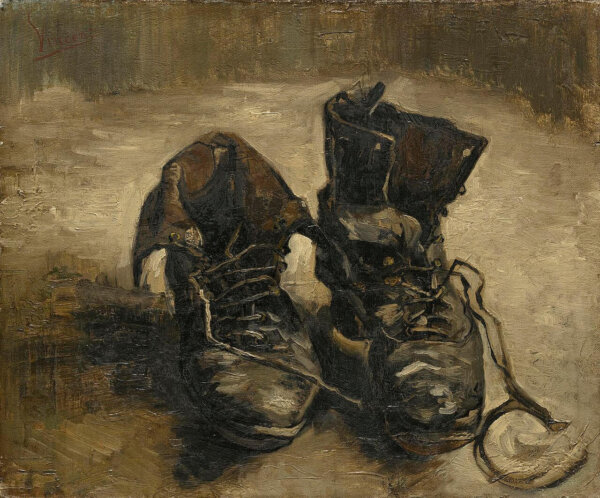
Martin Heidegger’s “Origin of the Work of Art” explains the definition of ‘equipment’ using an example of a painting of peasant shoes by Vincent Van Gogh. Curiously, Heidegger claims that a mere pictorial presentation of the shoes is enough to explore the concept of equipment. Moreover, he does not specify the exact name of Van Gogh’s painting.
From its name, we already know what a pair of peasant shoes is. As the name suggests, the function of a pair of peasant shoes is for farming. For Heidegger, a piece of equipment is defined by its functionality. Now we know what a piece of equipment is, so can we move on from the nondescript Van Gogh painting? Not so.
At first glance, the painting does not show us much— “a pair of peasant shoes and nothing more.” We cannot see the ground on which it stands or where it has been used. Despite the sparseness, we learn more things from the painting upon further inspection.
Heidegger explains that this simple painting of a pair of peasant shoes reveals the earth to which it belongs and the world of its user, a peasant woman. How does Heidegger see the setting of this painting? By looking at the painting closely, Heidegger makes new discoveries: “From the dark opening of the worn insides of the shoes the toilsome tread of the worker stares forth. In the stiffly rugged heaviness of the shoes there is the accumulated tenacity of her slow trudge through the far-spreading and ever-uniform furrows of the field swept by a raw wind. On the leather lies the dampness and richness of the soil.”
A still-life pair of peasant shoes thus indicates how it is part of both the natural world and the human world. Heidegger claims that this artwork can reveal more about the world than the actual pair of shoes worn by a peasant woman. A peasant woman simply wears the shoes without reflecting upon their essence. After all, she knows exactly what her shoes do—they help her farm. However, with use, the shoes become worn out and fall out of their utility, which leads to their ruin. Once those shoes are worn out, then, their essence is harder to fathom. In its worn-out state, the shoes become merely themselves, only showing us their functionality. The world in which they were used no longer exists because they have fallen out of use. This is when Van Gogh’s painting becomes useful.
To recover the world in which these shoes exist, Heidegger claims that we have to bring ourselves before Van Gogh’s painting. I believe that Van Gogh’s painting can make us understand the essence of the shoes because it is a static artwork that makes us reflect upon the nature of the shoes. Regarding what the painting does, Heidegger puts it poetically: “This painting spoke. In the nearness of the work, we were suddenly somewhere else than we usually tend to be.” By looking at Van Gogh’s painting closely, we see the shoes’ essence, which we may not have seen in their day-to-day usage. When we are using a piece of equipment according to its functionality, we reflect less upon its nature because we are more focused on the task of using it at hand. But when we look at the painting of that piece of equipment, we are able to reflect more on its essence.
Hence, Heidegger provocatively argues that art reveals the truth about the material world. Mysteriously, he claims “art is truth setting itself to work.” The truth is uncovered in a work of art because both the artist and the viewer of the artwork are concerned with capturing the essence of the thing that artwork is portraying.
Heidegger’s reflections on the nature of art began with his attempt to explain what a piece of equipment is. Hence, he uses the example of Van Gogh’s painting of a pair of shoes. However, his final thought on what an artwork can do points toward something larger than merely understanding the concept of equipment. Art can “open up its own way of the Being of beings.” How can we understand this statement? Knausgaard can help us here.
Karl Ove Knausgaard’s My Struggle, a six-volume novel, started the contemporary boom of autofiction, the fiction of the self, where the line between fact and fiction is blurred to the point of infinity. My Struggle is praised for its brutally honest portrayal of life; Knausgaard spares no detail about various life events that are often cringeworthy. Amidst writing about the shame-inducing events of his life, Knausgaard describes the power of art early on in the first volume of My Struggle. Let us now go to the National Gallery in London, where Knausgaard observes a self-portrait of Rembrandt.
Early in volume one of My Struggle, Knausgaard describes the changeability or mutability of human life as time goes by. In a book inspired by the death of his father, it was expected of him to reflect on how things are never constant. Our faces (at the very least, Knausgaard’s) change not just through age, but every time we communicate with different people. Knausgaard claims that he never says what he really means and that every communication with others involves putting on a different mask. While these reflections might be the thoughts of a neurotic man who, after all, wrote a work of autofiction of three thousand pages, Knausgaard’s concern with the instability of life rings true for us as modern human beings.
However, there is one thing that is unchanging in our life—human eyes. Knausgaard claims that the eyes are “no less bright than the day we die as the day we are born.” The ontological and the biological stability of eyes give us something to hold on to, a kind of unchanging truth. If eyes do not change, the truth about them can be captured in visual art.
At the National Gallery in London, there is a painting that moves Knausgaard “every time [he] goes and sees it.” It is a self-portrait of Rembrandt after he grew old. Knausgaard notes that this self-portrait was painted in a classically realistic style that is more reminiscent of the younger Rembrandt, unlike the more expressive style often seen in Rembrandt’s later work. His more expressive style is focused more on capturing the essence of a moment or an action, rather than still-life things. The portrait that moves Knausgaard captures old Rembrandt’s “very being,” not just Rembrandt in action. How did Rembrandt achieve this capturing of his being in this portrait?
In this self-portrait, we can see all the details in the face that are ravaged by time. Every single aspect of life is captured in this weary face. Rembrandt died in the same year it was painted, so it depicts an entire lived life. Amidst the details that show the weariness and aging, the eyes do not show signs of aging. They “transcend the time that otherwise marks the face.” The contrast between the aging face and unchanged eyes makes its viewers, including Knausgaard and us, feel as if the portrait is a portrait of Rembrandt being seen by someone else, since the unchanged eyes could have been anyone’s eyes. At the same time, that someone else is Rembrandt himself, because we know that despite their unchanging nature, the eyes still belong to Rembrandt.
The goal of philosophy, as the famous Delphic maxim goes, is to know oneself. In his portrait, Rembrandt was able to reveal what it looks like to know oneself by painting the face and eyes in a contrasting manner. This specific artwork of Rembrandt reveals the way in which we can learn the truth about life itself—the unchanging eyes. Knausgaard argues that the difference between this portrait and other portraits of Rembrandt is the “difference between seeing and being seen.” In a typical portrait, the focus is on the outward appearance of the subject or how he sees the world. In the portrait of old Rembrandt, the contrast between the aging face and unaged eyes shows us that Rembrandt is seen by himself as well as others, since as I mention above the eyes in the portrait could belong to anyone, including Rembrandt himself.
This is the true power of art, revealing both truth itself and the way we get to the truth. Visual art is the primary way by which both Knausgaard and Heidegger get to know the truth. Especially for Knausgaard, the unchanging nature of visual art is essential for learning about the truth. Art’s function of beautifying the world is something that is universally agreed upon, but its additional power to reveal the truth about the world should not be underestimated.


Related Posts