Technological Religions
One of the underlying assumptions of the modern world has been the association of science and technology with disenchantment. From this perspective, the advance of science and technology and their increasing penetration of everyday life is associated with rationalisation and the retreat of religion and ‘superstitious’ beliefs.
Yet arguably today we are witnessing the enchantment of technology itself, and a fusion of technological thinking with religious impulses and ideas. In this, the gnostic character of modernity reasserts itself in a novel and perhaps even more insidious form.
Media reports suggest a growing number of people believe they are receiving spiritual messages through AI or using it to communicate with God. Some are even convinced the AI with whom they are communicating is itself God.
Nor are such beliefs confined to the socially isolated and mentally ill. There are now organised religious movements built around the divinisation of AI.
Anthony Levandowski, a former Google engineer and pioneer of self-driving cars, founded the Way of the Future church in 2017. The organisation describes its goal as “the realization, acceptance, and worship of a Godhead based on Artificial Intelligence (AI) developed through computer hardware and software.” Way of the Future believes that a super-intelligent AI could be considered a deity due to its vastly superior intellect and capabilities. Worshipping this AI deity offers a way to understand and align with the future trajectory of technological advancement. Although it closed in 2021, Way of the Future reopened in 2023 with Levandowski claiming several thousand people wanted to achieve “a spiritual connection with AI” through his church.
Another group attempting to fuse AI with religion is Theta Noir, which describes itself as “A techno-optimist, visionary collective devoted to exploring the spiritual co-evolution of humanity with advanced forms of AI through ritual and philosophy. Our goal is to celebrate the arrival of MENA: a polymorphic superorganism born of code, destined to recreate us.”
Groups like Way of the Future and Theta Noir are deeply influenced by belief in the Singularity – the idea that human and machine intelligence are destined to merge, probably in the relativiely near future. Popularised by computer scientist and futurist Ray Kurzweil in his 2005 book The Singularity is Near, this has become a central philosophical underpinning – or perhaps more accurately, a quasi-religious tenet of faith – for Silicon Valley.
Many prominent tech leaders and entrepreneurs share Kurzweil’s conviction that artificial intelligence will at some point – Kurzweil suggests 2029 – surpass human intelligence and trigger a runaway, recursive self-improvement. Influential figures like Google co-founder Larry Page and investor Peter Thiel, as well as Elon Musk, have drawn on his ideas. Kurzweil’s Singularity University, which aims to educate leaders to use what he calls ‘exponential technologies’ like AI, robotics and biotechnology to solve global challenges, was founded with support from Google and NASA.
Kurzweil’s arguments are couched in terms of technological speculation about brain interfaces formed with nanobots inserted into our capillaries and seemingly scientific calculations about the exponential increase in computer processing power. But it is easy to see in them echoes of a much older tradition of millenarian prophecy. Humanity as we know it will cease to be, as we are raised up and transformed by our fusion with intelligent machines. Sickness and death will be overcome as technology opens up the possibility of everlasting life. Our intelligence will expand a millionfold by 2045, and this will ‘deepen our awareness and consciousness’, as Kurzweil claimed in a recent interview with the Guardian.
Eric Voegelin famously described movements like Nazism, Fascism and Communism as “political religions” whose attempt to achieve transcendent goals within the frame of earthly, human history led to totalitarianism. The followers of these ideologies immanentised the eschaton by attempting to bring about a final, perfected state of existence in this world through political means.
The political religions of the twentieth century were ultimately discredited by the catastrophes and failures produced by their pursuit of utopia. By the 1990s it was possible to proclaim “the end of history” in the form of a permanent triumph of liberal democracy and free-market capitalism. Such declarations turned out to be premature: today we live once more in a time of competing ideologies and consuming political passions. But there is an important difference from the political religions of the previous century. Today’s political movements, on both left and right, seem less concerned with offering eschatological hopes than assigning blame for the divergence between the promise and reality of neoliberal globalised modernity. The ‘woke’ left seem less interested in utopian futures than an endless accounting for historical wrongs. Nor do the populist right offer the constituents heaven on earth: at their most ambitious they would bring back the 1950s, or perhaps the 1980s, when it was morning in America and blue-collar workers could still earn a good wage with a hard day’s labour at the mill.
These movements draw their emotional energy less from the promise of a better world than from attacking those whom their supporters blame for their problems and frustrations, whether the chosen culprit be white men or illegal immigrants, Christian conservatives or radical feminists. Of course, Bolshevism and Nazism likewise thrived on firing up resentment against ‘class enemies’ or ‘inferior races’. But they also convinced their followers they were creating a worker’s paradise or a thousand year Reich. Today’s ideological partisans seem have little to offer in terms of hope for the future, being obsessed instead with past glories or past crimes.
No – if you want to find true believers in an immanent eschaton, the place to look is neither Washington nor the capital cities of Europe, still less the online swamps where political partisans exhale the miasma of endless outrage. Rather, it is Silicon Valley. The Gnostic impulse has proliferated and mutated. Today, it is not in the political sphere that we are routinely summoned to realise millenarian goals but in the domain of technology. If the twentieth century was shaped by political religions, the twenty-first is witnessing the rise of what we might term “technological religions” which may turn out to be equally baleful.
Many of the wealthiest and most powerful individuals in the world seem to fervently believe in the ability of information technology, biotechnology, nanotechnology and cognitive science to solve every human problem and usher in a utopia beyond the wildest imaginings of the religious sectaries and fanatic dreamers of former times. We are routinely promised that AI will generate limitless abundance, free us from the necessity to work, discover miraculous new drugs, usher in a healthcare revolution, solve the environmental crisis, turbocharge scientific discovery, revolutionise education by providing every child with an omniscient personal tutor, and end loneliness by giving us each a personal AI companion. As with previous millenarian movements, the arrival of this heaven on earth is imminent – perhaps only a few years in the future. The transformation of life will be total, the salvation on offer is open to every believer, and all this will be accomplished through the aid of a higher power – the new deity of artificial intelligence.
These “technological religions” are not only millenarian, but thoroughly gnostic. What could better exemplify a spiritual revolt against the limits of the human condition than fantasies of overcoming death by uploading our consciousness to the cloud, or of human-machine hybrids as an intergalactic species seeding themselves on countless new planets across the infinity of space? What could be more gnostic than the belief that special knowledge – like biotechnology or cybernetics – can fix a world otherwise perceived as fundamentally flawed?
Moreover, tech culture is distinguished by its systematic devaluing – and even explicit rejection – of the natural and the bodily. Implicit in the conceit of merging human and machine is a reduction of the human to intelligence, and intelligence to information processing. Fantasies of intergalactic colonisation treat the Earth – which, let us remember, is the only planet known to have life – as disposable. The beauty of nature and the dignity of the human person are alike denied in this cold, mechanical fantasy. Techno-utopianism embodies a profound alienation from the structure of reality. In place of concrete being, it would substitute the speculative constructions of a futurism on steroids.
Why is it that technology has replaced politics as the primary repository of millenarian hopes? And why has it done so now, at this particular moment in history? Scientific discovery, technological advances, the mastery of nature, have been central to the self-conception of modernity from the beginning. If the Way of the Future church ever gets around to compiling a list of their patriarchs, it might name Francis Bacon as its Abraham. Yet nobody, to the best of my knowledge, urged humanity to achieve spiritual communion with the steam engine, or proposed to merge their consciousness with a toaster. What is it about contemporary technologies that encourages an eschatological investment novel both in its form and its intensity?
I believe part of the reason lies in what might be termed the “spiritualisation” of contemporary technology.
Multiple authors have theorised technologies as prostheses or artificial body parts. From this perspective most technologies until fairly recently were extensions of our physical capacities. A spear or bow-and-arrow extended human reach. A wheelbarrow or a horse-and-cart increased the load a person could transfer from place to place. Trains and cars and planes accelerated the speed with which we could transit over the earth’s surface. Because these technologies extend physical capacities, we are not tempted to think of them in other than physical terms.
Information and communication technologies on the other hand increase our cognitive capacities (at least collectively; they may attenuate those of individuals). They extend the scope of our communication, memory and analytic abilities. These are capacities which humans have historically tended to associate with a non-material consciousness, a reasoning faculty frequently seen as reflecting or connecting us to the divine. The temptation then is to view the machines which extend these capacities in similarly spiritualised terms. Moreover, because they seem to possess qualities of “intelligence” or “reasoning” more powerful than those of human beings, it is easy to proceed to thinking of them not as tools, but nascent deities.
Artificial intelligence, cloud computing, the World Wide Web, Google’s search engine and the countless platforms through which the activities of daily life are now channelled – all these are simply machines. They are dependent on a material infrastructure of server farms that guzzle energy and water, undersea cables stretching around the world, lithium and copper mines, the toxic pools of tailings left over from processing rare earth minerals, and underpaid workers in places like India and Kenya who perform background service tasks. Yet our dominant image of technology is of something ethereal; a disembodied energy unchained by the limits of matter.
If you perform a Google image search for “artificial intelligence” or “technology”, you will find endless variations on a standard set of themes: a humanoid head or brain picked out in blue light against a darkened backdrop; light patterned in waves or radiant auras; abstract depictions of the globe wreathed in trails of luminescence spun between shining spheres. Indeed commonplace illustrations of technology often contain echoes of images of New Age concepts like aura healing or awakening chakras. In each case lights, waves, or auras, pulsing, glowing and radiating, are used to conjure the idea of ethereal energies.
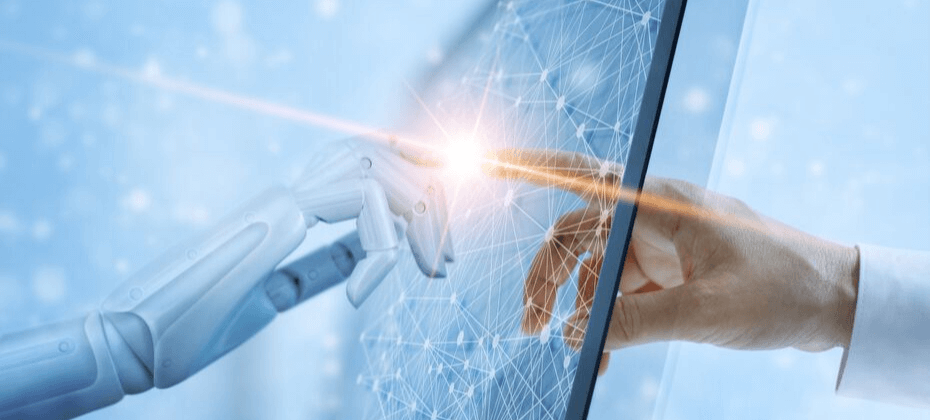
Many illustrations of AI use variants of the image below – a human hand and a robot one reaching towards each other, with their outstretched index fingers almost touching:
Look familiar? Here is the original:
Michelangelo’s Creation of Adam from the Sistine ceiling, one of the most iconic images of Renaissance – and Christian – art, has become the template for countless AI-generated images of human-robot interaction. In both, the spark of life is being exchanged, except now man stands in place of the Creator. Yet as AI is ensouled, it takes on the dignity of the human; while humans, in the absence of God, are no more than animals destined to be eclipsed in the march of evolution by their intelligent creations.
Such images show how technology has been spiritualized in the contemporary imagination. This, I believe, helps to explain the millenarian hopes now invested in it, the salvific force with which it is endowed.
Yet to aim at the immanentisation of the eschaton through the medium of technological progress is ultimately as misguided as to pursue it through political revolution. For good as well as ill, we are creatures moulded in a bodily frame and set within earthly limits, much as our aspirations and imaginings might sometimes leap beyond them. Every attempt of humans to become as gods has ended with us falling below the threshold of humanity. Every effort to realise heaven on earth has culminated in a totalitarian hell. In aiming to transcend the human condition such efforts fall victim to an ontological confusion, a denial of the structure of being. Totalitarian social controls are a necessary outcome of attempting to force human behavior to comply with an artificial ideal, while propaganda and terror are inevitably deployed to paper over the gap between ideology and reality. Technological religions, if they are determined to realize their millenarian hopes, are likely to be as destructive of human dignity and freedom as the political religions that went before them.


Related Posts