A Heavenly Flight
In today’s world, many would say poetry is a useless activity. Across the world, especially in our technologically driven environment, the madness of mocking reading, writing, and poetry is commonplace. I was heard on the radio a host demean the study of literature at university as a waste of time, calling the venerable study of literature and poetry “candlelight poetry reading.” The rhetorical point was obvious.
Don’t listen to such Neanderthals. The irony of our technological age is that we are becoming primitive yet again—but instead of living a life with a club in our hand, we are living lives with metallic devices. Instead of bashing others in the head, we vigorously bash others with screens in easy-to-read tweets.
What is poetry about? Ask many poets and you’ll get many different answers. That’s what technologists hate about poetry. There is no symmetry. There is no universality. There is no monoculture. There is no single way. There is no single answer. Math and science drive us to that conclusion. Language, literature, storytelling invite us—by contrast—to a grander and diverse reality, an ethereal experience of multiplicity as we soar on the wings of human hearts into air with sweet fragrance that allows us to close our eyes, smile, and listen.
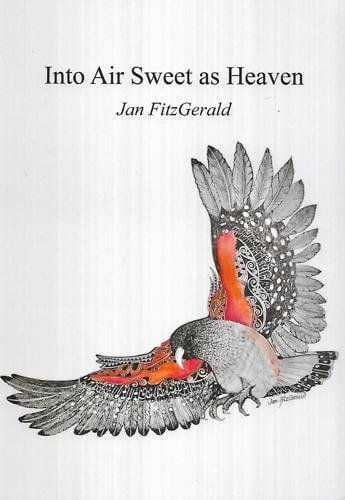
Jan FitzGerald is a well-established poet in New Zealand, and she may be a familiar name to readers of VOEGELINVIEW. Her most recent collection of poetry is aptly titled Into Air Sweet as Heaven. The work is a vivid, imaginative, and pleasing read of 46 poems written over the decades that whisk readers into the beauty and serenity of nature, the cramped rooms of a hospital, the fields of a cemetery, to a kitchen oven.
Reading the poems that FitzGerald has brought together is an experience of the human heart in all its emotional variety. There are moments of hope alongside despair, blessed memories amid loss and the happiness of belonging with someone by your side. Here, I would say that memory is a special theme that cuts across numerous poems that I would like to highlight.
One poem, “The stream” (written in 1964), links the beauty of nature with the love of a mother:
Of gatherers of sphagnum moss
there is none better than my mother.
She knows the best spots,
secret and private as the plant itself
that moistens the stems of her floral art creations.
Another such poem is “Graham’s garden” (written in 1971) and dedicated to the memory of Graham Cooper:
We spotted your green V-Dub in a haybarn
and whacked our way through long grass,
tracking the sound of a typewriter.
…
We potted herbs and transplanted saplings.
You grew garlic and citrus for the immune system.
Onions and greens for the blood.
If we go back to the origins of poetry in its written form, we enter a battle between Walter Ong and Plato. The Jesuit scholar of language and religion preoccupied himself in his scholarly work with the transition from orality to literacy in culture and society which led to a greater degree of individualism. While Ong notes that writing is a form of technology, he maintains that memory, or remembering, is the goal of writing. Plato, however, lamented that the rise of writing would lead to the end of memory.
I would agree more with Ong that writing is a means to preserve memory and allow for a sudden remembering that is also personal and more intimate than the oral tradition in its mass form permits. It is with this outlook that Jan FitzGerald’s poetry takes on a new special providence. While her poetry is rooted in her memories and experiences, her poetry transcends that and can speak to any reader of similar experiences. For while our individual experiences are particular, the memory of a loved one by looking upon a garden, exploring nature, or seeing a plant can transport us back into the air of childhood love, young adult romance, or the despair and hope of seeing a loved one in a hospital.
What do you remember as you listen and read to this simple yet powerful song:
The poem is a room I built for you —
breaking new ground for the foundation,
tying weighty metaphors to floor joists
to prevent any shift in meaning.
Long sentences form the sill plates of a doorway and windows —
a threshold to step over, portals of white space.
A skirting board nailed with half-rhymes
makes the junction between lines euphonious.
The ceiling is plastered with satin smooth phrases
and alliteration at each molded cornice.
I mounted a feature of synonyms at eye level,
laid a hearth of rock-solid stanzas.
As an afterthought,
I hung the moon as a chandelier.
Bring your dog or Persian cat.
Blankets and cushions may be found
in surprising cubbyholes.
No key, no password required.
The lintel has your name on it.
If you have a memory dance into your heart and mind by reading these lines, you know what poetry is important.
Into Air Sweet as Heaven
By Jan FitzGerald
Napier, NZ: Wolfdale Publishing, 2025; 58pp


Related Posts