Arvo Pärt at 90
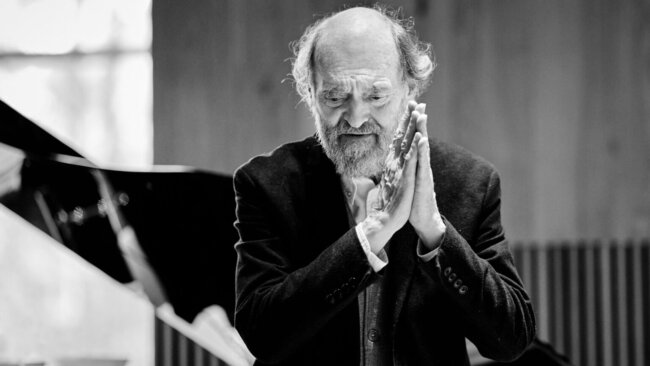
Few contemporary composers are as well-established in the classical music repertoire as Arvo Part. Like Stravinsky, who also achieved international fame during his lifetime, Part’s music is performed regularly in the greatest concert halls in the world. Unlike Stravinsky, however, he avoids the spotlight and almost never conducts performances of his compositions. He is most known for his tintinnabuli style, a minimalist aesthetic that combines tonic triads and diatonic stepwise motion to a create a spare, chant-like sound that feels both ancient and timeless. As Part describes it: “Tintinnabuli is the rule where the melody and the accompaniment [are] one. One and one, it is one—it is not two.” The most famous examples of this are his compositions Fratres and Spiegel im Spiegel.
This year, ensembles around the world are performing Part’s music in honor of the Estonian master’s 90th birthday. To that end, the Estonian vocal ensemble Vox Clamantis, a group based in Part’s hometown of Tallinn, has released an album of Part’s choral music on the ECM label titled And I heard a voice. (For whatever reason, the avoidance of capital letters is all the rage in classical music programming right now). The album was recorded in Estonia’s famous Haapsalu Cathedral and features six of Part’s vocal works set to texts in Latin, English, German, and Estonian.
Vox Clamantis has collaborated frequently with Part, and it shows. The singing is crisp and clear, expressive but limited in a way that aligns with Part’s pseudo-minimalist sensibilities. The ensemble and its conductor, Jaan-Eik Tulve, clearly share with Part a deep understanding of Renaissance plainchant music, a genre that, one could argue, is transplanted into the present day by Part’s compositions.
The album begins with Nunc dimittis, a somber work that builds in tonal layers to a desperate and spine-tingling climax that perfectly encapsulates Part’s singularly beautiful harmonic imagination. It is later followed by Kleine Litanei, a similar work that plays wonderfully on the brilliant acoustics of Haapsalu Cathedral. The singers highlight this acoustic by waiting a full five seconds between phrases at the start of the piece, thus creating a breathless, suspended atmosphere that seems to ride on the resulting reverberations. Fur Jan van Eyck is the only work on the album that features an instrument—this time the organ, played by Ene Salumae. Part deploys the organ much like another voice, sustaining it through broad, resonant lines that add timbral depth to the singers’ voices. The album closes with its namesake, And I heard a voice, a piece that sets a sacred text in the Estonian language. It begins with a series of unsettled harmonic gestures that showcase the control and precision of the choir before resolving in a peaceful cadence.
The centerpiece of the album, though, is the seven-part Sieben Magnificat-Antiphonen, Part’s magisterial 1988 setting of the Roman Catholic Church’s liturgy for the seven days leading up to Christmas (specifically, the Virgin Mary’s song of praise). This subdued but powerful work alternates between deep, reverent plainchant lines and startling bursts of Part’s unique dissonance. Consecutive antiphons contrast each other to wonderful effect: the reflective O Adonai, for instance, is followed by the dark intensity of O Spros aus Isais Wurzel. These differences are presented with mastery and touch by Vox Clamantis, which surges and breathes with one impulse, letting each chord ring through the cathedral before singing the next note. This is a truly wonderful album, and I would be hard pressed to recommend any better foray into Arvo Part’s work.


Related Posts