At the Crossroads between Athens and Jerusalem
The relations between early Christianity and pagan philosophy were marked by strong ambivalence and ambiguity from the very beginning, which was due to many factors. In the case of first Christians, their distance from philosophy may have been explained by the inherited Old Testament mentality, suspicious of anything connected to Paganism, which was considered idolatrous and quite often immoral. Moreover, it can be argued that many first Christians, coming as they were from the lower strata of society, easily contrasted faith, which justifies the faithful, with the independent searching of philosophers, which could appear as proud and arrogant. But that would be only one side of a coin. If this were the whole story, it would be difficult to explain the further development of Christian Tradition, which eventually became a manifestation of an exceptional symbiosis of two seemingly distant worlds: Semitic and Greco-Roman, Athens and Jerusalem. Fortunately, a careful reading of the books of the New Testament doesn’t allow for such a one-sided assessment, because we can find there a number of allusions to philosophy that give us a more complex picture.
One of the most telling fragments is the famous Prologue to the Gospel of John, explicitly confessing the Divinity of Jesus Christ. In the original Greek text Saint John used the philosophical, not biblical, term λόγος to describe Christ’s Divine nature that created all things and entered into what orthodox Christian theologians later called hypostatic union with human nature:
In the beginning was the Word, and the Word was with God, and the Word was God. The same was in the beginning with God. All things were made by him: and without him was made nothing that was made. In him was life, and the life was the light of men . . . And the Word was made flesh, and dwelt among us, and we saw his glory, the glory as it were of the only begotten of the Father, full of grace and truth. (John 1.1–14)
It is noticeable that the above fragment could have been written by some Middle Platonic philosopher without any connections to Christianity. However, Palestinian Jews were certainly closer to Hellenized Jews living in the Alexandrian diaspora than to the pagans. Therefore, it is reasonable to assume that the Johannine Prologue could have been inspired by the thought of the main representative of Jewish-Hellenistic syncretism, Philo (who lived at the time of Christianity’s nascence), who famously preached the doctrine of the Divine Logos, the inner cognition of God, containing the noetic archetypes of all things, and an intermediary between God and the created world.
But that’s only one possibility. On the other hand, one should take into account that the doctrine about Christ-Logos from the Prologue may have its roots in the “sapiential books” of the Old Testament, which contain numerous references to Divine Wisdom or Word. For example, in the Book of Sirach (1.1) we read, “All wisdom is from the Lord God, and hath been always with him, and is before all time.” In the Book of Wisdom (9.1–9) Solomon praises God thusly, “God of my fathers, and Lord of mercy, who hast made all things with thy word . . . . Give me wisdom, that sitteth by thy throne . . . . And thy wisdom with thee, which knoweth thy works, which then also was present when thou madest the world.”
Finally, the Book of Psalms points to both the creative and healing (or even salvific) function of the Divine Word:
By the word of the Lord the heavens were established; and all the power of them by the spirit of his mouth. (Psalm 32.6)
He sent his word, and healed them: and delivered them from their destructions. (Psalm 106.20)
However, regarding these fragments, it should be noted that praising God’s Wisdom as if it were almost a separate, sentient hypostasis is only a literary device, and the fragments about the Word of God do not personify it at all, not distinguishing it from the God Himself. In turn, in the Johannine Prologue, the Christ-Logos is explicitly revealed as a Divine Hypostasis/Person, God the Son distinct from God the Father (though sharing one Divinity with Him).
A very interesting fact is mentioned by the notable French historian of ancient philosophy, Pierre Hadot (1922 –2010), who found in the work of Eusebius of Caesarea a quotation from the Neoplatonic philosopher Amelius, the main disciple of Plotinus next to Porphyry. If this is an authentic Amelius’ statement, it proves not only that said thinker was familiar with the Johannine Prologue, but also that he had moderately affirmative attitude towards it:
This, then, was the Logos, thanks to which all engendered things were produced while he himself exists always (as Heraclitus believed) and which the Barbarian [that is, John the Evangelist – P.H.] believed “was near to God” and “was God,” possessing the rank and dignity of a principle. By him absolutely everything was created; in him was the nature of the living being, of life and of being. And it fell into bodies and, donning flesh, took on human appearance; but at the same time it shows the greatness of its nature. When it is freed, it is once again made divine, and is God, as it was before it fell into the world of bodies, and before it descended into flesh and humankind.
An important set of references to philosophy, seemingly negative, but in fact more ambivalent, can be found in the epistles of Saint Paul. In the First Epistle to the Corinthians (1.20–25), the Apostle of the Nations clearly contrasts faith in Christ with “wisdom of this world,” i.e. knowledge acquired by the natural light of reason, pointing out that said wisdom failed to truly know God and turn the world towards Him, therefore God’s will was to convey the truth to humanity through the revelation. In other words, God chose to teach us not through natural, but through supernatural knowledge. Moreover, because it is supernatural knowledge, in the face of the critical judgement of natural reason it must appear to be “foolishness”:
Where is the wise? Where is the scribe? Where is the disputer of this world? Hath not God made foolish the wisdom of this world? For seeing that in the wisdom of God the world, by wisdom, knew not God, it pleased God, by the foolishness of our preaching, to save them that believe. For both the Jews require signs, and the Greeks seek after wisdom: But we preach Christ crucified, unto the Jews indeed a stumbling block, and unto the Gentiles foolishness: But unto them that are called, both Jews and Greeks, Christ the power of God, and the wisdom of God. For the foolishness of God is wiser than men; and the weakness of God is stronger than men.
Saint Paul, however, doesn’t seem to be particularly strict in this regard, since at the beginning of his Epistle to the Romans (1.20) he writes that pagans cannot make their ignorance an excuse for not glorifying the One True God, because their natural cognitive powers gave them the possibility of acquiring certain knowledge about Him, i.e. about His existence and His essential attributes:
For the invisible things of him, from the creation of the world, are clearly seen, being understood by the things that are made; his eternal power also, and divinity.
Is it a contradiction? By no means. It’s true that pagan philosophy didn’t make the Greco-Roman world monotheistic. The pre-Christian Mediterranean cultures were often steeped in idolatry, despite their many impressive achievements. That said, it’s also true that learned pagans had the necessary tools to know God, and we, taught by the history of philosophy (and by the history of religion as well!), can presume that many of them indeed knew Him. (Of course, they couldn’t know what God only disclosed through His Revelation; perhaps at best they could have vaguely anticipated some of it, but that’s a whole other discussion.)
Another, highly interesting ambivalence can be seen (though not so easily) in the Epistle to the Colossians (2.8), where Paul warns the faithful, “Beware lest any man cheat you by philosophy, and vain deceit; according to the tradition of men, according to the elements of the world, and not according to Christ.”
Despite appearances, this fragment can be interpreted in ways that are far from obvious. First of all, it is possible that the Apostle here condemns not philosophy as such but those philosophical currents that reject any notion of a higher reality and admit only the existence of the physical world. Such was, for instance, the philosophy of Democritus or other Atomists, about which it can be said that it’s concocted purely “according to the elements of the world.” To be fair though, such interpretation may seem a bit far-fetched, so, while it cannot be totally ruled out, it’s more natural for the reader to lean towards the more literal, “pessimistic” version of Pauline warning. In this version, philosophy “according to the elements of the world” would be identical to the “wisdom of this world” from 1 Corinthians. But here’s the interesting thing: if we look at Saint Paul’s “devaluation of philosophy” in the above passage through the prism of the history of theology, we will be able to see it in an unexpected light.
Fideism is a theological affirmation of the superiority of faith over reason. Such a definition is clear, but in practice fideism can have different undertones. There is fideism of Tertullian, who in De praescriptione haereticorum famously contrasted Athens and Jerusalem, and there is “fideism” of the apophatic or “negative” theology. A good example of the latter approach can be found in the work of the Eastern Orthodox theologian Vladimir Lossky (1903–1958). In The Mystical Theology of the Eastern Church Lossky writes (in the context of “the essences of things”) that the “natural theology” of Aristotle and any other philosopher “reaches only to nature in its fallen state.” Earlier on, comparing pagan and Christian notions of the unknowability of God and unio mystica, he states that for the Platonic philosopher the Divine is always an object of knowledge (as the One, the polar opposite of Many), and the ecstatic union is a “reduction to simplicity,” while for the Christian “mystical theologian” God is an absolute mystery, and the state of union with Him implies “going forth from the realm of created beings.”
Thus we arrive at an interesting paradox. Lossky’s statements are very much in the vein of Saint Paul’s “fideism,” and show that there is a chasm between pagan philosophy and “mystical theology.” However, these two “realms of wisdom” are not only divided by crucial differences, but also share important similarities. Accordingly, this same chasm can be seen as a continuity and development (for example, from one phase of apophatic theology to another). As the great Catholic teacher, Saint Thomas Aquinas said, grace doesn’t destroy nature but perfects it. In this light, the Christian wisdom surpasses the pagan one, but at the same time the pagan wisdom anticipates the Christian one – as a praeparatio evangelica. For this reason, there is no obstacle for a Christian to explore the “wisdom of this world” in search of “pieces of truth,” but at the same time he should remember that after the Cross has been exalted over the world there is no return to this wisdom for its own sake: his own philosophy must be based on Christ, and not on the “elements of the world.”
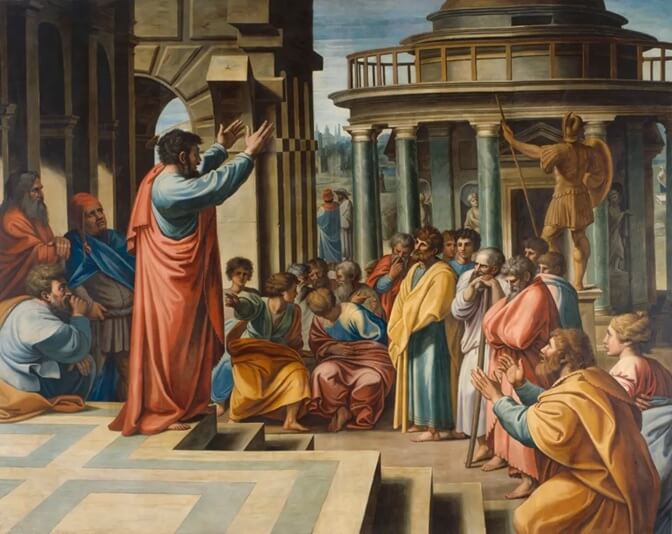
Perhaps the most telling testimony to the not-so-obvious attitude of Saint Paul towards philosophy is the account of his speech on the Athenian Areopagus hill, which can be read in the Acts of the Apostles (see Acts 17.16–34). Their author, traditionally identified as Saint Luke the Evangelist, conveys that the Apostle of the Nations, finding himself in Athens, initially was agitated by the idolatry common in that city, and also that he talked to Jews in the synagogue (where he went first), as well as to people on the marketplace. Yet, Paul didn’t shy away from the philosophers who were present on the Athenian agora – Epicureans and Stoics (this is the only time when we find philosophical schools explicitly mentioned on the pages of the Holy Writ). On the contrary, he starts a conversation with them, and even let them take him to the Areopagus. There he delivers his famous speech in which he says that among their numerous objects of worship he found an altar dedicated “to the unknown God” (Ἄγνωστος Θεός). Then he adds that he came to preach to them this very God, who is the Creator of the whole world.
Let’s focus on the figure of speech used by Saint Paul in because its content is not self-evident in the light of various Bible translations. Incidentally, it’s a good example that, although the Douay-Rheims Bible (DRB), based on Saint Jerome’s Vulgate, is arguably the best English Catholic translation (all the above Bible quotations come from this version), it’s not flawless. According to DRB Saint Paul said, “Ye men of Athens, I perceive that in all things you are too superstitious. For passing by, and seeing your idols, I found an altar also, on which was written: To the unknown God.”
In turn, in the Revised Standard Version Catholic Edition (RSVCE) we read that the Apostle expressed a different thought, “Men of Athens, I perceive that in every way you are very religious. For as I passed along, and observed the objects of your worship, I found also an altar with this inscription, ‘To an unknown god.'”
According to the first translation, Saint Paul chastised the Athenians; according to the other, he praised them. Personally, I’m inclined towards the second option, and I base my position on the original Greek text. To be fair, Paul’s courtesy was probably only a rhetorical figure, because, as we can read earlier, he was shocked to see that Athens were κατείδωλος (“full of idols”). Nevertheless, in the original Greek of the above quoted fragment we find the word δεισιδαιμονεστέρους, which can be translated both as “very superstitious” and “very religious” (i.e. “god-fearing”). Moreover, in the next sentence Paul speaks about τὰ σεβάσματα, which means rather “objects of worship” than “idols,” because this noun is derived from the verb σέβομαι, “to revere,” “to worship.” We also find a very similar word in the Second Epistle to the Thessalonians (2.4) where we read that the Antichrist will be “lifted up above all that is called God, or that is worshipped (σέβασμα).” Besides, we can point to a very simple psychological truth: people don’t like being criticized, so if we start our speech by rebuking them, there is little chance they will be eager to listen further.
In other words, Paul tried to win the sympathy of his listeners. This argument can be strengthened by the fact that Paul subsequently (see Acts 17.28) uses a very peculiar means of revealing the truth to the Athenians: he quotes pagan poets and a philosopher: respectively Epimenides (“for in him we live, and move, and are”), and Aratus and the Stoic Cleanthes (“for we are also his offspring”). His overall approach was clearly to some degree successful: although some people laughed at him when he told them about the resurrection of the dead, some were converted to the Faith, among them a woman named Damaris and a man called Dionysius the Areopagite.
Careful analysis of Saint Paul’s “Athenian moment” reveals that he not only talked to philosophers and referred to a philosopher in his speech, but above all he himself used a method that can be described as (at least to some extent) philosophical. Firstly, Paul’s actions resemble Socrates, who also talked to various people on the streets of Athens, and Zeno of Citium, the founder of Stoicism, who taught from a public portico. Secondly, and more importantly, his speech on the Areopagus bears some similarity to the Socratic method, especially to the Socratic irony. Socrates craftily pretended to be an ignorant who wanted to be instructed, and Saint Paul showed his appreciation to certain aspects of pagan religion and poetry – in both cases we are dealing with a tactical figure of speech that serves to arouse in the listener a disposition that would be a good starting point for further search for truth. There is a fundamental difference though: Socrates perceived himself only as an accoucheur of the soul, who helped people realize the truth already contained within them, albeit unconsciously, while Saint Paul brought to the Athenians a completely new doctrine, received in a supernatural way, which shook the very foundations of Greek thinking on things human and divine.
All things considered, the above interpretation of Saint Paul’s visit to Athens and his speech delivered on the Areopagus allows for us to treat this event in terms of the first documented meeting between the young Christianity and Greco-Roman tradition. This meeting was reserved and marked by mutual distrust, but it anticipated the future synthesis, first ancient, and then medieval; a synthesis that the great Colombian aphorist Nicolás Gómez Dávila beautifully called (in its Romanesque version) “a combination of the Gospel and the Iliad.”


Related Posts