Kairos and Daimon as Complementary Concepts
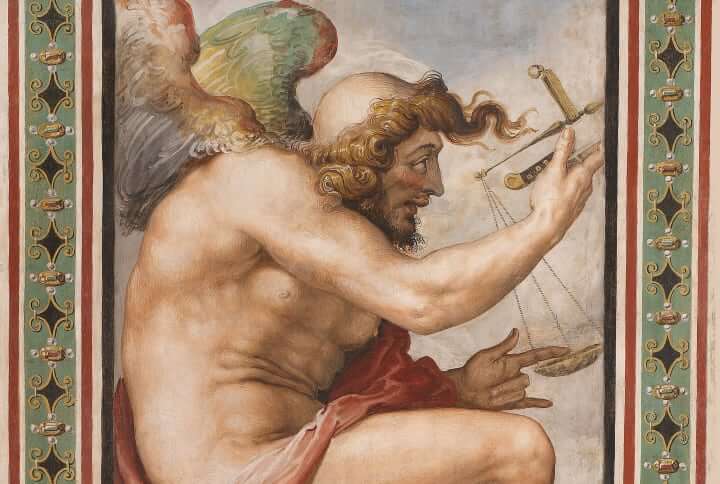
The Ancient Greek concept of “kairos” comes to me vaguely in translation as “the opportune moment.” Occasionally I encounter a fuller and more useful elaboration, as when Gary Dorrien writes, regarding Paul Tillich’s reading of Schelling and Hegel, that “every living thing contains within its deep essence a conflict between a present and a becoming form,” and “some things [like, specifically, cultivating this becoming form] are possible only in particular times” (and I would humbly add under particular circumstances).
Kairos, seemingly, might be translated as “the opportune moment” for the unfolding or realization of this “becoming form.”
I read it together with another Ancient Greek concept, the daimonic, and I adopt Hannah Arendt’s usage of the latter. As I recently wrote in VOEGELINVIEW, “What’s truly daimonic is that other people tell you who you are.” This happens because (1) they see you in a way you constitutively cannot see yourself and (2) they tend to read back from doing (the speaking and acting that they see and hear) into being (the nature or essence of the actor or speaker).
Kairos might be the opportune moment to extricate oneself from present inauthenticity, which latter is constituted daimonically (other people hold me in my inauthenticity by reading back from my doing into my being), and to begin to develop a more authentic self.
I took a semester off from college during my junior year and rented a $300 room in a boardinghouse mostly for this reason, though without having any theory to justify or understand this leap of faith. Mostly what was supporting my decision to take this minor risk were the writings of Charles Bukowski.
Like Bukowski, back then I wanted to earn a living doing anything at all, just whatever, and read and write in my free time. I held onto this ideal all through college and beyond, although at some point a competing ideal arose and more or less stuck: continue on in formal education and become a teacher. Yet becoming a teacher meant first of all something like becoming righteous by love of wisdom, in the words of Eric Voegelin:
The force of tradition and habit keeps them on the narrow path, but they are not righteous by ‘love of wisdom,’ and in a crisis they have nothing to offer the younger generation which is already exposed to more corruptive influences.
Yet it was above all Bukowski who was in my head back then, not Voegelin who I encountered only by chance a few years later. Under Bukowski’s influence I wanted to be a writer, not a teacher — even precisely not — and yet something like Voegelen righteousness, a quest for righteousness, undergirded this project as well. Writing like teaching could only be a side-effect of this more essential aim, the kairological recovery or cultivation of a more authentic self.
Bukowski himself says, “Writing is only the result of what we have become day by day over the years. It’s a […] fingerprint of self…” His advice to folks in roughly my position was to “read good writers and live—and writing all the time isn’t living.”
This brings me back to that semester off from school. I had two part-time jobs and spent much of my free time reading. Yet reading all the time isn’t living either. Certainly for Bukowski “living” had something to do with classical music, horse races, and alcohol, but I don’t think any of this is really essential to what he meant. He traveled prolifically as a young man but I don’t think that’s the essential thing either.
Bukowski’s fundamental tendency might have been status-denying, both externally and internally, with regard to others and to himself. You see this internally when he writes, “Believe you are good when they tell you you are good and you are thereby dead, dead, dead. Dead forever.” I take “death” here in the spiritual sense of being overcome daimonically by the judgements of others.
And you see Bukowski denying these judgements externally in the way he rejected supposedly great writers like Shakespeare and in his retrieval of John Fante from total obscurity, or again in the way he could esteem, say, a janitor over and above a president, the former being potentially equal to or greater than the latter “in nondestructive worthwhileness,” which apparently was the thing that mattered. What mattered was spiritual renewal, and it just so happens that an effect of this renewal is nondestructive worthwhileness.
No one really understood what I was doing there in that boardinghouse, any more than I myself did. I should be in school or at home, they thought. One of the other tenants told me to live with my parents for as long as possible. I think of this sometimes, now that I am apparently doing more or less that, of how ridiculous I thought it was, of how embarrassed I was for this man. It’s not that I think he was right after all but that his point is more understandable now than it was then. It’s not that I believe, in retrospect, this unsolicited offering actually constituted a pearl of wisdom that fell unfortunately on deaf ears. Far from it. The man, I suppose, wasn’t wise. Specifically he wasn’t wise to the legitimacy of my project—that of becoming spiritually renewed, or authentic, or righteous, or nondestructively worthwhile, all of which amount, in my mind, to roughly the same.
Yet what might be said on his behalf is that he treaded the narrow path of decency marked out by tradition and/or habit, though hollowed out of wisdom. The younger generation, my generation, “exposed to more corruptive influences” and flailing about in a world perceived as unjust and spiritually stultifying, rejects this kind of unwise decency that comes, I suppose, from a strictly non-kairological, daimonic frame of mind and which, thus, fails to be as “nondestructive” as it imagines. It had precisely a destructive effect on my “becoming form” which was in conflict then with my “present form,” as Dorrien put it above.
In the years since this relatively idyllic period on the cusp of adulthood, I have remained ineluctably non-wise but have grown in decency. I doubt whether I have very much worthwhile to pass on to a younger generation, except to acknowledge that this decency may conceal a certain hostility to kairological renewal, and to that extent should be disregarded.


Related Posts