Being Called Beyond the Wall
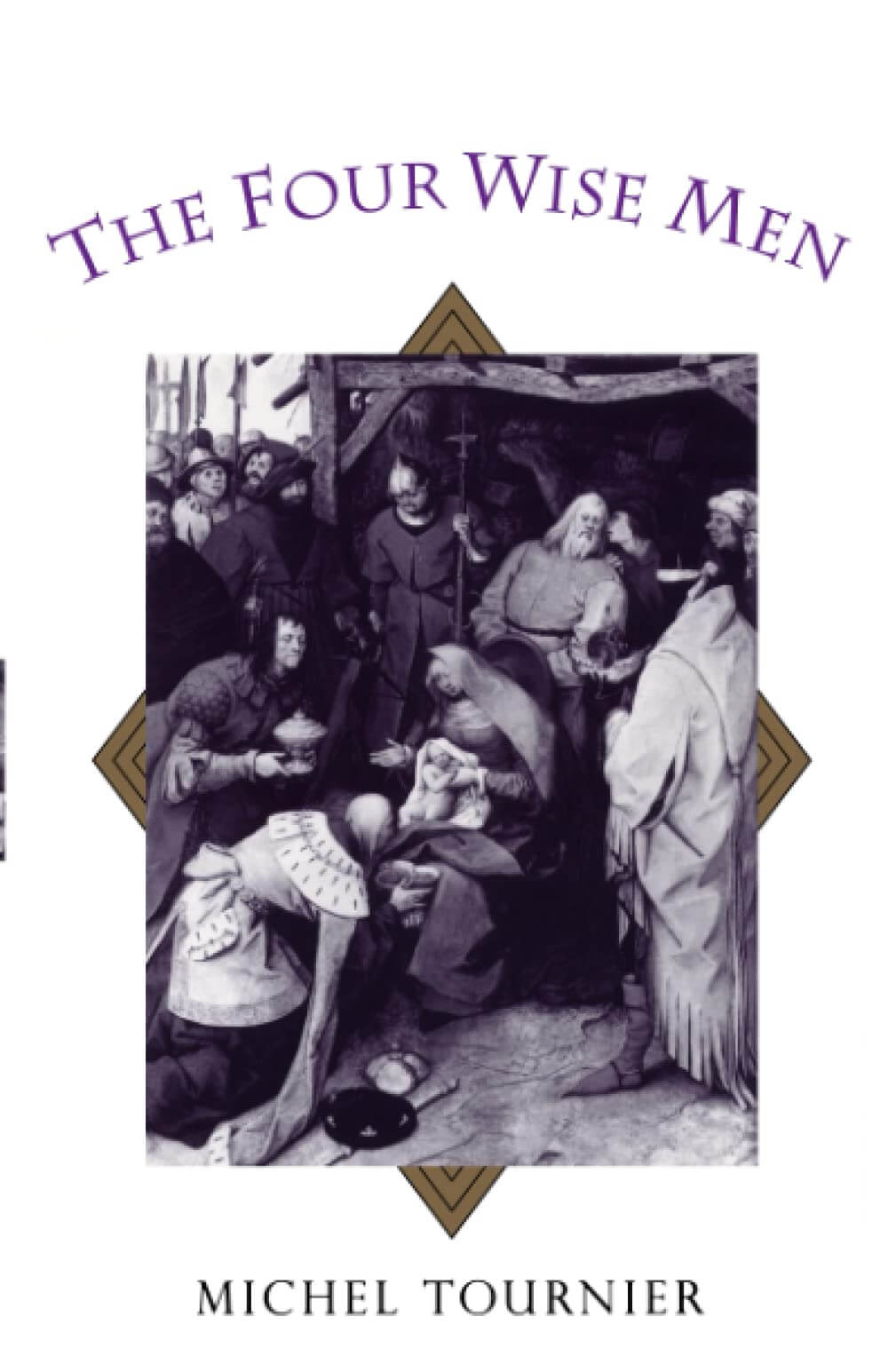
The Four Wise Men. Michel Tournier (Baltimore, MD: John Hopkins University Press, 1997).
The gospel stories are about movement—Jesus comes to a town, crosses to the other side of the water, or encounters a person. Ultimately, the gospels tell a road story that ends up in Jerusalem, before once again moving from the confines of a tomb toward an open future. “Stagnant, lifeless water becomes brackish and muddy, while flowing, singing water remains pure and limpid,” Michel Tournier writes in The Four Wise Men, quoting the poet Mohammad Asad. “Similarly, the soul of a sedentary man is a vessel in which endlessly ruminated grievances ferment. From the soul of the traveler pours a pure stream of new ideas and unforeseen actions.” Living in the flow of being, somewhere between immanence and transcendence, one does not hide their soul behind a castle wall. Their soul roams, searching the places of beauty and the mysteries of shadow, perhaps seeking the home where Jesus lives, or the stable where Jesus was born.
Tournier’s The Four Wise Men is a story of the wise men from the east who visit the baby Jesus in a Bethlehem stable, as recounted in the gospel of Matthew. It is a story of their journey across open desert, rough seas, ancient orchards, and weather-worn hills, where long lost people, cultures, and food are brought to life. The four pilgrims venture out from a sedentary life tortured by a restlessness for something new, for a human purpose on this earth, and for a way to grow closer to a distant God. They are inspired by a golden haired comet, and the unknown horizon that surrounds them. The four wise men are kings, or princes awaiting their time for the throne. The comet draws them out, inviting them to the west, causing them to wonder aloud whether the comet brings ill omen or new beginnings.
In the reading of the tale, we are also treated to a study of some problems that arise in political life, and the spiritual remedies the baby Jesus offers. Among the kings, we read of one who suffers from isolation in his place of leadership. Another king rules a population whose passions are manipulated by a jealous priestly class. A prince lives with a dream of a new social reality where all people will share in the daily work, and the daily bread, equally. And we read of a prince who has become irrelevant because of his childish sense of self.
Gaspar, King of Meroe, travels with a broken heart as a result of unrequited love. In the market, Gaspar’s habit is to buy incense, appreciating what it brings to love-making. Incense, he understands, “is not so easily desacralized. Its vapor sifts the light and peoples it with impalpable silhouettes. Its fragrance lends itself to reverie, to meditation,” suggesting sacrifices and making for a religious atmosphere. Gaspar loves his carefully purchased possessions, including his slaves, yet rues the isolation he feels from being King. One night he ventures out from camp and comes upon an old sage. In the still night a shepherd’s flute suddenly bursts forth with a solitary and throbbing sound. What is that? wonders Gaspar. “It is Satan weeping as he beholds the beauty of the world,” answers the sage. “That is the way with all degraded creatures: the purity of things makes the evil in them weep with regret.”
Balthasar, King of Nippur, is in love with beauty, and in particular, images, which the priests of his land abhor. The king is restless. In Greek art he sees hardly any room for “plain human reality.” He meditates on Genesis, where he reads that God made man in his image and likeness. Why are these two distinct words used in describing the creation of man? When man sinned, he forfeited his likeness to God, and now only a small, deceptive image remains. This must be why, Balthasar muses, representing man in art is a cursed practice. He will not find peace until he sees “heartrending human truth merge with the divine grandeur.” He wonders if one day fallen man will be redeemed and regenerated, perhaps by a hero of some sort.
While still young, Balthasar travelled not with a sword but a butterfly net, for he noticed clouds of butterflies who always travelled west. He considered butterflies to be pure beauty—they were weightless and without market value. He ventured east, to find where the butterflies came from, and met a caretaker of the insects named Maalek. Balthasar sees how some butterflies are asphyxiated with myrrh so as to be preserved for all time. Maalek gives Balthasar a block of myrrh as a gift, “the symbolic substance which enabled putrescible flesh to attain the perennity of marble, the perishable body the timelessness of a statue.”
Melchior, Prince of Palmyra, is a prince in exile, having lost his rightful place on the throne to a conspiring uncle. He travels in anonymity, carrying his worldly possessions on his back. His most valuable possession is a gold coin that bears the image of his father and former king. The gold coin is the only proof he has of his royal lineage. He has come to know his subjects by living as one of them, sometimes begging for his food. Melchior realizes Kings, bandits, and beggars “acquire nothing by toil or exchange.” He hopes one day there will dawn a new social order where there are no injustices that lead to excessive power in the hands of a few, or soul crushing poverty amongst the masses.
On his pilgrimage Melchior enters Jerusalem with all its ancient splendor. While there, he meets Gaspar and Balthasar. Recognizing Melchior’s place in the order of kings, they smuggle him into a meeting with King Herod, a feared ruler who is dying, alone and desperate. Herod cannot help but share his worldly wisdom with the three lesser kings in his presence. The laws of morality and justice do not apply to questions of power, Herod counsels, and there is certainly no “Reason of State,” but only “Madness of State.” Herod is preoccupied with succession in his kingdom, where his own family members have betrayed him, and asks his guests to honor the new king to be born beneath the comet. The three royal pilgrims are confused by this babe king, who seems to possess greatness and littleness, power and innocence, riches and poverty.
In Tournier’s retelling of the Christmas tale, there is a fourth royal visitor intent on reaching the baby Jesus in a Bethlehem stable. Taor, Prince of Mangalore, is a young man living under the controlling thumb of his mother, a Prince possessed by an “immoderate taste for sweets.” His agents comb the old world in search of novel recipes, and so it is he is introduced to rahat loukoum. He is possessed by the taste, but Taor is frustrated by the lack of a recipe. Perhaps to console their master, his agents speak of desert hermits who foretell the birth of a Divine Confectioner who will bring a new, transcendent food to the earth that will remove hunger, and the desire for evermore luxurious foods. Taor is introduced to the food of these hermits, locusts preserved in wild honey. This hermit food is salty and sweet, an obvious paradox, yet Taor is enamoured by this novel flavour.
Taor feels called to journey forth into the unknown to find the recipe for rahat loukoum, and perhaps to meet this Divine Confectioner. In preparing for his journey, a lethargy that had ringed his thoughts and actions his entire adult life falls from around his mind and heart. With five ships, five elephants, and bundles of sugar and sweet resins for his chefs, Taor’s pilgrimage begins. But as the journey continues, he slowly loses his luxurious items, and his servants, who are unnerved by the adventures and challenges they are confronted by. Yet Taor continues to mature, casting off his naivete and learning to empathize with the people around him, an accomplishment Kings and Princes typically can never achieve.
Taor meets a desert nomad who makes some simple bread for him over a charcoal fire. Body and soul were made of the same substance, instructs the nomad, but the great fall broke the body and soul into two pieces. In response to the fall, nomads of the desert have chosen extreme frugality combined with the most spiritual of physical activities—walking. “Our feet mime the progress of a mind in quest of truth,” shares the nomad chieftain beside the charcoal fire. Taor eats the plain bread, his teeth crunching on grains of sand that have found their way into the dough.
Tournier’s Christmas morning does not forget the shepherds, nor the ox or ass. The rich and poor, and the lowly animals, are lifted up in the Christmas story, helped along by the mystery of the angel Gabriel.
Balthasar recognizes the dawn of a new art, where a mother nursing a child in a stable is a moment filled with divine light. He offers the block of myrrh, recognizing the accession of flesh to eternity. The image is saved, the face and body of man can now be celebrated without idolatry.
Melchior’s simple ideas of a new social order, where people could live together in peace, justice and harmony, are replaced by a sober realization that violence and fear are indispensable components of earthly power, combined with “contagious disease of character,” baseness, duplicity and treachery. The kingdom of God will never be established once and for all. The child in the stable teaches Melchior the power of weakness and the law of forgiveness. These realizations do not rid the world its ugly forms of temporal power, but infinitely transcend them. He lays the gold coin beside the infant Jesus, his only treasure and only proof that he was legal heir to his father’s throne. Melchior withdraws into the desert, called to live a life of hermetic prayer.
Gaspar realizes that he carries a great love in his heart, compatible with incense, “because it aspired to flower in worship.” The love of worship is shared, because “its radiance makes it irresistibly communicative.” What Gaspar comes to learn of Christian love is that we are to become like those we love, seeing with their eyes and speaking their language. If you expect another to give you pleasure or joy then you live only for yourself. “True love is the pleasure we get from another’s pleasure.”
Taor is late to arrive for Christmas morning. The family of the nativity has fled to Egypt. Taor has his remaining chefs create a sweet feast for the children of Bethlehem, who are poor and hungry. Unwittingly, he becomes a witness to Herod’s slaughter of the innocents, and so it is he comes to understand the concept of sacrifice. In turn, Taor will sacrifice himself for the freedom of a family man burdened by debt. For thirty three years he will live as a slave, cut off from the world and anonymous in the salt mines of Sodom. When he is freed, emaciated and poor, Taor will seek after Jesus, whose teachings he has heard while a slave.
Biblical narratives are sparse in detail, which makes for exciting exploration as one meditates on what is said, and not said, in the stories. Tournier’s novel explores the possibilities of the Christmas story, and in so doing offers a tale loaded with quietly placed symbols and biblical references a reader follows as though on a scavenger hunt. The Four Wise Men is a rich meditation with more than a few surprises, and in the end, leads the reader experientially to Christmas morning and the walls that were broken down that day.


Related Posts