Breaking History: Israel, Iran, and Trump
“Political science is suffering from a difficulty that originates in its very nature as a science of man in historical existence.” Any political science and understanding of politics (and society) that doesn’t understand the historical existence of humanity, the essence of human nature, and the “self-illumination of society through symbols” is a failed political science. Humans are not value-free beings, and the notion of contemporary political science in perpetuating this falsity makes it insufficient in even understanding the political events that it seeks to analyze. As Eric Voegelin makes clear, humans are spiritual creatures whose politics and political society reflect their spiritual desires, moreover, the contest of persons and the forces that shape political society are manifested through symbols of meaning that give humans a sense of right and wrong, order, and destiny in life.
In it nauseating to hear the repeated phrase “the right side of history.” The statement is also ironic, as it is often promoted by people who will also claim there is no natural order to morality, that everything is relative, and all human action is ultimately about power. If so, how can there ever be a “right side to history”?
Embedded in this “right side of history” rhetoric is the residue of the psychology of Good and Evil, of a cosmic struggle between light and darkness, justice against injustice, righteousness against cruelty. All of this stems from the fact that humans are spiritual creatures—endowed with a sense of the Divine, of Good and Evil, and justice.
This is not shocking to people outside of the Western world. Many people around the world have a spiritual sense of themselves, their mission and destiny in the world, and God’s providence over the arc of history. Westerners used to have this view; some still do.
To understand the crisis of the leadership and intellectual class in many places across the Western world, one must understand the historical existence and movement of Western culture and how it got to the “profound spiritual destruction in the autonomous secular sphere.” Eric Voegelin notes in Revolution and the New Science, that the contest between state and church led to the banishment of religious, metaphysical, considerations of life to just the private sphere which resulted in a monopolization of the public sphere by the secular state. This historical outcome, however, does not diminish humanity’s spiritual impulse, the metaphysical reality that moves the heart and soul of humans toward a higher understanding of life.
Liberalism, Voegelin argued in his assessment of Thomas Hobbes and those who followed after Hobbes, served as a bulwark against “Gnostic” revolution—the spiritual or metaphysical struggles of the 16th and 17th centuries that are remembered today as the “Wars of Religion.” Voegelin doesn’t hide the fact that these wars, including the English Civil Wars, were fought because of a religiosity. In fact, it could only be so given the spiritual reality of human beings.
The (liberal) constitutional orders erected in the aftermath of the bloody wars of religion were meant to restore peace and order to a world, and societies, torn about by the anguish and fanaticism of a sense of Good vs. Evil, justice vs. injustice, and righteousness for respective causes. The success of political liberalism was the elimination from the public sphere those metaphysical questions and concerns that had always dominated human consciousness. The success of political liberalism also ensured its eventual impotence: the inability to grasp and counter the metaphysical reality of life and what moves humans to be willing to fight and die despite the relative economic prosperity that has followed from the formation of liberal political order because liberalism doesn’t speak or permit the cadence of metaphysical reality.
The metaphysical spirit cannot be eliminated as it is central to the very essence of human nature. That spiritual impulse for mission, destiny, goodness, righteousness, and justice has erupted in the 21st century in a multitude of ways with a multitude of movements. We live not in a world where our political struggles are merely between categorical sciences like democracy and despotism, liberty and oppression, equality and inequality, but between Good and Evil. This is something that leftist politics, despite its attendant philosophies of relativism, understands in its rhetoric. This is something that the liberal leadership and intellectual class – be it in politics, journalism, or academia – fail to understand. Moreover, with the threat of world peace always coming “from the right,” liberals invariably accommodate the far left in its battle against the right—however construed and understood. The crisis of American politics, its seeming disintegration and polarization, is the result of the historical phenomenon of political liberalism reaches its exhaustion without returning a sense of the metaphysical, spiritual, and Divine back to the public sphere and public debate. This pressure comes both from the left and the right.
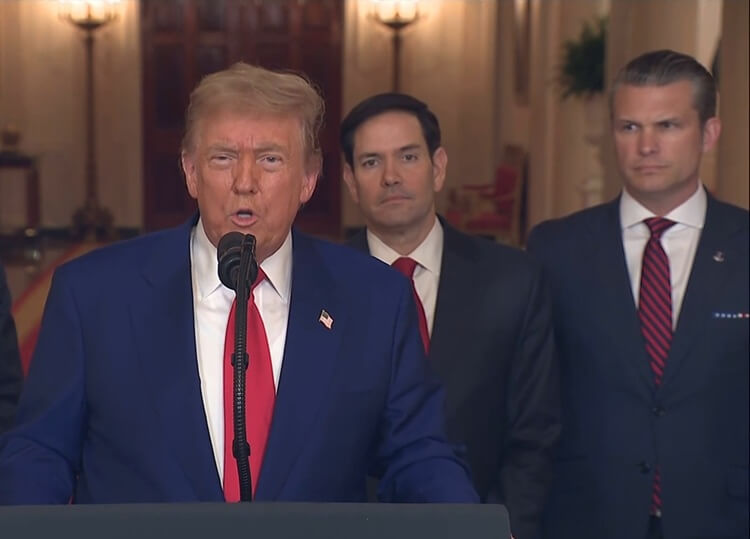
The idea of history as a value-free progression toward greater liberty and equality is being cracked by the emergent return of the understanding of Good and Evil in politics. President Donald Trump’s joining of the Israeli airstrikes against Iran and its nuclear facilities is a reflection of this. The Mullah regime in Tehran is Evil and the inevitable confrontation with it must recognize it as such. The struggle is spiritual, not simply because this is how the Mullahs understand their battle but because the battle between Good and Evil is spiritual, both in its origin and ultimate end.
Liberalism did not defeat fascism and communism in the wars of the 20th century as if these struggles were merely ideological, the outcome of a scientific political struggle over which system of political governance was best or most efficient. The victory of the West, led by the United States of America, against fascism and communism was the result of its spiritual strength against the disordered spiritualism of fascism and communism; that spiritual fortitude rested with the people and not the ideological state. The continued struggle against Evil will require the spiritual strength of those who fight it, the spiritual strength of those who understand the true nature of the conflict and acknowledge it as so, and the spiritual renewal of the societies engaged in it lest they succumb to spiritual comatose which precipitates disintegration and disaster.
Weakness, spiritual weakness, is what allows spiritual disorder—Evil—to grow. Evil, which must consume and destroy by its nature, eventually erupts out of its contained spiritual wickedness of the internal to the external: the physical world. If we were too weak in the past to confront Evil when it could have been curtailed before eruption, now we must be strong in the face of the spirit of Evil’s incarnate manifestation.
Whatever faults one has with Donald Trump, what he said at the end of his Oval Office address after authorizing the American airstrikes in Iran is the closest understanding to the truth of the political conflicts we are caught up in: “I want to just thank everybody. And, in particular, God. I want to just say, we love you, God, and we love our great military. Protect them. God bless the Middle East. God bless Israel and God bless America. Thank you very much. Thank you.” Thank you, indeed.


Related Posts