Frontier Demons: A Review of Aaron Gwyn’s “The Cannibal Owl”
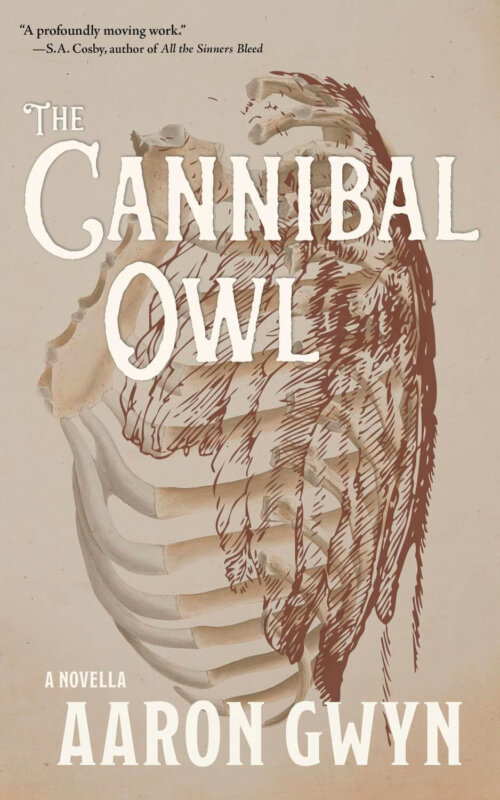
It takes a special brand of confidence to write a western. Packed with swashbuckling films, warrior ballades, and sprawling novels—not to mention the tremendous influence of the two greatest western writers in history, Cormac McCarthy and Larry McMurtry—the western genre can appear almost impenetrable. Yet none of this seems to have perturbed American novelist Aaron Gwyn, whose recent novella The Cannibal Owl brims with classic western motifs and relentless, poetic prose.
The Cannibal Owl tells the mid-nineteenth century story of Levi English, an orphan who is adopted by a restless band of Comanches. Levi comes of age among the Comanches, learning how to make bows from an elderly man named Poe-paya. Poe-paya tells Levi of Pia Mupitsi, The Cannibal Owl, who haunts and kills disobedient children. For the rest of the story, Levi is preoccupied by thoughts of the Cannibal Owl.
After Poe-paya dies, the Comanches descend into violence. Levi flees after seeing the head warrior, Turns in Sunlight, brutally kill the chief, Two Wolfs. But he soon returns to uphold a promise he made to Poe-paya to save his daughter, Morning Star. In doing so, Levi calls upon the Cannibal Owl to enter him. “Blind my enemies,” he prays. “Make their eyes fail at the sight of me. Give Mupitsi leave to swell my soul.” The Cannibal Owl grants his prayer, inspiring him to almost reckless levels of violence when he slaughters the warrior who he believes killed Morning Star. Levi then recruits a group of self-professed Indian hunters led by a gigantic character named Cajun Bill to return to the Comanche settlement and avenge Two Wolfs’ death.
As in McCarthy’s Blood Meridian, death—and unexplainable perseverance in the face of it—is everywhere in The Cannibal Owl. Indeed, Blood Meridian seems to echo through much of Gwyn’s novella, which is to be expected given Gwyn’s academic specialization in McCarthy’s fiction. Yet Gwyn also departs from McCarthy in several important ways. Levi feels, for instance, like a more redeemable and accessible version of The Kid. I half-expected Cajun Bill to be a brutish savant akin to McCarthy’s Judge Holden, but he was not: he was merely Cajun Bill.
Gwyn’s prose struck me as distinctly American. It was often lyrical like McCarthy and Faulkner, but other times it was spare and direct like McMurtry or Hemingway. Many sentences started with warm colloquial turns of phrase (“Spring of ’29,” and so on). Certain scenes also seemed to harken back to great American writers of the past. For instance, Gwyn crafts a lengthy scene in which Poe-paya teaches Levi how to make a bow, beginning with the selection of the wood and progressing through each step of the process until the bow is ready for combat. I was reminded of Hemingway’s methodical telling of Santiago’s fishing tasks and Melville’s painstaking description of how to extract oil from a sperm whale.
What, then, are we to make of the terrible Pia Mupitsi? Levi never escapes his initial preoccupation with the Cannibal Owl. It’s as if, by invoking the power of Pia Mupitsi in avenging Two Wolfs and Morning Star, he has sold his soul to the demon. And the price he pays is not clear. In the epilogue, where we find Levi as an old man with “the forgetting disease,” Gwyn tells us that Levi’s “prayers have been granted; he has done terrible things.” When Levi wonders, “What was her name?,” it is unclear whether he is thinking of the Cannibal Owl, his mother, or Morning Star. And that is where Gwyn leaves us—partially sated, wanting more, still shrouded in the mysterious grasp of the creature under whose wings Levi English lived out his days.
The Cannibal Owl
By Aaron Gwyn
Fort Smith, AR: Belle Point Press, 2025; 80pp


Related Posts