
Bringing the Parties Back In: A Review of Hollow Parties
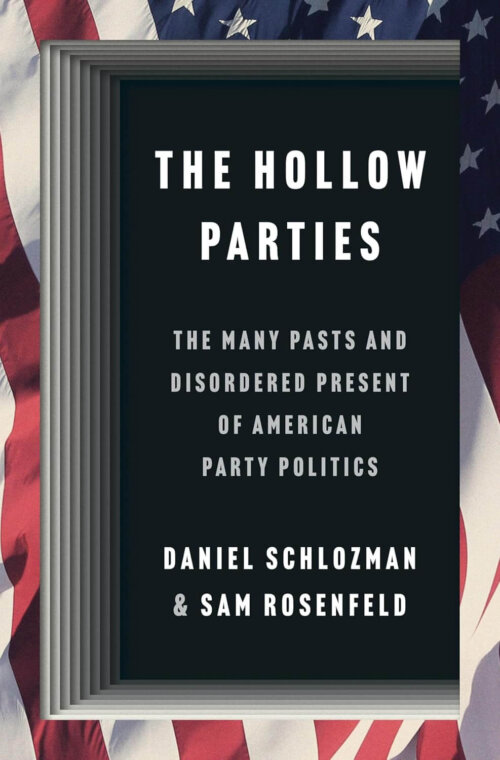
Daniel Schlozman and Sam Rosenfeld, political scientists at Johns Hopkins University and Colgate University, respectfully, have written a searching and scorching overview of the state of the two major political parties in the United States, and it’s not pretty.
Polarization, coupled with neoliberalism’s dismantling of the New Deal’s legacy, has challenged American political parties in unprecedented ways. However, rather than dwelling on how Democrats and Republicans have diverged, Schlozman and Rosenfeld emphasize what they share: both have become ineffectual instruments of democracy. “Hollow parties do not merely enfeeble governments, they endanger democracy,” they warn (10).
Building on scholarship in American political parties, political development, and history, the authors adopt E. E. Schattschneider’s definition of a political party as “an organized attempt to get control of the government” (11). They expand on this framework by identifying five collective party actors in the U.S. (left dissidents, Democratic institutionalists, neoliberal centrists, the Reaganite GOP, and right populists) and six ideal types or strands of parties (accommodationist, anti-party, pro-capital, policy-reform, radical, and populist).
Schlozman and Rosenfeld are unapologetically pro-party. “Political parties have within them the possibility to serve as democracy’s savior or its saboteur,” they assert (256). Yet rather than bringing voters together to pursue common goals and mediate conflicts, today’s parties, they argue, are hollowed out: “Hard shells, marked with the scars of interparty electoral conflict, cover disordered cores, devoid of concerted action and positive loyalties” (3).
At the heart of the issue lies the disconnect between the rigidity of the two-party system and the fragmented institutions that require compromise to perform even basic governance. While multi-party systems can lead to fragmentation, the two-party system is designed to foster robust and responsive parties. However, hollow parties have lost touch with the civic lives and concerns of Americans, becoming preoccupied with national matters and, paradoxically, “everywhere and nowhere” at the same time (4-5).
Party influence is further undermined by “paraparty groups,” which the authors call “the party blob.” These groups operate without accountability to public opinion and often use the parties as scapegoats to advance their agendas. As a result, parties lack legitimacy, relying more on negative partisanship than on coherent political programs. This advocacy-dominated regime, combined with the high costs of campaigning and changes in campaign financing, has placed parties at a disadvantage. Schlozman and Rosenfeld argue for ending financial contributions to paraparty groups, though they acknowledge that public funding for political campaigns remains a distant prospect.
The authors reject centrist, anti-party solutions, such as increasing party control over nominations and campaign funding, which they see as missing the mark. Instead, they advocate for a revival of the core functions of parties: grassroots organizing and crafting a positive policy agenda. They contend that abandoning the party system is neither practical nor desirable; instead, the existing system must be repaired so that parties can better fulfill their essential role at the center of popular government.
Historical examples illustrate what strong parties can achieve. The Republican Party, at its founding, advanced freedom and preserved the Union, while the Democratic Party spearheaded New Deal and civil rights-era reforms. The authors highlight the Nevada Democratic Party, shaped by the late Harry Reid, as an example of a strong party organization, with its professional staff, volunteer mobilization, candidate recruitment, and strategic planning. While the Nevada model may not be universally applicable, its lessons are relevant to both major parties and even to national politics.
The authors, both declared Democrats, can be commended for the extent to which their political preferences have not tainted their analysis. They take each party and its members on their own terms, without becoming partisans or sliding into a banal bothsidesism. The GOP and its media ecosystem, they observe, has become obsessed with power at all costs, including abandoning key tenets of its own platform and policy commitments, such that it needs to moderate itself and reject the anti-democratic and extremist forces that have firmly taken root within their ranks. This will likely require a series of electoral defeats, Schlozman and Rosenfeld acknowledge, especially, we should add, since these elements have been emboldened by the results of the 2024 election.
At the same time, Schlozman and Rosenfeld urge Democrats to avoid ideological battles and strategies that are overly focused on demographics and identity. In particular, they identify the education gap and struggles with working-class voters, which have been the focus of much post-election analysis. Indeed, the elites within the Democratic Party scrambled to oust its nominee in the summer of 2024, only to discover that the party was lacking more than a vigorous standard bearer.
Schlozman and Rosenfeld skillfully tie their arguments to the public record, making their analysis both sharp and accessible. While data-driven readers may find the lack of quantitative evidence lacking, the authors’ conceptual framework offers fertile ground for future research.
Hollow Parties is well-written and suitable for readers with a solid interest in current events or American political history. Its relevance is underscored by the 2024 election results, which only reinforce the urgency of its argument. Overall, the book is a timely and compelling call to action for revitalizing American democracy.
The Hollow Parties: The Many Pasts and Disordered Present of American Party Politics
By Daniel Schlozman and Sam Rosenfeld
Princeton: Princeton University Press, 2024; 448pp


Related Posts