Caligula and Jerusalem
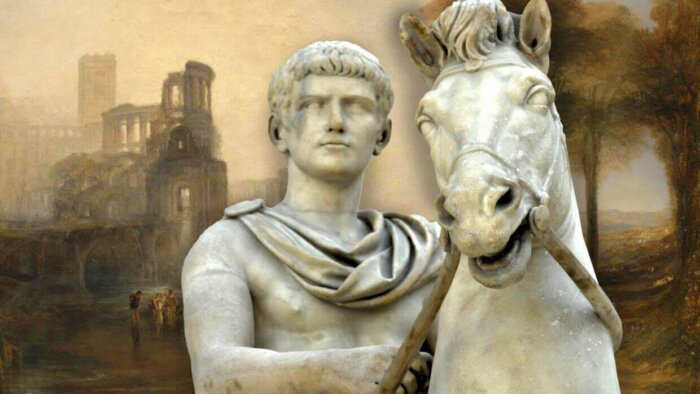
He was strongly inclined to assume the diadem, and change the form of government, from imperial to regal; but being told that he far exceeded the grandeur of kings and princes, he began to arrogate to himself a divine majesty. He ordered all the images of the gods, which were famous either for their beauty, or the veneration paid them, among which was that of Jupiter Olympius, to be brought from Greece, that he might take the heads off, and put on his own. ~ Suetonius – The Twelve Ceasars
What’s the rationale of antiquated ways,
That are extant and breathe without a use,
And inhibit these our finite days,
With dreams of the world’s infernal youth.
Where none had ventured, my feet trespassed,
I touched the flame of holy things,
And the wisdom of past ways amassed,
Were linear time’s burnt offerings.
Within these worldly things, our elevation,
Whilst the fable’s the veil of our fall,
And to eulogise the Lord of all creation,
Is to anoint myself King (or god) of all.
I caused fraught looks on umpteen faces,
Through mischievous deeds my hands hath worked,
When I pierced the veil of holy places,
I saw the black abyss and smirked.
I hath ridiculed ancestral ways,
And in fetters captured work’s defenders,
With no funds given to the ancient of days,
Though Kopeks to Ceasar only rendered.
Within this void a worldly leaven,
A promise of unplumbed joy and mirth,
When I disbelieve in day in heaven,
I’ll remould anew another earth.
I have urged my subjects to break free,
By tearing the sacred apart from them,
I sing the dirge to eternality
Like Caligula with Jerusalem.


Related Posts