Chernow’s Mark Twain: Portrait of a Stormy Artist
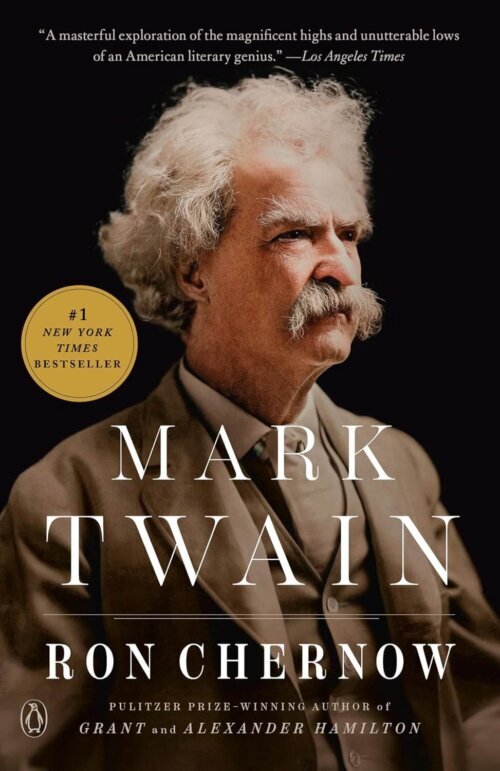
Ron Chernow’s Mark Twain is a substantial and intimist treatment of one of America’s preeminent storytellers. Utilizing extracts from numerous letters and contemporaneous accounts, Chernow weaves together an authoritative narrative that not only looks at the man’s biographical details but illustrates his evolving views on religion, politics, morality, race, human rights, and sexuality. The result is a work of literature as much as it is a work of detailed research—a literary biography in every sense of the term.
Chernow avoids the pitfalls common to previous generations of biographers, such as tangential commentary. He offers an adequate amount of background to historical obscurities and doesn’t drown his reader in an ocean of minutiae.
Just as a philosopher must make distinctions between propositions, a biographer must not deliberately cover up parts of his subject’s life just because they don’t fit a seamless or spotless narrative. The biographer wisely avoids making a caricature of his subject, that shortcoming of filing him under some character stereotype, thus making the writing of his life easier as it readily conforms to that of anyone else who has been assigned the same stereotype. Twain would likely be pleased at finding that he could not fit perfectly into the confines of a cramped ideological box.
Since childhood, Samuel Clemens (who would adopt the pseudonym Mark Twain in his writing career) forged his own way, tossing propriety aside and seeking all the attention he could get. Born in 1835 in Florida, MI, following his family’s recent move to the town, and later raised in Hannibal, Sam proved quite the character from an early age. Hannibal furnished the seeds of inspiration that would eventually sprout and give rise to the adventures of Tom, Huck, Jim, and other Mississippi fables.
As a boy, Sam sought recognition and charmed his peers, as well as his elders, with his humor. Chernow quotes Twain’s Autobiography, in which the revered American author states:
Celebrity is what a boy or a youth longs for more than for any other thing…He would be a clown in a circus; he would be a pirate; he would sell himself to Satan, in order to attract attention and be talked about and envied.
The scholar Andrew Delbanco, whose work is not referenced in the Chernow book, has shed light on the reasoning behind such language:
By 1850, Americans found themselves both liberated and imprisoned by the enormously compelling idea—once decried as pride—of the striving self. There could be no place for the old devil in this new world, whose religion was pride of the self.
Whether or not it preluded the rampant existentialism of the last century and of our own, this changing cultural tide which Delbanco highlights only displays the selfish vein that has long persisted in human nature. Sam embodied such pride, seldom seeking to squelch it, but so did his father, John Marshall Clemens.
The senior Clemens wanted to gain a respectable social status and settled on the role of local judge. While John suffered financial troubles aplenty, he never ceased seeking some fantastical remedy for them. He chased worldly greatness, which largely eluded him and, in time, came to rest on Sam. Nevertheless, his pining for recognition and riches rubbed off on his son.
Sam whetted his early appetite for stories with classics like Robinson Crusoe and The Arabian Nights, two books that also provided some of the earliest entertainment for an older writer, Charles Dickens. By twelve, Sam’s formal education left him thoroughly steeped in the Old and New Testaments, from which the future writer culled much fuel for satire.
Young Sam did not limit his thirst for adventure to the pages of novels. His blustery wanderlust blew him far and wide in search of wealth and fame. After serving as an assistant under his brother at a local newspaper, the budding storyteller plied his energies to a range of pursuits. He was trained as a steamboat pilot, a gig that harnessed his innate love for the Mississippi River and compensated well, both monetarily and in notoriety. He had a short-lived stint as a Confederate soldier. After that, he journeyed west to the Nevada Territory with his brother Orion, where Sam devoted himself to the extravagances of silver mining and writing news reports and satire for the Territorial Enterprise.
Twain’s travels both across his native soil and abroad exposed him to people and cultures vastly different from his white Southern upbringing, in which abolitionists were criminals and escaped slaves were hunted down and killed. While he was still young, Sam grew familiar with African Americans and grew particularly fond of their knack for storytelling. This isn’t to say there weren’t biases in Twain’s conception of and language for Black people, but his sensibilities continued to adapt based on his experiences and social influences. Later in his life, in Hartford, Twain and Harriet Beecher Stowe (author of Uncle Tom’s Cabin) were affable neighbors. He claimed Frederick Douglass as “a personal friend” and had a deep respect for him.
Chernow cites a plethora of other examples of Clemens’ camaraderie with and admiration for Black people, as well as his defense of their inherent dignity. The writer of this beefy biography will himself use the phrase “Blacks” in speaking of African Americans. Though it’s not used with demeaning intent, the phrase “Blacks” is impersonal and, some could argue, even dehumanizing. In contrast, a phrase such as “Black people” might find a sounder footing and a more pleasant reception.
In contrast with his (at the time) progressive views on African Americans, young Sam “reserved special bile for Native Americans,” Chernow observes. In this respect, Twain’s racism was the inverse of that of Thomas Jefferson, who had belittled Black people on account of the color of their skin but found certain admirable qualities in Native Americans. In the twilight of his life, Chernow explains, Twain came to view the indigenous peoples of his home country “much more sympathetically.”
In 1867, Mark Twain embarked on what was branded a religious pilgrimage aboard the seagoing steamer Quaker City, which was ultimately bound for the Holy Land. The trip would trigger other racist comments and no small outpouring of negativity. Along the way, Twain had the opportunity to visit Tangier in Morocco, Paris in France, many grand cities in Italy, and Constantinople in modern-day Turkey.
The future author of Tom Sawyer said of Tangier that “the true spirit of it can never be found in any book save the Arabian Nights.” In a letter to his family, he said, “This is the infernalest [sic] hive of infernally costumed barbarians I have ever come across yet.” His disgust did not end there. Chernow regularly appeals to Twain’s notebook from which he can glean the author’s inly thoughts, and his readers then share in that experience. On this occasion, Chernow informs us that, in his notebook, Twain “disgorged a farrago of slighting racial comments on the dark-skinned Arabs and Africans that he had seen and their supposedly ugly women.”
When he and the other passengers of the Quaker City arrived in the Holy Land and explored the main attractions, Twain was left underwhelmed. It should be noted that not all Westerners of Clemens’ era shared his dreary perspectives on Arab and African people and their native lands. The Frenchman Charles de Foucauld (1858-1916) had a resume similar to Twain’s: He had served in the military, he was well-read and well-traveled, and he was a man of letters. (He was the boots-on-the-ground researcher and author of Reconnaissance au Maroc, a work examining the geography of Morocco.) Yet, Charles detected a rugged beauty in the lands of North Africa and the Middle East, and he found the faith of its people inspiring, so much so that he eventually lived as a missionary among the Tuareg.
The heart of these two men’s worldviews might be summed up in their wildly different views on Christ’s hidden life. Pulling from Sam’s own reflections, Chernow relates:
[Twain] experienced a…letdown in Nazareth, with its “mud hovels” and “fantastic Arabs & dirty children,” and moaned, “Imagine Christ’s 30 years of life in the slow village of Nazareth.”
Twain could not bear the thought of simple work and anonymity. Compare this to Charles de Foucauld’s ardent desire to enter into the poverty and humility of Christ. At one point in his faith journey, Foucauld said that what he desired was
A life in accord with Christ’s, one in which I can share his poverty, his humble work, his hiding away in obscurity in Nazareth. His abjection.
These two anecdotes perfectly illustrate how similar experiences can awaken opposite reactions in different people. (Those interested in learning more about Foucauld will appreciate the moving biography Charles de Foucauld by Jean-Jacques Antier.) Nevertheless, for Twain’s part, he failed to shed much of his racial bias (whether for those abroad or for certain ethnic groups in his home country) in his early life. Even later, he struggled with slurs and, at times, seemed to make excuses for Southerners who, goaded on by herd instincts, remained complicit in the lynching of African Americans.
On the subject of Twain’s occasionally racist leanings, Chernow wades into the choppy waters of book banning, a subset of cancel culture targeting everything from Plato’s philosophy to the sexualized fiction of modernity, and an all-around hot-button topic.
Many schools have banned Mark Twain’s Huck Finn due to its open use of the N-word and its disparaging depiction of Black characters, particularly the prominent figure of Jim. Chernow presents both the pro-ban and anti-ban positions, which run a wide gamut of literary assessments—from valuable yet insensitive to grossly pejorative to an unsurpassable work of great American literature.
As his own book is meant for a more mature audience, Chernow seems to have no qualms about openly using the N-word in quotations, rather than providing an edited, sanitized version that would convey identical meaning. In this as in other subject matter, the biography presents a raw portrait of humanity and an unflinching gaze upon a flawed, if brilliant and prolific, human being.
The years following the Quaker City exploits held mounting success for Twain in publishing his travelogues and novels. He struggled to stay still. Some thought only marriage would be able to tie Twain down. Then Twain met Olivia Langdon and found himself spellbound by this well-read woman of seemingly feeble health but hardened will. In time, they courted, wedded, and had four children. Nevertheless, when money troubles arose, Twain would take to public speaking engagements and tours, which kept him on his feet and away from his family for lengthy intervals.
Providing guidance and helpful feedback on his writing as well as trying to instill in her husband proper etiquette, “Livy” tried to edit his manners as much as his manuscripts. Some critics look unfavorably on the influence that Twain’s wife held over his writing; they claim that her puritanical edits and overall taste in literature stifled the author’s satire. The consensus is that Livy urged her spouse to write more works dealing with medieval subjects, and the critics deem a few of these works inferior to the author’s potential. Chernow comes to Livy’s defense somewhat, noting the value added by her editing. But he sides with the literary critics who think novels like The Prince and the Pauper and Joan of Arc detracted from the main focus and true genius of one of America’s great writers.
Yet, anyone who has read Joan of Arc knows it to be brimming with just as much humor and criticism of authority as any other Twain classic. Clemens’ interest in things medieval was by no means a rare development, especially considering the similar interests shared by his fellow literati. Robert Louis Stevenson and Andrew Lang, both of whom Chernow notes had encounters or correspondence with Twain, had their own forays into medieval-themed literature. Stevenson’s The Black Arrow (which makes brief mention of Joan) was serialized in the early 1880s and published as a single-volume novel in 1888. Lang, an ardent lover of folklore (including the miraculous happenings recounted in hagiographies), wrote his own book about the “Maid of Orléans,” which was published in 1906 and was much shorter and less creative than Twain’s novelization.
Livy and Sam’s first and forever youngest child, Langdon, was the only boy; like his father, he was born prematurely. Langdon died at 19 months following a trip in inclement weather. Twain blamed himself for his little boy’s death. Livy and Sam also had three girls. The famous author would live through the deaths of two of his daughters and of his wife. With this in mind, it’s easy to see why Twain grew sour to the notion of a benevolent God. But even before the tragedies of later years, the American writer grew increasingly pessimistic. Chernow reconstructs a broad spectrum of the family’s dynamics, examining the personalities of Twain’s daughters and the influence their father and their upbringing had upon them.
In earlier, cheerier times, the Clemens clan settled in Hartford, CT, where Twain had designed the family home. Evocative of the Victorian style in its structure, the house’s interior was beautified by arabesque patterns and various Eastern influences. The family lived happily here until a self-imposed exile brought on by financial straits.
Twain’s saga is a legacy of publishing success haunted by bitterness in his personal life and business endeavors. Besides personal and family-related health crises and accompanying fatalities, Twain was beset with another illness—hubris—which led him to believe that he was quite business savvy, had an eye for genius inventions and lucrative investments, and was beyond capable of starting his own publishing house. None of which proved realistic.
On Twain’s mismanaged investments, Chernow (with his background in financial reporting) makes a well-informed commentator. While Chernow doesn’t often delve into his personal opinions and put his own spin on events in this biography, he does occasionally step out of his area of expertise, his painstaking research notwithstanding. Such is the case when he strives to interpret some of Twain’s dreams.
One particular dream that the biographer gravitates to features a young Black woman flirting with Sam. Chernow finds the scene that Twain relates to be laden with amorous allusions. While the story is undoubtedly of a sexual nature, Chernow seems to read farther into than Twain himself would have, making a veritable mountain out of the molehill that was “a pale brown tint of a stain.”
That dreams have meaning, few will deny. That Chernow can accurately determine the meaning of another man’s dreams is another matter entirely. When Twain wasn’t dreaming through slumber, his daytime imagination ran wild with visions of grandeur and riches.
After starting his publishing firm, Twain brought his nephew Charley Webster onboard, assigning him the task of overseeing the day-to-day business affairs of what became known as “Charles L. Webster and Company.” Meanwhile, Twain maintained high-profile friendships, and Ulysses S. Grant was a most admirable comrade. Around this time, the aged soldier had lent “his name and prestige to an investment firm known as Grant and Ward,” Chernow tells us.
In 1881, Clemens prompted Grant to write down his memoirs, a process in which the latter wanted to know the former’s opinion regarding his own literary powers. Twain obliged with affirmation. Grant considered this writing project more seriously after the former president found himself a victim of an elaborate Ponzi scheme perpetrated by his business partner, Ferdinand Ward, a move that left the Grant family nearly bankrupt. It seemed as though Grant had as much luck with business as Clemens would. Grant was dying of cancer, and the welfare of his family, now thrust into a dire situation with lacking funds, weighed heavily upon him. Twain saw an opportunity.
He got Grant to decline a contract for his memoirs from Century Magazine and succeeded in having his friend sign on to produce the two-volume work for Charles L. Webster and Company. Making good on his commitment, Twain published Grant’s memoirs, which released a healthy flow of royalties to the family that the Commander-in-Chief left behind. (For a great read that approaches this waning time of his life from Grant’s perspective, I recommend The Captain Departs by Thomas M. Pitkin.) Ironically, this proved the most successful book put out by Twain’s upstart publishing house. The subsequent memoirs by other gray-haired Civil War generals, the collected folklore of the Sandwich Islands by “his Hawaiian Majesty Kalakaua,” and an authorized biography of Pope Leo XIII all proved to be commercial flops.
As the publishing business turned south, Twain’s temper flared, piling the blame on Charley. The failure of the venture had more to do with the ineptitude and grandiose imaginings of sales on the part of its founder than with the shortcomings of his nephew. Still, Twain convinced himself that the fault lay with Webster, whom he grew to despise, going so far as to avoid attending his funeral and speaking ill of him after his death.
This was characteristic of Twain, who seldom let go of a grudge. Whenever he felt slighted by his publishers, beneficiaries, or even his friends, he tended to harbor nothing but umbrage toward them. As a result, his quill spewed venom, and his words stung. His religious and sociopolitical critiques, clothed in the approvable garb of fiction, were no less potent.
Though his beliefs and his actions often conflicted, Twain’s character could always be described as bold and loud. If we were to offer some similes on this iconic American scribe, they are as follows: Twain smoked cigars the way Humphrey Bogart did cigarettes. He could let loose a dark, morbid flavor of humor akin to Dennis Leary’s. And he was in the habit of suing everybody around him, much like Donald Trump.
If we can compare Twain, or certain facets of his character, to those of modern people, then there is reason to expect that this author’s struggles—his egomania, anger, unwillingness to forgive himself or others, and so on—are perennial aspects of our fallen human nature. Each of us might not reach Twain’s fever pitch in attitude, but many of us hold on to petty grievances. Examining Clemens in this tome from Chernow is like looking at a microcosm of the human condition under a microscope: detailed and laser-focused.
A work of literature reflects the mental state of the one who wrote it. The readers of such a work, in turn, tend to use it as a kind of mirror. The audience of a work of fiction, for example, is apt to relate to some character in the story, someone who embodies their struggles or else their ideals. This is no less the case for a work of biography. For the historians wish to make history relevant once more by saying that it should be remembered and studied if we are to avoid repeating the same flaws as our forebears, and their point is valid.
Chernow’s Mark Twain is not only a portrait of a stormy artist; it is a mirror displaying a convoluted image of a hypocritical figure: the self. It can leader the thoughtful reader to reflect: When life feels cruel, how do I react? How do I react to pain and loss? In the limited amount of time I’m given to walk this earth, is focusing predominantly on my salf-aggrandizing career and financial investments—to the detriment of the time spent with family and friends—the path to true happiness?
Though at times considered heterodox, hyperbolic, and hypocritical (and rightfully so), Twain nevertheless distilled some nuggets of genuine wisdom primarily through satire and, later on, more serious non-fiction writing.
One such tidbit came from his observation that postlapsarian man (that is, humanity as Twain witnessed in his daily interactions) more often returned goodwill with ingratitude than with thanks. Twain also weighed in on a slew of political issues. He was concerned about the willingness of members to blindly follow the dictums of their particular party at the expense of the truth. Our modern polarized culture suffers from a similar mindset that doesn’t want to face uncomfortable truths. The danger of the herd mentality losing touch with reality is alluded to in a famous quote of Twain’s that goes, “Whenever you find yourself on the side of the majority, it is time to reform (or pause and reflect).” Too easily, individuals get swept up by the momentum of a crowd, an attribute Twain feared was a key ingredient in the mob lynchings of African Americans that took place in the South in the decades following the Civil War.
As he aged, Clemens began to let go of his fear of public opinion, feeling obliged to speak his mind freely. The author had always been fiery in one way or another, but now he didn’t hold back any of the fire’s heat. He resented Communism just as he loathed the power-hungry mindset that gave rise to British colonialism and American expansionism. Initially a supporter of the Spanish-American War, the author grew disgusted as he learned that the U.S. was involved for the sake of its own interests instead of the well-being of Cuba. Reflecting on other events of his day, he denounced missionaries who went abroad to places like China, accusing them of ulterior motives (which very well might have been true in some cases). Such was Twain’s distaste for the Christian religion that he helped pay college tuition for a promising young Black student up until the man discerned that he wanted to study theology and pursue ministerial work. The famed author did not wish to fund the pupil any further, expressing disappointment with what this young man hoped to do with his life.
In his own lifetime, Twain famously defied institutions, traditional beliefs, and the sounder science behind legitimate medicine. He chased after the pot of gold by investing in zany inventions and pursuing get-rich-quick schemes. In the end, his writing paid off—both monetarily and in service to the goal of personal fame. Even after death, Twain was not finished speaking his mind. The initial volume in the complete and unabridged edition of his Autobiography was only published in 2010, the centennial of his death.
The admiring reader of Twain will appreciate the Homeric tribute Chernow has produced on the inner thoughts and idiosyncrasies of Samuel Langhorne Clemens. Those wishing to dive still further into the author’s personal story may appreciate the three-volume Autobiography, the Mark Twain Papers and Project, and even the virtual tour of the Clemens home in Hartford on the official Mark Twain House & Museum website.
Mark Twain
By Ron Chernow
New York: Penguin Books, 2026; 1200pp


Related Posts