Coming to Love Two Great Books
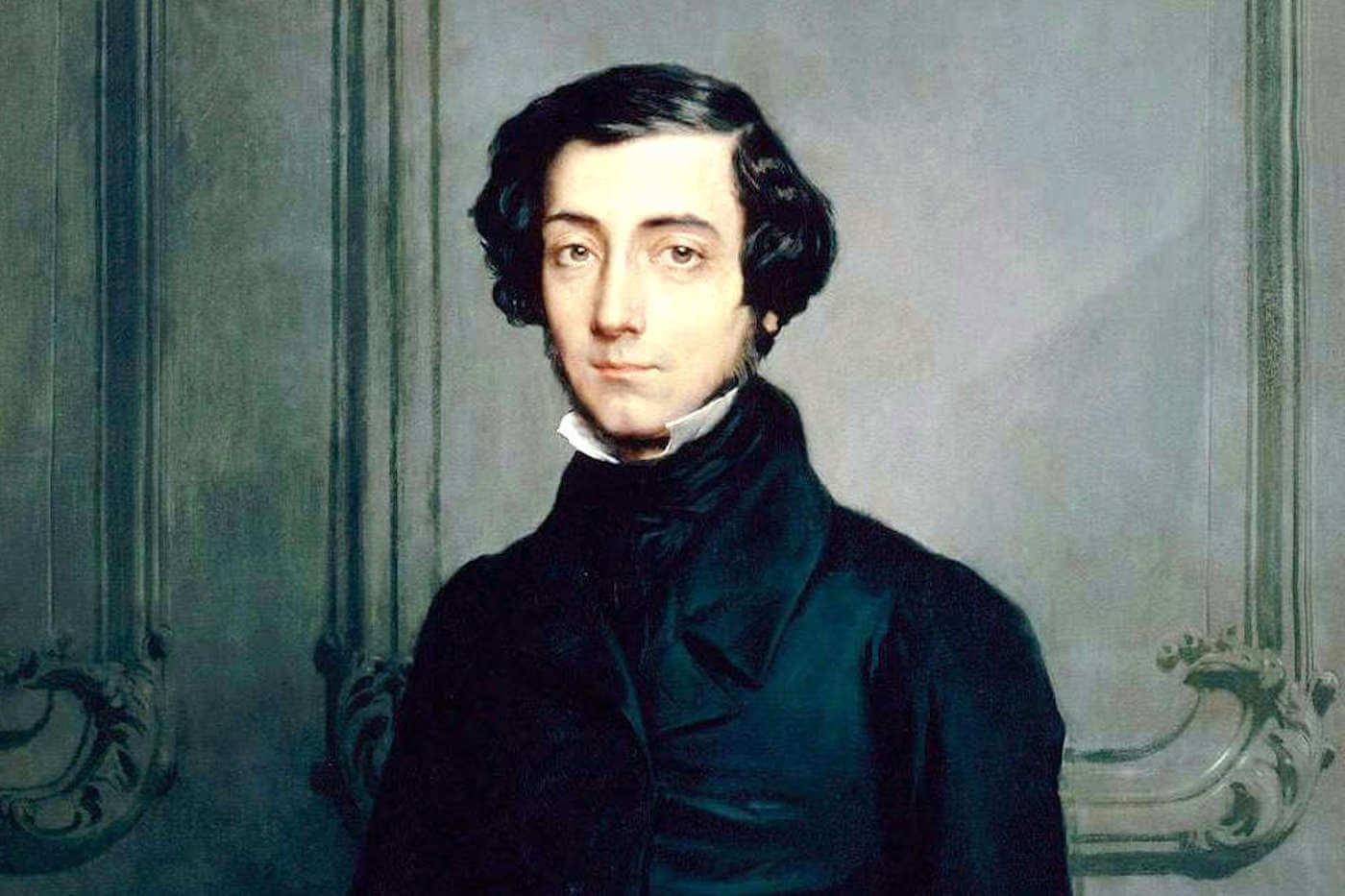
It began on Staten Island, as few great stories do. I was nineteen years old, and on my first summer vacation from college. Some lazy day in June my mother had taken me along to the mall. We parted ways, and I shuffled through Barnes & Noble. I knew what I wanted to find: Tocqueville’s Democracy in America—I had heard about the book from an unusually excellent high school history teacher and had intended to canvass it at some point in the undefined future. Well, why wasn’t now the time? I found it low on some dusty paperback shelf and picked it up. Sitting down in a chair near a window, I started with the introduction.
And I was instantaneously entranced. No other book I had ever read in my life up to that point had hit my mind so forcefully and so quickly. All of human history explained in the first pages—the march of democracy and the advance of equality. The Middle Ages and the revolutions and modernity. All moving toward a “Providential fact.” The spell was broken, the author said, but in telling me that a new one was placed. That was it. This was the most spellbinding narrative, the most incisive understanding of my ordinary middle-class life and of my normal, boring worldview I had ever heard. This was the best professor I’d ever had. The person who wrote this knew me and hundreds of millions of other people already. He might as well have grown up with me. I simply couldn’t believe a book could say this. How could a dead writer know our souls and our entire political predicament.
It was providential. It couldn’t be stopped. It could only be directed toward good or bad ends. Those aristocrats and reactionary Catholics who fought it were hopeless. The Marxists were wrong too, because this was an idea first and only later a material reality. The talk of spells being broken. The talk of seeing differently to see further. The talk of a great choice we still must make. What’s more, this author didn’t just dissect and dismantle—he cared and wanted to help, but also spoke for something so much more magnificent than anything I had considered up until then. In ten minutes with the book, the remnants of my vapid teenage amour-propre evaporated. This was authentic greatness.
When I finished the introduction, I got up from my chair, slightly dizzied, paid for the item, and walked back out into the sunlight. The rest of that otherwise obscure summer was spent with the masterwork, reading it during the slow hours at the law firm I was meant to be interning at and thinking about it instead of the law school I had told myself I was preparing for, reading it on the sagging basement couch of my parents’ rowhouse, on the hard plastic benches of empty nighttime subway trains, at midday on a city beach in the presence of the Atlantic Ocean, our gulf against the old world. It was the most meticulously I had ever read anything in my life up until that point. Every sentence was full of meaning. I memorized, without even meaning to, entire portions of certain chapters. I committed certain phrases and passages to memory. I could not help it. The book was shaping me.
In recent years, there has arisen something of an exhausted dismissal of Tocqueville, especially by cutting-edge post-liberal writers. Isn’t he played out? Deployed in so many pro forma statements, whether issued by a senator defending the latest advance in equity or by or a think tank trying to cover up its corporate donors’ intentions by invoking hazy memories of ‘civil society’? Indeed, there are perhaps too many books (and book reports) citing Tocqueville “in support of the same quaint clichés.” But that a writer’s words have been put on the intellectual equivalent of bumper stickers (or sometimes on actual bumper stickers themselves) may just as well be an indication that the thinker is so important that vulgarization is almost a kind of tribute to their indispensable place. Think of the overuses, dangerous as well as trite, to which Nietzsche’s words have been put. Do these tell us that he is passé—or that he is so relevant and insightful that even half-attentive, agenda-driven types feel compelled to toss in a line or two, to pay vice’s tribute to virtue?
I still look back today at that edition of Tocqueville. That cheap Bantam edition sits on my bookshelf, and sometimes, when no one is looking, I still dip into it. The Reeve translation? Seriously? Haha. Don’t you know he gets so many things wrong? Don’t you know other scholars rendered it better? (Yes, I have multiple translations now.) But it was the one I read first. As incorrect as it is, that one—that language—that cheap paperback from a Barnes & Noble on Staten Island—was the one that I encountered before the sophistication came in. It can’t be replaced. It was how it felt to be 19. (That feeling can and should, of course, be refined and enlarged.)
To change the subject—and to speak of supposedly mundane books—for a long time I found the Federalist so common as to be unworthy of notice. My views were unconsciously more or less those expressed by Clinton Rossiter, who, in commenting on the shortcomings of the Federalist in his 1961 introduction to the papers, wrote:
As a piece of very special pleading—some have called it a lawyer’s brief—it says the same thing over and over in a half dozen ways, tiptoes delicately around many of the hard criticisms directed against the Constitution and slogs ponderously through some of the silliest, and makes at least a few arguments and appeals which its authors must have had trouble justifying to their own consciences.
In graduate school I went through a period of finding it even worse than that: blinkered and downright dull. All it wanted to talk about, it seemed, was politics in the narrowest and least-imaginative sense of that term—the formal institutional setup of the federal government. But those issues aren’t the most interesting questions in human life, or even in politics. It seemed to me that Plato, Augustine, Rousseau, and Nietzsche all talked about much more exciting topics. I had a line, ready to hand, that I dropped on anyone who dared praise its wisdom: “If aliens landed on earth,” I’d ask, “and wanted to know what life as an American actually looked like, would the Federalist tell them anything at all?” It was a pretty good line, especially because it pointed implicitly back toward my earlier love, Tocqueville, as the one and only explicator of the American soul. (Though in retrospect I suppose invoking aliens as potential supporters of your cause is not the sign of strength that I had imagined it to be.)
It should be said that the Federalist is not redeemed from these charges of dullness by some of its would-be defenders, especially more lawyerly types. It is, unfortunately, easy to be oblivious to the bigger philosophical and moral concerns in the Federalist, and to indeed treat it as a legal textbook, as if its sole value was in offering an infallible “guide” to interpreting the Constitution. Some well-meaning originalists may be guilty of describing it in that way, though its authors nowhere claim their writings offer the single hermeneutical key to interpreting the document. Yet even where it does explicate the meaning of specific passages of the Constitution (and this it does much more infrequently than one might think) it hardly “tells” a reader what to think. It invites them to reflection.
That charge of dullness also simply isn’t true. Like all great books—if we’re going to use that designation—the Federalist is actually concerned with everything important in human life. It has something to say about epistemology (how we know things), about human nature (quite a lot to say about that, in fact), about virtue and the scale of the various virtues and the ranking of regimes according to soul types, about literature and poetry (even if it is broadly distrustful of the imagination, its authors simply can’t avoid the topic), about faith and religion and God (really), about history ancient and modern, about biology, linguistics, zoology, psychology, and so much more. I found that Publius knew Shakespeare, Milton, Homer, and many other authors better than I knew them. Like any reliable guide, he pointed me beyond himself.
It also deals, as everyone must, with Socrates (No. 55). It explicitly criticizes Plato (No. 49) and implicitly criticizes Rousseau (No. 10). It even complicates (ahead of time) Nietzschean notions about what power means and what makes a great-souled “enlightened statesman” and in fact goes further than the yet-unborn German to distinguish false and authentic greatness. So—in a way—the Federalist does understand and anticipate and answer my criticisms. It does admit that those thinkers are “more interesting,” and it does what it can in the space it has to engage them. It is not, indeed, a work that can be fully appreciated apart from a broader grounding in Western philosophy and political thought. In fact, it might even be said that the Federalist, by virtue of its character as a work of advocacy, is perhaps less “complete” than certain other great books. Perhaps no text is ever entirely self-contained, but the Federalist in particular practically demands a reading of the Anti-Federalists, the individual writings of the framers, and the great founding-era documents, not to mention an acquaintance with a deeper background stretching to antiquity.
But how did I come to see what was really there? How did I find a different path to loving a book—one that was not “love at first read?” Partly it was through a method almost completely opposite to the way in which I found Tocqueville. Tocqueville was instant. But I came to love the Federalist by living with it so long I couldn’t imagine life without it. Lest this sound like a hostage situation or an unhappy marriage that both parties remain in for sheer inertia, the benefit of being forced to read, re-read, and re-re-read the book was that I came to an awareness of both my own inadequacies and of the subtle offerings of the text. It wasn’t the text that was the problem—I had been glazing lazily over passages that seemed to hold little meaning. I had been treating words as rough synonyms that actually denoted subtly different concepts and which had been placed with care and precision by the author. I had foolishly thought that the last lecture I’d heard that mentioned the book was the final word on it. When I re-read it for the fourth or fifth time, I finally became un-exhausted with the shades of meaning contained there. And of course there are eighty-five papers, not just the handful usually assigned in an introductory course, and they move in patterns, if not in precise sequence.
Another way of coming to love it was reading it cover-to-cover, by knowing the text, in full, from beginning to end. Reading the work cover-to-cover, exploring every nook and cranny, luxuriating in the discussion of the District of Columbia in No. 35 or the militia in No. 29 or David Hume in No. 85 or the mother tongue in No. 2 or the imagery of a wanderer in an enchanted castle in No. 31 or an Ottoman emperor’s harem in No. 67 were moments where the writing took on rich shades of color, where it surprised and delighted and challenged a reader who’d thought he’d had a good-enough handle on the “overarching argument” of the work. Sure, Nos. 10 and 51 are the papers everyone reads and knows (although, do they?). I thought I knew them and became wary of hearing about the supposed problem of “faction.” It didn’t seem particularly relevant in 2012, that year of the dullest presidential election in recent American history, and when I had read a grand total of four papers as a control group. (“Faction,” of course, seems far more relevant in 2024, and students today need little convincing that it is a problem). Here, indeed, was another lesson: the importance of taking a kind of serene nonchalance toward whatever was thought to be “cutting-edge.” What if journalists think something isn’t relevant in a particular time and place? They read great books to collect flowers, not fruits. If it contains an important idea and a great insight, it will be relevant again. It will be patiently waiting for those who came to know it when it was out of style.
These aren’t the only two great books I’ve come to love. But the wild variation in the way I came to them is still striking. One was through long, plodding, tiresome devotion that was even, at times, against my will. The other was instantaneous. Nor are these the only two ways of coming to love great books. There must be, I am sure, many more. What about affection initiated entirely by a class or seminar? Does that happen? There might also be ways of falling out of love with books. I have yet to experience that, but it might be a possibility, if one comes to realize, on one’s own part, a pervading naivety and an amateurish enthusiasm that is not rewarded by the author.
But these were my ways of knowing. The value lies not in the fact that it is “my” experience or “my” truth but in precisely the opposite point—that what is real in a book is unchanging and waiting for anyone who seeks it out—and that the seeking can take many and diverse forms.


Related Posts