The Cross of Aeneas: Virgil’s Aeneid as a Christian Epic
It is not uncommon knowledge that the great Christian thinker C.S. Lewis owed a great debt to the ancient Roman poet Virgil, whose long poem the Aeneid Lewis considered a “Christian epic.” Indeed, the Aeneid played an important role in Lewis’ conversion to Christianity. Although Lewis is one of the more well-known modern Christian writers to pay tribute to Virgil, he is far from being the first. For centuries, the Aeneid has rested close to the heart of the Christian world; for centuries, Virgil’s moral imagination has been drawing people closer to God.
For those unfamiliar with Virgil’s work, this may be surprising to learn. After all, Virgil was a pagan who lived in a pagan world and wrote for a pagan audience less than fifty years before the birth of Christ. What could he possibly have to say about the Christian life? What can a pagan poet teach the illumined Christian about virtue?
But the further that the Christian reader delves into the Aeneid with an open mind, the less mysterious he will find the connection between Virgil’s imagination and the Christian worldview. This is because Virgil’s great epic poem introduces the ancient world to a new type of hero: a hero who understands that the true wages of heroism are not glory, but suffering—and through suffering, life and glory again.
Life and Obscurity, Death and Glory
To fully grasp the reasons why Virgil’s hero is a role model for Christian virtue, we must first examine the literary context that lies behind the Aeneid. Before we can understand Virgil, we must journey back eight hundred years to his great Greek predecessor: the blind poet Homer.
When looking for the most prominent themes of Homer’s famous epic poem, the Iliad, we might note that Homer has a lot to say about death. Even the casual reader of the Iliad will notice that the poem lingers on the deaths of minor characters, catalogues the fatal wounds of Greeks and Trojans alike with almost loving attention to detail, and focuses its narrative around the choice of its protagonist, Achilles, between life and death. Will Achilles live a long life and die forgotten, or live a brief but glorious life? Achilles chooses death and glory; he decides that he wants his deeds to be remembered forever. Ironically, the Iliad’s very existence is proof of his choice. We still tell Achilles’ story.
At the risk of oversimplification, we might boil down the portrayal of life and death in the ancient Greek mythology to the following thesis: Life is good—full of poetry and glory and adventure. But death is better, the pathway to immortality for those who have truly achieved greatness in life. It is only in contrast to this philosophy, to the mindset of the Homeric heroes, that we begin to understand just how unusual Virgil’s epic hero is.
Imagine that you are the poet Virgil, living in ancient Rome roughly thirty years before the birth of Christ. The Roman Republic has fallen and Caesar Augustus, the new emperor, has ushered in an empire to take its place. Rome has become more powerful than anyone would have expected of the tiny hamlet full of criminal refugees that Romulus founded over 700 years ago, and yet you have seen unimaginable horrors in your lifetime. You have seen civil war, bloody proscription lists, brothers fighting brothers and fathers turning on their sons. The peace established by Augustus is a relief, but it feels evanescent. Are the horrors really over? Does Rome deserve peace anyway?
And then the emperor asks you to write a poem.
The task must feel daunting. For starters, everyone knows that the Latin language did not develop for poetry, but for shouting commands in battle. The Romans have largely left both the writing and the storytelling to the Greeks, whom they recognize as artistically superior. To write an epic in the style of Homer’s Iliad and Odyssey, to craft a poem that would tell the Roman story in the Romans’ own language, is a groundbreaking concept. The Romans are not storytellers. The Romans are not artists. The Romans are killers, conquerors, descended from the man who killed his own brother on the same spot where he built Rome’s first walls.
The ancient Romans have their heroes, of course— early Republican legends of Roman citizens who excelled in duty and virtue. But somewhere along the way, those stories have been swallowed in the power struggles, the ambitious leaders and civil wars. Besides, Rome is not the tiny republic it once was, but a growing empire. In the chaos and bloodshed of their newfound power, where will the Romans find their heroes now?
It is to this world that Virgil introduces the first Roman epic hero: Aeneas, a refugee who escapes the burning city of Troy and, fato profugus (“a fugitive by fate”), follows the commands of the gods on his voyage to found a new city in a strange land that he has never seen.
A Reluctant Hero
The first book of the Aeneid sets the stage for the rest of the poem. The spiteful goddess Juno, who has various reasons to hate the Trojan people, is hunting desperately for ways to stop Aeneas from reaching his destined homeland in Italy. She enlists the help of a minor god, Aeolus, in releasing the winds to stir up a storm that will shipwreck Aeneas’ fleet. As we zoom in on Aeneas’ ship through the rushing winds and driving rain, for the first time, we see our hero—a devastated man lifting his open palms to the sky and crying out to the heavens:
Three, four times blest, my comrades
lucky to die beneath the soaring walls of Troy—
before their parents’ eyes! If only I’d gone down
under your right hand—Diomedes, strongest Greek afield—
and poured out my life on the battlegrounds of Troy!
The astute reader may find these first words of Aeneas surprising—as he should. After all, our hero expresses a death wish that, from a modern perspective, is not particularly heroic. If Aeneas could have chosen his own fate, he would not be journeying toward a land he has never seen to build a city he does not want. If Aeneas could have taken his destiny into his own hands, he would have died along with his comrades at Troy.
As we have seen, this is a fundamentally Homeric sentiment. To live is good, but to die in glory is better. But Virgil frequently describes Aeneas by the epithet pius, a Latin word which is sometimes mistranslated as “pious,” but more accurately means “dutiful.” Characterized by his duty, Aeneas is committed to following the commands of the gods, even when his personal desires conflict with his divine destiny. Our hero is truly fato profugus—driven not by his own will, but by the will of the gods.
Already, we begin to see a difference between the Homeric heroes and Virgil’s protagonist. Achilles and Odysseus both have relatively simple goals, even if those goals are difficult to achieve. Their destinies and duties do not tend to conflict fundamentally with their personal desires. In contrast, Aeneas is forced to struggle with the tension between what he wants—to have died at Troy, to settle on some quiet island, to sink into blissful nothingness—and what the gods require of him. He is pius, but not because he wants to be. He is dutiful in spite of his desires.
This conflict becomes even clearer when we, the readers, learn about what Aeneas has been doing in the last seven years since he and his companions fled from the burning city of Troy. Despite knowing that his destiny is to establish a homeland in Italy, Aeneas has tried to settle on practically every island in the Mediterranean. Each time that Aeneas attempts to settle in a land that is not Hesperia, the land of the west, the gods visit and force him to set sail once again. A reluctant hero, Aeneas does everything he can to escape his destiny. He has to be reminded constantly of the divine will that has decreed his future. Even so, he sees that future only through a glass darkly. Against his own will, he submits continually to a higher will.
And although this is only the beginning of Aeneas’ story, we may note something else in this character that we do not find among the Homeric heroes. For Aeneas, the burden of heroism is more palpable than its rewards. In the imagination of Virgil, being a hero is not primarily a matter of slaying enemies on the battlefield, performing glorious deeds, or conquering kingdoms—although in time, Aeneas will do all of these things. In that first moment when we see Aeneas crying out for death in the rain, we begin to understand that heroism requires, more than anything, the dull ache of putting one foot in front of the other, even while longing for rest. In Virgil’s epic landscape, to be a hero means, above all else, to suffer.
The Cross of Living
In the second book of the Aeneid, Virgil offers us a closer glimpse at the cataclysmic event that set the great sufferings of Aeneas’ life into motion. Prompted by Queen Dido of Carthage, Aeneas tells the story of the fall of Troy in his own words. He describes the devastating ruin of his homeland, the near total genocide of his people. Hearing Aeneas tell of the brutal destruction he experienced, we begin to understand why he is such a reluctant hero. In a single night, Aeneas endured enough pain for a lifetime—more pain, perhaps, than Achilles and Odysseus combined.
According to Aeneas, when he first learned that the Greeks had overtaken Troy, his first response was to take up his arms and rush into battle with the expectation of meeting a glorious death. This is a deeply Homeric response. When faced with the doom of one’s people, the only honorable response is to die with them. That is what Aeneas wants, and that is what he sets out to do.
But as he sets out to meet his death, he encounters his mother—Venus, the Roman goddess of love. Venus orders Aeneas to leave the battle, to abandon the Trojans who are defending their city against the Greeks, and return home. She tells him to gather together his father, his son, his wife, and his household gods, and escape the burning city.
With characteristic obedience, Aeneas goes home—and immediately encounters even more obstacles. His father Anchises does not want to escape. He insists that if the gods wanted him to survive, they would not have allowed his home to be destroyed. Moved by his father’s anguish, Aeneas nearly gives up his resolve to follow his mother’s orders. He longs to take up his arms again, to run back out into the fray and die in the streets of Troy. He nearly does.
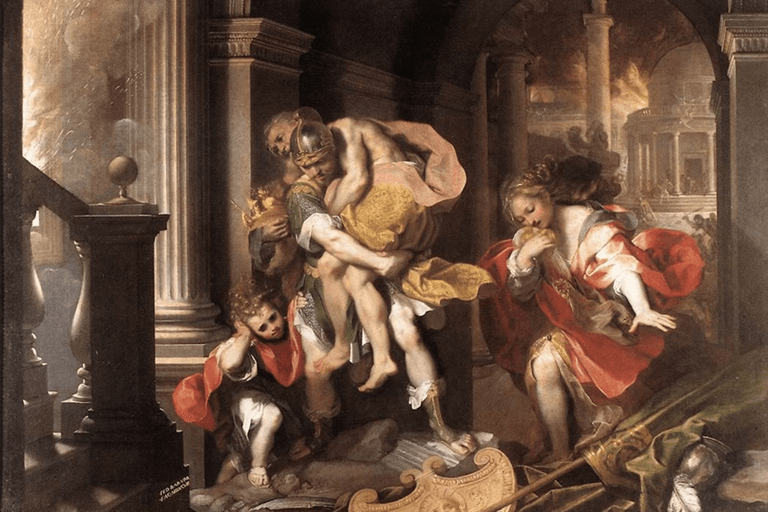
But Jupiter, the king of the gods, sends two dramatic signs. First, a tongue of fire licks the air above Aeneas’ young son’s head, but without burning him. Second, a shooting star lights the sky above them. Strengthened by these signs of divine ordinance, Aeneas sets aside his desire to die. He lifts his father up onto his back and says:
So come, dear father, climb up onto my shoulders!
I will carry you on my back. This labor of love
will never wear me down. Whatever falls to us now,
we both will share one peril, one path to safety.
It is no accident that at the very moment when Aeneas chooses to live, he must simultaneously shoulder a burden. He carries his father, like a cross, out of the fallen city toward an unknown land that the gods have promised him. For the Homeric hero, to die is the greatest glory. But for Virgil’s hero, the hardest thing of all is to live—to lay aside one’s own desires, to take up one’s cross, to set one’s eyes on a distant horizon, and to bear the impossible burden of life itself.
And Aeneas’ heroism is, unmistakably, a burden. From the moment he takes the weight of Anchises onto his back, Aeneas embarks on a journey will cause him great suffering. He will watch his father die. He will fall in love with a woman, and then be forced to abandon her. He will outlive many of his friends. He will encounter storms and monsters and cruel gods. Like Christ, he will even descend into hell.
But in the end, he will arrive at the homeland he was always destined for, and he will not be the same reluctant hero that he was at the beginning of his journey. By the end of the poem, Aeneas’ desires will have fully conformed with the will of the divine. He will have carried his conquered culture, the religion of his homeland, to a new country where the kingdom of Troy can rise again. By his suffering, Aeneas will have saved his people.
And if that is not a Christian story, then what is?


Related Posts