Dido and Aeneas in the Shadow of Plato and Pythagoras in Virgil’s Aeneid
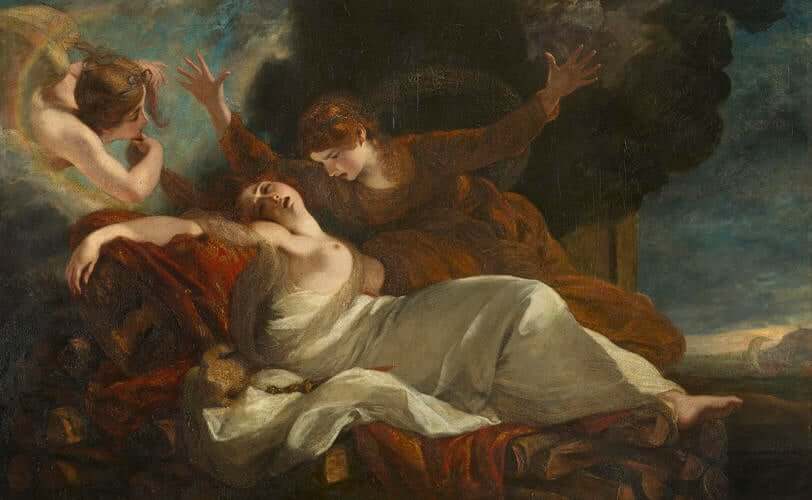
Virgil goes to great lengths to describe Queen Dido of Carthage as “tragic.” When we are first introduced to her in the epic, her sad backstory is related to the reader – after having married Sychaeus, Pygmalion (her own brother) slaughters him on the altar. Dido then flees and eventually establishes the city of Carthage where Aeneas and the exiled Trojans have landed after the Greeks had burned their city to dust and ash.
What follows in Books 2-4 constitute the most famous section of the opening movement of the poem. Dido is enraptured by Aeneas’s song of the destruction of Troy. She then sees in him the “ancient flame” (agnosco veteris vestigia flammae) of Sychaeus burning in Aeneas’s eyes as she whispers to her sister Anna, implicating her as having fallen in love with the princely Trojan exile: “I know the glitter of that ancient flame.”[1] However, Dido’s romance with Aeneas is not fated to be; the gods have other plans and Aeneas eventually leaves. Dido, consumed with guilt and rage, curses Aeneas and then kills herself on a burning pyre with an effigy of Aeneas as she plunges his sword into her heart.
Virgil, among the classical poets, while he is in many ways indebted to the poetic tradition of Greece which came before him—Homer, Sophocles, and Theocritus especially—is also indebted to the philosophical traditions which had landed in Italy which were the subject of Roman intellectual debate. Here the genius and creativity of Virgil can be more fully seen. Far from being a copyist of Homer as some would suggest, Virgil is a self-conscious poet of philosophical creativity within his works. The story of Dido shows signs of Pythagoras and Plato looming in the background. This shouldn’t be much a surprise given Virgil’s interest in philosophy, especially seen in his utilization of Epicurean and Pythagorean ideas in the Eclogues as well as his wrestling of Stoic ideas throughout the Aeneid (some of which he endorses and others of which he strongly reacts against).
Pythagoras articulated a cosmos unified through the spheres of math and music, the musica universalis, where a symphony of music kept the cosmos in balance. The notion of a musical existence is clearly part of the legacy of the Eclogues, but it is implicit throughout the whole of the Aeneid. The epic is a song, Aeneas’s song, meant to reharmonize the broken Roman world in which Virgil was living and writing (as well as the broken poetic world in which the epic situates itself). Within Aeneas’s song there are other songs fighting for attention—this is the case with the tragic song of Dido that Virgil includes but as a tale of cautionary instruction regarding the reality of the musical cosmos.
In Plato’s Republic, Socrates infamously banned the poets from his ideal city. The poor reading of this passage renders Plato’s view on poetry as simply and wholly negative. However, the more nuanced and critical understanding of Plato’s condemnation of the poets is not poetry, per se—and we should never forget Plato was himself something of a poet in his dialogues—but a condemnation of the message of the poets. In Plato’s argument about why Socrates bans the poets from his ideal city there is the recognition that poetry has the power to instruct the soul. Plato just happens to see the present current of Greek poetry instructing citizens in immorality and falsehoods. Plato’s message, in contrast to the message of the poets and playwrights, will instruct in morality and truth. Plato, however, relies on the structures of myth, poetry, and drama to advance his philosophy. Yet the corollary must be true by way of implication: if poetry can teach immorality and falsehood, it can also teach morality and truth—Plato just happens to think philosophy will do a better job at this since poetry is imitation and imitation is already a step removed from the Forms.[2]
Virgil inherits these two philosophical ideas and creates a wrestling contrast of them in his depiction of Dido. Virgil seemingly agrees with Plato that poetry has the power to grab and unhinge the soul, spiraling it toward immorality and doom. Virgil also wrestles with Stoicism in Dido’s story as well—for Dido clearly lets her passion overwhelm her and causes her to commit suicide. Furthermore, the danger posed by Dido’s grief-stricken lament, despite whatever sympathies Virgil may otherwise have, demands that Aeneas remove himself and his song instructing in moral duties (pietas) from the de-harmonizing shrieks of Dido which literally unbalance the Mediterranean world and her curse will bring for the Punic Wars that will ravage Italy, Africa, and the Mediterranean Sea (Turnus shares this same theme though Virgil doesn’t go to the same lengths to cast him in a tragic and sympathetic light as he does Dido). Yet Virgil goes beyond Plato to recognize the corollary entailed in Plato’s argument that poetry instructs in the negative; poetic song can offer moral instruction for poetic songs can instruct in the moral good as much as it can also lead to immorality through the foils of Aeneas and Dido (and then Aeneas and Turnus). Virgil’s pivot in recognizing this dichotomy brings him closer to Pythagoras where he can sing the song of Aeneas as the instructing tale while offering cautionary lessons in the songs of Aeneas’s foes, tragic or villainous. After all, that is the moral message of the Aeneid—it is a poetic song instructing in the virtues of pietas: to the gods, to one’s father (especially) and family, and to one’s countrymen.
Let us now turn to Dido more specifically to look at her as representing the cautionary song, a new siren that poses a danger to Aeneas and the rest of the Trojans.
First, it must be made clear that Virgil does present Dido as a tragic figure as hitherto mentioned. She is introduced sympathetically with her tragic backstory leading her into the epic. Dido is regularly described as being the “tragic” queen of Carthage. Her desire to want children (indicated by her playing with Ascanius) and marry Aeneas to safeguard her independence from conniving African kings and reignite the flame of her original love bring her close to certain Epicurean ideals that Virgil speaks fondly of in the Eclogues. She also acts as a kind host to the Trojan refugees, permitting them a place to eat, stay, and rest. Moreover, she offers to make Carthage a joint home for them to build together.
This presentation of Dido as an admirable, albeit fated, character is Virgil’s splendid achievement. Dido, the mythic queen of Rome’s greatest foe, is not some moral monster. Far from it. She is nowhere depicted as evil incarnate.
However, the duties of love are not self-directed. Aeneas is a lover, and he does love Dido. But he has duties to the gods, his family, his countrymen. He must sublate his own love for the greater love of others—sacrificing his own pleasure to the good of the community (and here we see Virgil wrestling with his earlier a-political Epicureanism found in the Eclogues). When the gods fear Aeneas is falling in love with Dido and would choose to stay in Carthage, Mercury is sent by Jupiter to force Aeneas to Italy. Aeneas, accepting his duty, acquiesces to the will of the gods. Virgil subtly includes free-will within his reimagined Stoic framework, thereby undercutting the determinism of Stoicism while also acknowledging its merits in other areas like the danger of excessive pathology which is clearly represented by Dido. In deciding to leave, Aeneas does not just abandon Dido. He goes to her to inform her that he cannot stay. Aeneas’s proto-chivalric departure is met by furious storm of Dido’s rage. Here we have the first appearance of the clashing spheres of music with Dido’s lament consuming the cosmos:
At last she assails Aeneas, before he’s said a word:
“So, you traitor, you really believed you’d keep
this a secret, this great outrage? Steal away
in silence from my shores? Can nothing hold you back?
Not our love? Not the pledge once sealed with our right hands?
Not even the thought of Dido doomed to a cruel death?
Why labor to rig your fleet when the winter’s raw,
To risk the deep when the Northwind’s closing in?
You cruel, heartless—
…
You’re running away—from me?”
Dido’s lament begins with a lie. She accuses Aeneas of wanting to depart in secret, not realizing that Aeneas is standing before her to do the opposite—tenderly announce his departure because “Dido who means the world to him knows nothing.” Aeneas has come to Dido to assuage what he knows will be her broken heart. But Dido, seeing him in her halls, accosts him and accuses him of treachery, villainy, and abandonment.
A song that begins with a lie poisons the soul. Insofar that this is a Platonic truth, Virgil agrees with Plato. But, as we’ve established, Virgil doesn’t see poetic song as the lyre of mere corruption. Aeneas’s song instructs in moral virtue even amid the ruinous screech of Dido. Aeneas had shown a duty to her in coming to her to announce the will of the gods and his forthcoming departure. He becomes a model of the departing soldier, echoing Hector on the walls of Troy with his family, bidding his lovely woman adieu knowing that they will never see each other again.
Aeneas is dignified in his response to Dido’s accusations:
“[Y]ou have done me
So many kindnesses, and you could count them all.
I shall never deny what you deserve, my queen,
Never regret my memories of Dido, not while I
Can recall myself and draw the breath of life.
I’ll state my case in a few words. I never dreamed
I’d keep my flight a secret. Don’t imagine that.”
Aeneas begins what is really a duet between the two, two contrasting songs with two competing philosophies battling for the souls of readers who, according to Pythagoras, are attune to the musical reality of the world. Dido sings as a siren of corruption, not merely a corrupting temptress to Aeneas, but a corrupting temptress to herself. Dido’s own song begins with an accusatory lie which eventually consumes her, blinding her the reality right before her eyes: Aeneas does love her, but Aeneas’s love goes beyond merely themselves. Aeneas sings in the cadence of future chivalry: he comes to the queen, acknowledges her kindness, admits his love for her, but also states that his duties must separate them but that they can still live together in their heart of memory. Aeneas’s song instructs and brings back balance to the world destabilized by Dido’s shrieking.
As Aeneas leaves, Dido’s self-corruption overwhelms her. She deceives her sister, Anna, in order to begin building the pyre that she will kill herself on. Finally, when Dido has been totally consumed with rage boiling over to guilt, she thrusts Aeneas’s blade into her heart and dies on a smoldering pyre—her death being a climactic choral allusion to the destruction of Carthage in the Third Punic War. Dido, though, blames everyone but herself in her death. She blames Sychaeus because she saw him in Aeneas’s eyes. She blames Anna for having built the pyre she herself commanded her sister to build while hiding why she wanted it. She finally blames Aeneas and curses him and his descendants.
The song of Dido within the Aeneid is powerful. 400 years later, Saint Augustine famously stated he wept for Dido but not his own soul. Yet this is the fear of Plato and the fear of Virgil—hence why Virgil offers the duetting contrast with Aeneas. Sick souls grieve only for Dido and ignore Aeneas, excising him from the duet that Virgil deliberately constructed. These sickened souls miss the crucial inclusion on Virgil’s creative wrestling with the problem and power of poetic song: Aeneas as the contrasting singer singing in a far more beautiful key than Dido. Aeneas embodies an honorable duty to Dido in coming to her, announcing his attention, then softly and kindly rebutting the lies that consume Dido. Aeneas gives Dido the chance to sing with him and be healed; she, however, refuses. As such, her vocal dissonance and the self-created lie in which it begins consumes her to her own demise. We are meant to sing with Aeneas not against him. Dido chose to sing against Aeneas and dies.
Dido’s song ends with her death as she does not speak in the underworld. Aeneas gets the closing leitmotif of declarative love when he recognizes her and runs to her, pleading his love for her one last time:
“Tragic Dido,
so, was the story true that came my way?
I heard that you were dead…
you took the final measure with a sword.
Oh, dear god, was it I who caused your death?
I swear by the stars, by the Powers on high, whatever
faith one swears by here in the depths of earth,
I left your shores, my queen, against my will. Yes,
the will of the gods, that drives me through the shadows now,
these moldering places so forlorn, this deep unfathomed night—
their decrees have forced me on. Nor did I ever dream
my leaving could have brought you so much grief.
Stay a moment. Don’t withdraw from my sight.
Running away—from whom? This is the last word
that Fate allows me to say to you. The last.”
It is evident that Aeneas loved Dido. But Aeneas’s love is proper and virtuous and follows the order of love: gods, family, countrymen, beloved (Dido). Dido’s song, which is a storm of passion, has the order inverted: herself which subsumes the beloved (Aeneas), then the gods, family, and even countrymen. Aeneas swearing by the stars (per sidera iuro) in his final words to Dido evokes the Pythagorean heavenly spheres of music. It is Aeneas’s final choral ode to Dido and to us, as readers and listeners, of the song that matters and instructs in moral virtue. Aeneas does love, in fact, his love is the superior love to Dido’s. Aeneas’s song restores the balance of the cosmos and reorients the soul to the love that governs life. Virgil goes beyond both Pythagoras and Plato in seeing the world as a competition of songs, and in this competition he composes a masterpiece offering a song that can instruct in the Good, True, and Beautiful.
NOTES:
Quoted lines from the Aeneid, except where noted, are from the translation by Robert Fagles.
[1] My translation.
[2] Aristotle recognizes the moral purpose of poetry in his Poetics.


Related Posts