The Varieties of Sublime Experience
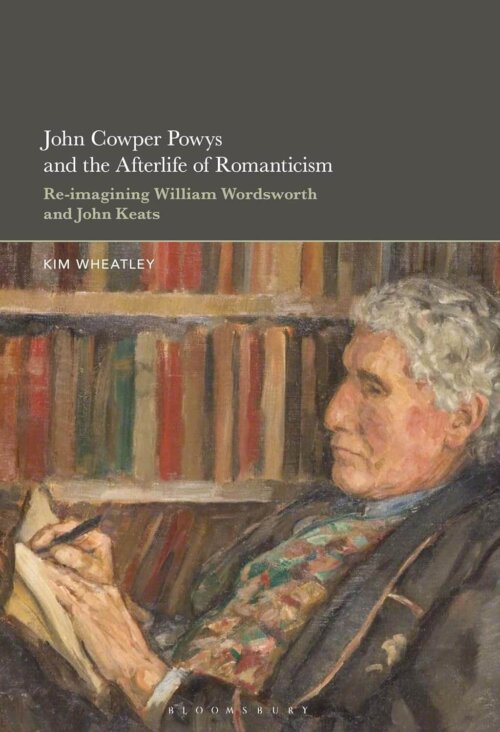
When I read or think about the work of John Cowper Powys, which I greatly admire, I tend to ask myself two questions: Why is Powys’s work apparently so ignored by readers and academics alike? And: Is JCP a metaxologically inclined writer whose work would lend itself to a – my own area of interest – metaxic literary critique? In hand is Kim Wheatley’s new book, and it is a welcome addition to Powysian scholarship. It may also help to illuminate some approaches to Powys’s work the metaxologically-inclined reader or critic might take.
First, a quick word outlining what the basic elements of the metaxological approach may focus on. Following the work of the philosophers Eric Voegelin and William Desmond, we would see as metaxic an understanding that would constantly keep in mind the “in between” condition of, primarily human existence, but all existence generally. This “in-betweeness” (metaxu) is not hard to understand per se, but the consequences of a foregrounding in our “everyday and every moment consciousness,” as far as this is possible, can be far-reaching.
Perhaps the “easiest” sense of our in-between condition is our conscious recognition of the fact that, we all come from and return to, as Tennyson puts it in The Coming of Arthur, “the great deep” and that the source(s) of our beginning and any ultimate destination our existence may (or may not) have are beyond our capacity to fully comprehend or understand.
That existence, in this broadest sense, can thus be seen as a mystery is something that Powys is constantly aware of, and constantly exploring and describing in his poems, novels and philosophical works. It is his quest, so to speak, for the Grail, and Wheatley’s book can certainly help to illuminate this. Wheatley sees Powys’s “re-imagining” of (principally) Wordsworth and Keats as an aspect of “the afterlife of Romanticism” and, in Powys’s works she argues, this will also partake of elements of ecological/mineralist approaches, Modernism and even “proto-postmodern” techniques.
Powys lived a long life. A contemporary of Browning and Tennyson, he lived through both World Wars, the discoveries of quantum physics, the beginnings of space travel, and he could just have heard the first recordings by the Beatles! For a self-reflective individual this is a period that would have provided ample mysteries and wonders to ponder. Late in his novel Porius his eponymous hero, in conversation with Medrawd ap Llew (based on Tennyson’s Modred) who he perceives as a nihilist, admonishes Medrawd by exclaiming that his view of life is “not mysterious enough” (I will return to Porius’s comment below) which, I would suggest, is a metaxic recognition of those “mists” (and there are plenty of mists in Powys’s work) into which, from our perspective in-between, our beginnings and endings seem to disappear. In the novel Wolf Solent, Wheatley draws our attention to Wolf’s comment, “What was the air of a morning like this, without those mysterious emanations from the glimmering depths.” Wolf is talking about his “sensations” in a manifestly Wordsworthian language, yet we may inquire as to the nature of these “mysterious emanations.” They would certainly seem redolent of a direct quote from Wordsworth (Powys, as Wheatley points out, often does not acknowledge his sources, it is as if they have become his own language) that he often uses, about “Something more deeply interfused” (from the Immortality Ode). This “Something,” as Wheatley makes clear, will recur throughout Powys’ work, although, as we might expect, the nature of what this “Something” is will always be less important than that it is nearly always sensually present yet just beyond any precise formulation. In Wolf Solent these kinds of experience are often presented “Through Wolf’s distorted, untrustworthy and sometimes comical point of view, (nevertheless) it has enabled readers to share a sense of wonder not just at the ‘material’ existence of living and non-living things, but at the power of the imagination to half-create and transfigure everyday ‘reality.'” It is worth noting, and I think Kim Wheatley would agree here, that of this transfiguration of “reality” there is no implication that it is less real than its quotidian sources – it may be more real – and these are aspects of the nature of “things,” both material/mineral and that which may transfigure and transcend those quotidian sources.
Quoting from his Autobiography, Wheatley draws our attention to Powys’s words:
A few second ago, before touching my pen to tell you what kind of Seventh Heaven it was into which…I was transported, I felt all that I have ever felt, of the burden of this extraordinary moment. It certainly penetrated every recess of my being. I would call it a beyond sensation, and it lies in my consciousness now like a sunken ship, full of fathom deep treasure. But the touch of my pen…breaks the spell. I can tell you nothing!
Powys is literally describing a feeling inspired by a growth of moss and grass on a stone crop while he was a student at Cambridge. The sensual actuality though is clearly secondary to what lies beyond sensation (the emphasis is in Powys) – and also to the difficulty of trying to express/explain it: an experience that clearly goes beyond any words; and yet, of course, it is through language that Powys, like all of us, has to try and convey a sense of what is inevitably in excess of sense. As such we can, I think, see here an example of Powys grappling with a metaxic experience in which the sense he has of a beyondness that saturates even as exceeds its material/mineral source. In The Art of Happiness he will, whilst referring to political movements, comment “The cause of your country and the cause of humanity are nothing compared with the cause of the cosmos!” Again, this is another confirmation of Powys’s sense of that which exceeds, and yet is the cause of our quotidian “reality.”
All Powys’s consciousness of “what lies beyond sensation” notwithstanding, he also retains an acute sense of “human minerality.” Wheatley draws our attention to this in the sections of her book “Human Minerality in Owen Glendower” and “Minerality and the Mind in Porius.” In these well argued and detailed sections, Wheatley presents a fascinating analysis. These two relatively late novels are curiously imbued with a profound sense of just how material/mineral our lifeworld is, even as we aspire to that which transcends this physicality. Broch-‘-Meifod (a character in Owen Glendower) may have, “a strange yearning for the impersonal, for the non-human” and an “insatiable longing for the calm of the inanimate” and a “desolate and dehumanized world of wet mists and upon rocks,” on the other hand in the novel Porius, for all that it is immersed in a Wordsworthian landscape of “rocks and stones and trees”, Porius, “while devoting himself to his bond with ‘things,’ the organic and non-organic phenomena of the non-human world…This interaction between self and ‘things’ includes passages when, as in The Prelude, ‘the mind is lord and master…'” We can see that an in between perspective is possible, and Porius, as we shall see below, is very much a character who, as it were, looks both ways, indeed “all ways”- into the past, the future (he nostalgically recalls a past Golden Age, even as he looks forward to its future return), into the deep material/mineral earth and up to heavens and beyond. He has, in Wheatley’s words, “a hyper-alert consciousness.” Thus in these sections, in which she focuses mainly on the material/mineral, Wheatley also suggests that there may be ways in which Powys can present the mind as “lord and master.”
It would be fair to say that this “vacillation” in some of his characters is also Powys’s own. In fact he sometimes seems more inclined to valorise a transcendentalising mental mindfulness, whilst at others he seems submerged in a kind of organic/apeirontic nightmarish depth of nature; one of his later characters (Seth in The Inmates) represents “what might be called ‘the insanity of nature.'” This range or span of experiences, sensations, imaginings (both fictional and autobiographical) and so on, are varieties of the sublime of which Wheatley will describe no less than eight: ecological, egotistical, excremental, generational, material, negative, quotidian and neurodiverse. If the neurodiverse sublime is a kind of umbrella term, one might be tempted to wonder what the ultimate source of this neurodiversity itself is. If so, and I think this wondering is always at least in the background in Powys’s thought and works, then there is always a “route” towards, what Eric Voegelin would identify as “First Reality” – the metaphysical Ground of our very being as beings – which is the source (and therefore not just a “source” – see below) of the “Second Reality” of these neurodiverse sublimities. This is a phrase which does I suggest – as Wheatley presents it – neatly express a kind of boundary condition, an interface or threshold where the material and the perhaps transcendent “source” of that materiality may become that in which, in that Wordworthian phrase that Powys often refers to,” Something more deeply interfused” may be felt. Wheatley puts it this way, “Powys uses (this) phrase, often abbreviated to just the capitalized noun ‘Something,’ as a shorthand for mystical feeling. In doing so, he projects ‘fluctuating’ layers of transcendental awareness on to the poet (Wordsworth). These include an everyday sense of visionariness that is now known as the quotidian sublime; a quasi-transcendental contemplation of the vast extent of astromomical space in which material ‘things’ are ‘all there is,‘ and, looming even larger, an awestruck recognition of an alternative ontological dimension, a ‘Beyond-Nature’ that, in his essay on St. Paul, Powys calls ‘an overpowering sense of ‘Something more deeply interfused.'”
Wheatley tells us that, “Powys abjured transcendentalism toward the beginning and then again toward the end of his career.” Yet this raises the question of what, if anything, he substitutes for this “abjured transcendentalism”? It seems to me, and I think Wheatley’s research will support this, that he moves in his sometimes almost clumsily written later works to a perspective that abjures, even as cannot entirely overcome, “isms” of every sort. But, with Wheatley’s help, we need to look a little more closely at this trajectory. She writes:
A self declared “Polytheist,” Powys repeatedly endorsed William James conception of “a multiverse” because it lends itself…to the magical and the miraculous.” W.J. Keith argues that Powys locates his narratives in a middle-land between ordinary life on earth and the presence of ‘other dimensions’ beyond.” I would add that “middle-land” extends all the way from “the primordial elements” to a “something far more deeply interfused” that slides between the earthly and the “beyond.” And since even a “Beyond-Nature” can be taken as part of “Life Itself,” in using the Romantics to articulate his distinctive conceptions of the transcendent, Powys expands his own Romantic-inspired ecological vision past the green, gray, and flesh-and-blood-centred areas of his writing to regions “beyond colour!”
In this remarkable passage Wheatley identifies many of the key difficulties we can encounter when taking an overview of Powys’s work. If we situate ourselves in the “middle-land” perspective, which clearly extends from “primordial elements” to “Beyond-Nature” it is hard to reconcile this simultaneously with “Life-itself” without then wondering, not only what but where “something far more deeply interfused” comes from if “Life-itself” is all there is! Are we in danger of being sucked in, as it were, into an infinite regression in which, illogically, ‘nothing ever gets started’? To me, these are issues of metaxological significance.
I certainly do not intend any kind of negative criticism of Wheatley’s analysis here: on the contrary I think she is focussed on precisely the elements of Powys’s works, fictional and non-fiction, that make them at once so challenging and so rewardingly interesting.
However, I must begin to bring this review to a close. Let me do so by returning to the quote that I took from Porius above. If Medrawd ap Llew is a nihilist (he can remind one of Orwell’s O’Brien in Nineteen Eighty-Four) Porius seems to grasp the illogical reasoning of this, of what Medrawd seemingly accepts what he considers to be “logical opposites” (I cannot help but recall how the Coen Brothers in their film The Big Lebowski present this humorously, when the Nihilists exclaim “But we believe in nothing!”). Porius, almost lost for words, says:
oh I don’t know how to put all that I feel! … doesn’t seem … well! Let me put it plainly, doesn’t seem complicated or multifarious or scattered or mixed-up enough! In fact your God-life on the one hand, and your Devil-death on the other, to tell you the honest truth, Prince, doesn’t strike me as mysterious enough!
Porius, here, grasps the essential point. Interestingly, Kim Wheatley quotes from a letter written by Powys in 1955 (about the time when Powys was writing Porus) to Ichiro Hara which perhaps illuminates further his personal perspective on precisely this issue:
I think that Wordsworth in ‘Tintern Abbey’ where he talks of a something far more deeply interfused – a motion and a spirit that impels all thinking things all objects of all thought and rolls thro’ all things – has got beyond the Christian God beyond God the Creator – beyond all that the Theologians teach. I think he is feeling the Mystery that no science can possibly explain though it may split the atom & blow us all sky-high and destroy the Earth who is our Mother.
This does not seem to me to be an irreligious perspective. Certainly, Powys implies (as he often does) his dissatisfaction with doctrinal or “organized” religion religion(s), but he does express a religious sensibility in the sense of re-ligare, of re-connection, re-communication, a re-companioning with “the Mystery” which for all its being beyond our full understanding – it is not “the Earth” neither is it “our Mother,” but “it is” and this is certainly mystery. Is it “mysterious enough?”
Have we moved to Powys’s curious region(s) “beyond colour?” How so? Because if colour does not ‘exist’ as such – it is a consequence of waves of light – nevertheless we can still perceive it. Could Powys’s phrase then be an attempt to express this understanding of the sensual as, too, a burgeoning-if-inchoate perception of the “great deep” – the Source or Voegelinian “First Reality” (or, to use Desmond’s phrase, “the unoriginated origin”) of the sources of our lives of perception – our sensibilities – themselves? A source which both “exists” and does not “exist” at the same time? I don’t know the “answer” to this, either from Powys’ perspective, although his writings manifest his continual engagement with these issues. There may be no answer per se to the question: it is, from a metaxological viewpoint, beyond our understanding, yet we can perhaps, and reading a writer like John Cowper Powys can certainly involve us here, begin to understand both why we must keep asking these metaphysical/metaxological questions even though we cannot fully understand: which is because, as Porius senses, the universe is “mysterious enough!” And this is a good thing!
This is certainly challenging, and Powys challenges us in the way that most great writers do: they take us to boundary of our own perceptions and compel us, too, with them to ‘look beyond’ – see as thresholds – those boundaries. This is not easy! On the final page of her book Wheatley, states “disability and deprivation in Powys writings belong in any broader appraisal of how his ethical and humanitarian sympathies connect with his environmental leanings. One example is the ‘half-witted orphan boy,’ Larry Zed, in Weymouth Sands who responds to a ‘ghostly’ natural spectacle with ‘a deep groan of wonder’ and whose neurodivergent mind is treated is treated respectfully by that novel’s capricious narrator.” We too may occasionally be tempted to “groan with wonder” when we journey with Powys in his works – but the wonder should still be in our consciousness. And for all that “at different phases of his career, Powys does not always subscribe to the possibility of transcendental dimensions…” nevertheless, “Powys’s vision of the wondrousness of ‘life itself,’ as mediated through Wordsworth in particular, reaches – to quote the narrator of You and Me – ‘outside this whole bloody universe; yes, outside all the universes that ever were, are or will be.'” For all the vacillations in his relationship with the transcendent, it seems we can say with some certainty that Powys was not, to use a phrase of William Desmond’s, a default atheist – one of those who, as Richard Lewontin puts it, “cannot allow a Divine Foot in the door.” Powys, perhaps rather like his character Porius, is not a predominantly hubristically-driven individual (in any materialistic sense), and this contributes to his porosity to the “Divine”: in him the “the door” is always open (even if sometimes it may only be ajar).
Grappling with Powys’s vast body of work, which includes poetry, fiction and philosophy, can undoubtedly be a daunting challenge at times, and I am led back to the two questions I asked at the start of this review. After reading and considering Kim Wheatley’s book I feel enabled to add some further thoughts. First, to answer my first question: It is in some ways easy to understand the apparent lack of general readers: his books are often very long (for example A Glastonbury Romance is 1174 pages), they can be relatively hard to obtain, and I suppose to some they may be – I would say mistakenly – seen as somehow too old-fashioned (although his last novels are “fantasies” that can read like a kind of futuristic science-fiction) to be contemporaneously relevant. Further, the members of the very contemporary and lively Powys Society would definitely argue for his continuing relevance! The lack of academic interest is a little harder to fathom, but I suspect that it is, more or less, for very similar reasons, with the added lack of motivation to write books that academics may perceive few will want to read. Happily, Kim Wheatley is clearly not one of these! As for my second question above: I would like to “claim” Powys as a metaxological writer; and in many ways he is, (for example, as I hope we have seen, he is mostly conscious of our human condition of ‘in-betweenness’ – metaxu – and is usually porous to a sense of the transcendent) as the book under review, as I read it, makes clearer. If I am slightly hesitant about this, it would probably refer back to the “vacillations” already discussed; but, then again, for all that he wrote many books of “popular” philosophy, Powys is a literary artist primarily, and it is on that basis that he must be, in my view, positively judged.
Kim Wheatley has written a meticulously researched, clearly written and very useful book. I would recommend it to anyone interested in profounder studies of literary texts. Further, readers who are already familiar with Powys should be fully engaged, as I have been, by Wheatley’s insights this text. It is a very welcome addition to the field of Powys studies, and I can see it being used as a reference book for many years to come. It has certainly made me reach, once again, for my volumes of the work of John Cowper Powys: a singular, undervalued, yet important and unique voice in English Literature.
John Cowper Powys and the Afterlife of Romanticism
By Kim Wheatley
New York: Bloomsbury Academic, 2025; 252pp


Related Posts