Dostoevsky vs Musil: the Never-Ending Story
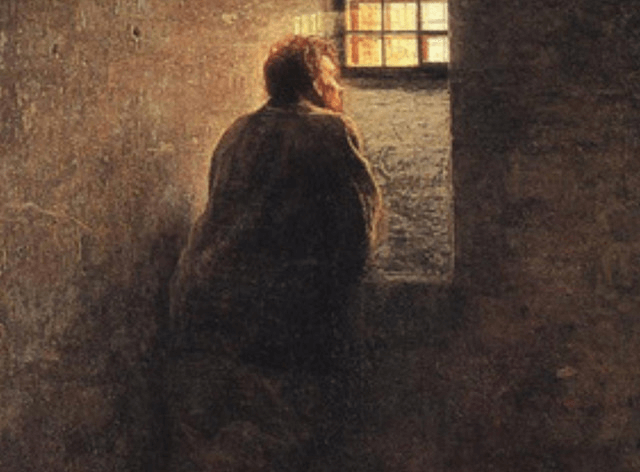
René Girard reread many of the classic novels of Western literature in preparation for a survey class he was about to teach. Girard’s insight, which he garnered as a result, was expressed in Deceit, Desire and the Novel, which was that all great books – the ones we have come to consider the classics – have the same structure and trajectory. There is a hated protagonist (essentially an antagonist) who comes to see the error of his ways. But, in order for this to happen, the author has to forgive this central figure who represents disliked aspects of himself. Girard refers to this as self-transcendence, which is uncommon and thus great novels are rare. It is, of course, easier to see the mote in another’s eye rather than the beam in one’s own.
The oyster has its grit to create a pearl, and the author has a related irritant; an annoyance, to the point of obsession, that provides the inspiration and motivation to write his novel. Cervantes was irritated by unrealistic stories of chivalry and has Don Quixote, thanks to his poor taste in reading material, insanely adopt the role of the knight errant featured in them, only to be relentlessly mocked, humiliated and beaten up within the novel. Flaubert’s hated figure is Madam Bovary. She too has been reading the wrong books and she destroys her life by trying to get it to conform to the fantasies found in romance novels. Julien Sorel in The Red and the Black, inspired by Napoleon’s rise to power, is a relentless, scheming, user of women and social climber whose every other utterance is described as “hypocritical.” Marcel Proust’s Monsieur Swann in Remembrance of Things Lost is self-destructively obsessed with a semi-prostitute Odette whose every act of predictable unfaithfulness pierces his heart. Swann is superseded in the novel by “Marcel” who exhibits similarly self-destructive behavior involving jealousy and obsession with Gilberte and Albertine. In both cases, the self-delusion is enough to make one want to shout, “You idiot!” at the characters. Naming the character after himself makes the claim below all the easier to support.
All these instances turn out to be cases of projection. When something really annoys you, out of all the things to which one could take umbrage, it means you have a special emotional connection to it. In many cases, it is something about yourself that you dislike. Without the personal connection, no high level of emotional intensity would be reached. I, for instance, am self-conscious about being an adjunct instructor since it gives one a child-like status next to the grown-up tenured professor, despite so many of them being very prosaic souls indeed. On one occasion I repeated Samuel Johnson’s assertion in a Facebook post that no one reads John Milton’s Paradise Lost and wishes that it had been longer, because I thought it was funny and probably generally true. A tenured English professor took exception to this. In our brief exchange, I mentioned that I had been reading and thinking for several decades with around 200 editor-reviewed articles to my name and had a right to my well-earned (in some cases) opinions. His response? “Maybe.” Since Johnson was Milton’s biographer and responsible for helping to make Milton famous and I was merely repeating Johnson’s opinion, perhaps Johnson and I deserve more than a “maybe.” Obviously, the professor touched a sore point.
Epictetus, a stoic, argued that you should thank those who insult you. Either they are right or they are wrong. If they are right, then what they say is true and should be acknowledged as such. If they are wrong, then their comments are irrelevant. Either way, they have not harmed you in any way. If you find yourself reacting angrily, then this means you have an emotional wound. This is educational. You now know you have a problem and you should thank the person who has unwittingly pointed this out. If you get mad merely because someone is trying to hurt your feelings, then you are at the mercy of every sadist and troll out there.
To qualify as great, a book must have a satisfactory ending. It is not enough for the author to repeat, “I hate you.” There needs to be, “I forgive you.” Given the reality of projection, it is really, “I hate me,” and “I forgive me.” Before you can be forgiven one must confess one’s sins and express a desire to change. The writers of these classic books have created a hated rival; an opponent. Someone looking from outside can see that the two antagonists (the author and a central character) resemble each other. In mimesis, one assumes an angry expression and raises his fists. The other does the same. Yet, pointing out the similarity will be most unwelcome. “What do you mean? That guy’s a jerk!” Especially at the height of the competition, one’s enemy is the last person on earth one to whom one would like to be compared.
The entire legacy media seem awash with projection and its attendant scapegoating. Persecution and victimization await those who challenge or defy progressive orthodoxies – though the Trump administration is currently pushing back against this. Traditionally, heretics are burnt at the stake. The modern heretic is instead fired, ostracized or rendered unemployable. But, unlike traditional Christian orthodoxy, as it has been frequently pointed out, there is no path to redemption. Confessing one’s supposed sins and apologizing simply gets the persecutors to double-down and feel smug that they were right to damn you. The progressive adopts slogans like “Be kind,” and “Love is love,” while exhibiting self-righteous hate-filled speech and behavior. There is no sign of the self-awareness shown by the great writers. No, I hate me, I forgive me; just projection. Thus, the Woke can create no great novels or movies. There can be no satisfactory resolution for such people. They could never ever recognize that the real evil resides within their own souls. The closest they might come to that is “implicit bias” and “white privilege” but those things are regarded as irresolvable; an original sin also with no grace or redemption. Always, there is the implication that the extermination of Whitey and the promotion of black women will solve all problems. If whites are the oppressors of blacks, then genocide is the logical cure – hence the intentionally annoying exclusionary assertion that black lives matter and never that all lives matter. For those who say that the phrase “black lives matter” has no exclusionary implications, try it as “white lives matter” and see how it makes one feel.
Without transcendent self-awareness, there can be no end to projection. One projects the despised aspects of yourself on to another person and then annihilates that person. It is imagined that the despised characteristics will die with the victim – though they turn out to be far more resilient than that. Since the real target lies in the hearts of the frenzied, bloodlust-filled scapegoaters, the projection continues unabated and a new target is found. In this regard, people have pointed out that if one wants to know what Democrats are up to, see what they accuse the Republicans of doing. They call, “Racist!” while denigrating all white men as oppressive bastards. They yell, “Insurrectionists!” while Clinton tries to use the Steele Dossier to implicate Trump with being a foreign agent in order to remove him from office. They shout, “Liar!” while 52 former intelligence agents claim that Hunter Biden’s laptop was not his and while repeating multiple hoaxes against Trump such as the Fine People and Drinking Bleach hoax with even lefty Snopes acknowledging the former hoax which is easy to check. They say, “Beware White Supremacist and MAGA violence!” while engaging in color revolutions against the American people with George (now Alexander) Soros sponsored violence during George Floyd riots and the “mostly peaceful” protests, with astro-turfed BLM and Antifa thugs, and now anti-Tesla and Musk violence, literally throwing Molotov cocktails and keying cars with not a single Democrat leader denouncing it and many “comedians” celebrating it.
The authors mentioned have hated the characters enough to write a book attacking them. So, it is quite something for them to acknowledge that they exhibit the same pathologies themselves. The only way to do this is to have the characters self-convict and apologize. If they simply carry on with the hated behavior, there can be no forgiveness. If the characters affected by their actions forgive them but the protagonist remains defiant and unapologetic, that does not work either. The characters have to acknowledge and atone for their sins themselves. In some cases, the characters literally apologize for craziness and admit their own madness. Madam Bovary laughs at herself as she is in agony and vomiting black bile having swallowed poison, because it is the final refutation of her romanticism. She had hoped to kill herself in a fetching swoon and reality, yet again, was slapping her in the face. Julien Sorrell declares his love to the woman he had manipulated and maltreated and apologizes to her before being executed. Don Quixote renounces his madness on his deathbed and seeks atonement and forgiveness. The corollary of this is that Stendhal had ambitions of social advancement. Flaubert was attracted to romance novels. Proust was drawn to faithless people who did not love him back – a form of self-hatred – not wanting to belong to a club who will have you as a member. And, Cervantes had read one too many tales of chivalry and enjoyed them. Why would he read them if he did not like them? How did he become such an expert otherwise?
Dostoevsky’s greatest novels follow this pattern. Crime and Punishment has Raskolnikov possessed by the idea that to kill a million men makes one a great conqueror in the style of Napoleon, but to kill one a mere murderer. He intends to show that what’s good enough for Napoleon should be good enough for the lone killer. Killing an old woman just to make a philosophical point is idiotic and the fact that he kills her innocent sister too because she happens to witness the murder is particularly disturbing. The great detective, Porphyry, named after a Neo-Platonic philosopher, needs a confession from him, not having enough evidence without it. Raskolnikov, after countless false starts and prevarications, ends up redeeming himself by confessing and facing his punishment voluntarily, accompanied by his moral inspiration, Sonya.
Dostoevsky’s The Possessed, AKA The Devils, has people recruited to what they are told is a socialist revolutionary cell. They are manipulated by Verhovensky, the son of Stepan Trofimovich, whose inadequate worldview has resulted in a demonic, nihilistic son. Verhovensky’s madness and evilness spreads to the actions of those who he is leading.
There are reasons for thinking that Trofimovich’s insidious influence on his son is quite plausible. I know two daughters who adopted extremist views seemingly as a response to their mother’s liberal wishy washiness. Whatever view was expressed, the mother would take the other side of it as a conversational gambit. If anyone were criticized, she would defend him regardless of merits. Seemingly as a consequence, one of the daughters decided for a while to be a manual laborer only because such jobs are male-dominated and also adopted veganism when it was extremely rare. She even, for two years, became a lesbian out of some kind of misandry and anti-patriarchal politics. This phenomenon is well-known to actual lesbians, many of whom try to avoid the type because they eventually go back to men. The other daughter became a Christian fundamentalist for a few years, much to her mother’s extreme consternation.
In The Possessed, there is also the grotesque, charismatic, and morally bankrupt Stavrogin. He is handsome and exerts a magnetic attraction for many who encounter him for reasons that he himself does not understand. There was a figure like this at the University of Canterbury in the 1980s. Tall, thin, older than the rest of us, well-dressed and unsmiling. Reminiscent of Malcolm McDowell facially, he seemed the essence of “cool.” The fact that his girlfriend committed suicide when he left her seemed somehow a reflection on him – though, perhaps, just bad luck. Verhovensky is inspired by Stavrogin, who becomes his mimetic model, saying “You are my idol!” and “I invented it all, looking at you.”
Towards the end of the novel, most of the main figures in The Possessed beg forgiveness from others negatively affected by them. This inclines the reader to, in turn, forgive them. They have been most assiduously hated by the implied author, so their redemption is particularly significant. Dostoevsky had entertained their equalitarian utopian aspirations himself when younger so he is well able to imagine why someone else would embrace these ideas. The character Shatov contends that utter scoundrels come in to exploit these utopian fantasies and this exploitation will only end when people renounce these desires.
One of the key quotations occurs when Shatov confesses to Marie that he has been mistaken and has thrown in his lot with rogues:
“Marie, Marie,” said Shatov, turning to her, much moved, “oh, Marie! If you only knew how much has happened in those three years! I heard afterwards that you despised me for changing my convictions. But what are the men I’ve broken with? The enemies of all true life, out-of-date Liberals who are afraid of their own independence, the flunkeys of thought, the enemies of individuality and freedom, the decrepit advocates of deadness and rottenness! All they have to offer is senility, a glorious mediocrity of the most bourgeois kind, contemptible shallowness, a jealous equality, equality without individual dignity, equality as it’s understood by flunkeys or by the French in ’93. And the worst of it is there are swarms of scoundrels among them, swarms of scoundrels!”
The novel is about a whole social circle swept up in a mimetic madness that involves killing someone. It gets its title from Stepan Trofimovich’s recognition that he, and the others around him, have been like the Gadarene swine. In the Biblical story, Jesus encounters a mad man possessed by demons. Jesus commands them to leave the man. The demons who say, “We are legion,” ask to enter a nearby herd of pigs. This occurs, and the herd rush down a steep bank and are drowned. The demonic Stavrogin has infected those drawn to him with his own moral worthlessness. We find out that he raped an eleven-year-old girl who hangs herself out of shame as a result. This section was censored but is usually restored in later editions. It is crucial to understanding Stavrogin and thus the events of the novel.
Many, but not all, of the characters fit the protagonist/self-transcendence model. Verhovensky, the satanic manipulator who has no ideals himself, but enjoys sowing chaos in others, is not forgiven. Nor does he die, but lives on to use his destructive skills on new unwitting victims. He represents a permanent demonic propensity. Utopias, based in unreality as they are, create a moral vacuum which demons will exploit – getting people to participate in evil, while providing moral cover for their own conscience.
The Idiot was intended to avoid this dynamic and to be about someone who was truly good; a Jesus figure. Somehow, despite his best intentions, Prince Myshkin succeeds in making the people around him act worse than they might have otherwise. One suspects that this was not Dostoevsky’s original intention, but he was too good a writer to manipulate his characters to a desired outcome. But, the novel has no resolution. Dostoevsky was never able to finish the novel (in the artistic sense). Instead, the implied author starts writing about how hard it is to write convincing characters – subjecting the reader to a kind of meta-novel. The Idiot, very unfortunately, does not demonstrate that a great novel can avoid the self-transcendence dynamic and still succeed. No one gets redeemed and neither does the second major figure, Natasha, who is simply murdered by Rogozhin; Myshkin’s rival. Natasha had been romantically torn between Prince Myshkin and Rogozhin. The former had a pitying love seeking to rescue her from her self-hatred, while Rogozhin is a combination of dark desire and similarly pathological impulses.
What about The Brothers Karamazov; what many people consider to be the finest novel ever written? There are four brothers – Dmitri is the eldest and he most resembles his hedonistic father. Ivan is the next oldest and is a thinker, a skeptic and an atheist. Alyosha is his younger brother and he is determined to avoid the sensualism characteristic of the Karamazovs and decides to become a monk. Ivan and Alyosha have a different mother from Dmitri. Finally, there is a probable bastard son, Smerdyakov from yet another mother who the father has employed as a servant.
The Dostoevsky novels with a single main protagonist fit Girard’s schema in a clear-cut fashion. When a novel has several storylines following many key figures one might conclude, following Dostoevsky’s example, that it is enough if some of the characters fit the protagonist/self-transcendence model and some do not. Aesthetically, it seems to be sufficient for some of the storylines to end in atonement, even if not all do, as was the case with The Possessed. In The Brothers Karamazov, two of the brothers reach an absolution of some kind – Dmitri and Ivan. Alyosha had no need of a special redemption, and Smerdyakov has merely been the dupe of someone else with a more powerful intellect, better moral compass, and persuasive abilities.
Before going into details, are we employing a Procrustean bed? Altering our description of novels to fit the thesis? I do not think so. It cannot be necessary for all the characters, or in this case, all the brothers, to be redeemed, since even in the novels where there is definitely a central character like Crime and Punishment, there are many other characters and only one of them, Raskolnikov, renounces his sins. Porphyry, for instance, needs no redemption and he does not receive it. Marmeladov, an alcoholic who has left his family to starve, never gets any better, and when he does finally get a job, goes to a bar instead, and so on. Svidrigailov has a similar beyond good and evil ethos as Raskolnikov, but he is not tormented by his evil actions. Similar to Fyodor Karamazov, he adds the child molestation of Stavrogin, along with saying that he would be willing to murder his wife if Dunya asked him to. His character has no redemptive arc and he kills himself once Dunya, Raskolnikov’s sister, rejects him.
With The Brothers Karamazov, Dmitri has the most self-transcending story arc. He definitely has aspects of Dostoevsky’s own self-destructive tendencies and lack of self-restraint and moderation. We know that Dostoevsky was himself a gambler and that he would sometimes use money he had borrowed from others, after much servile begging, on further gambling – reasoning that if he won, he could pay off his debts and still have something left over. Except, of course, he would usually just get even further into debt. Some of his great novels were written expressly to pay off money he had been loaned, or book advances. World literature is itself indebted to Dostoevsky’s immoderation. We know that he was filled with self-recriminations for his behavior.
Dmitri is engaged to Katerina Ivanovna Verkhovtseva, and yet he leaves her to pursue Grushenka, the same young woman his father is after. Both father and son are devoted to drinking, partying, and sex. Unfortunately for Dmitri, the father has more money than he has to afford such things, which is why Dmitri wants his inheritance. He already has inherited his father’s dissolution. Dmitri’s fascination with Grushenka is clearly a case of mimetic rivalry with his father – wanting her precisely because his father desires her – and Freud, who loved the novel, regarded it as a classic Oedipal dynamic.
Dmitri had taken 3000 rubles from Katerina and he is desperately trying to repay her so he can run off with Grushenka. When he does finally get 3000 rubles he blows it, in part, on French champagne which he buys for everyone at a restaurant. The reader has been following his quest for the 3000 and to see him waste it in this fashion is supremely frustrating.
Smerdyakov murders Fyodor Pavlovich, his probable father. And, he does so because he takes Ivan’s skepticism and nihilism seriously. He does it because Ivan had told him that without God all is possible, and there is no God. Ivan is horrified at what Smerdyakov has done. So much so that he hallucinates a conversation with the Devil, who Ivan is pretty convinced he must be imagining. Nonetheless, it is part of his descent into madness. The sequence ends with Alyosha informing Ivan that Smerdyakov has killed himself. Unfortunately, Smerdyakov has already framed Dmitri for the murder in the most deliberate of ways, planning what he does for this result well in advance. Ivan tells him that he intends to go to the police and to inform them of his partial culpability for the murder, but Smerdyakov replies that Ivan is too wedded to a comfortable life and that he can provide no positive evidence of Smerdyakov’s guilt anyway. All Ivan has as physical evidence is a handful of rubles that could have come from Ivan’s own household, as Smerdyakov points out.
Dmitri is charged with Fyodor’s murder and, with some moments of doubt and hesitation, he decides to accept his punishment, despite protesting his innocence throughout the trial. He does this for multiple reasons. One is that he had indeed threatened to kill Fyodor himself for not giving him his inheritance. His jilted fiancé, Katerina, even produces a letter at his trial where he writes as much. She does this out of revenge, for which Dmitri later forgives her. So, he is not innocent of at least wanting his father’s death. He also accepts punishment on behalf of all mankind for the fallen state of the world. Father Zosima’s theology is that we are our brother’s keeper. We are responsible for what all human beings do and that we are either saved together, or condemned together. We cannot rejoice while another burns in hell. The Three Musketeers’ “One for all and all for one” sums this up. Just as a spouse cannot rest easy knowing the other spouse has no health insurance or a dire health prognosis, so we should feel that way towards everyone else, on this view. Dmitri could be viewed as accepting the punishment on another’s behalf.
Good science fiction is simply philosophy that never calls itself as such. Science fiction smuggles serious philosophical musings into an accessible pop culture context – disguising vegetables as something more palatable. People who might run a mile from a philosophy lecture, eagerly consume it, in many cases, when a pointy eared alien and spaceships are involved. Pondering as prime time entertainment. The genre may seem lacking in seriousness, but the philosophical exploration is real, legitimate and sometimes profound.
There is a two-part episode in Star Trek Next Generation, “Encounter at Farpoint,” where Jean-Luc Picard is put on trial by “Q.” Q belongs to a race of beings known collectively as the Q who are not morally superior to human beings in any way, perhaps even worse, who have conquered the laws of nature to such an extent that they can bend them or break them in any way they choose. They live in an alternate dimension, the Continuum, outside space and time, and have god-like powers. Q puts Picard on trial for the sins of the human race, of which there are many. Picard has to defend all humanity in order to defend himself. He might not have done these things personally, but his fellow humans have. The prosecution is not nonsensical and shares something with Zossima’s universalism.
Dmitri does seem to see his punishment as an atonement for his sins. He has been petty, lustful, hateful, unfaithful and profligate. He and his supporters do foment an escape plan at his conviction, but he does not go through with it.
The four brothers resemble different aspects of Dostoevsky. With that in mind, Dmitri could represent Dostoevsky’s own worst tendencies, which brought his wife and friends the most pain. As far as we know, these were his most lamentable failings. Emotional, hot-headed, and incredibly unreliable, Dostoevsky repeatedly lost the money needed for household expenses, even when he had a baby to look after. Ivan is very much his intellect, culturedness, erudition and skepticism. Ivan’s hallucinated devil says, “I know a most charming and attractive young Russian gentleman, a young thinker and great lover of literature and art, the author of a promising poem entitled “The Grand Inquisitor.”” This is, of course, Ivan, and then, in most respects, the real-life author, Fyodor Dostoevsky.
The father of the brothers is also “Fyodor” (Pavlovich Karamazov) and Dostoevsky is indeed the father of the brothers artistically, and, perhaps, psychically.
Ivan is confronted by his negative influence on Smerdyakov. He has inspired the latter to kill their father and he repents of this. As mentioned, Ivan starts to make plans to thwart Smerdyakov’s evil schemes when he finds out about the murder – the same scheme that Ivan has himself inspired – only to be stopped by Smerdyakov who proves the uselessness of the attempt. Ivan is thus prevented from atoning for his sins. With no outlet and no remedy, he is reduced to madness. This punishment could be thought of as self-inflicted. The fact that Ivan is remorseful for his corrupting influence certainly is likely to produce sympathy from the reader. Ivan has not escaped his sins and has paid a price for them.
Alfred Hitchcock’s Rope has a similar theme to the Ivan/Smerdyakov story. A professor, Rupert Cadell, has told his students that there are superior people and inferior people, and the superior have the right to do what they want to the inferior. This is straight out of The Gorgias with the character of Callicles. Socrates does a tremendous job of demonstrating that Callicles is unable to explain in what manner his supposedly superior men are in fact superior. Every attempt to define “superior” breaks down. It is true that those who rule are the social superiors of those who are ruled. But, that mere fact cannot be used to explain why it is morally justified that they rule. Their rule is supposed to be justified by their superiority which, therefore, cannot come from the fact they are indeed ruling. That would be a circular argument where the conclusion is used to prove the premise, instead of the other way around. “I rule because I’m superior. What makes you superior? I rule.” This is tantamount to, “I rule because I rule.” Or, “I’m superior because I’m superior.”
Nietzsche effectively reprised these Platonic arguments, but this time, Socrates is removed from the picture and his claims go unrebutted. The intellectual dishonesty of doing that, from a philologist so talented that he was youngest ever professor of philology at the University of Basel, appointed at the age of 24, is astounding.
Rupert Cadell, in Rope, initially protests that he is not responsible for the actions of his students, only to relent and acknowledge that he is. The Cadell the Cad, becomes Cadell the Chastened.
Cynicism is so easy and so adolescent. It assumes a superiority on the part of the cynic. It is not necessary to actually know anything. It is not hard won. The cynic pretends to have seen through the illusions from which the rest of us are still suffering. It is an attractive ploy for social status and recognition that do not natively belong to the teenager. “I know I am a lowly runt and wet behind the ears, but really, I have seen beyond the veil in a way that you, with all your so-called “experience,” will never do.” Defending Beauty, Truth and Goodness smacks of naivete and idealism, while pouring scorn on them seems cool, world-weary, and smart. All educators should remember that arguing for nihilism to teenagers might turn out to be more effective than they might imagine and with consequences that the educator, like Ivan and Cadell, might regret.
Mikhail Bakhtin is thought to be the first to state that all Dostoevsky’s novels could be called Crime and Punishment – not just the one that is. For Dostoevsky, “punishment” is the happy ending, resulting in redemption and showing the consequences of moral transgression. Plato was of the same opinion. The literary critic Northrop Frye commented that Dostoevsky’s novels can be considered to be a continuation of Plato’s Dialogues and this high opinion of punishment is one shared characteristic. Socrates comments in The Gorgias that punishment for crimes is good because it is just – so it is good in itself. It prevents the evildoer from doing even more bad things, and that is good both for his potential victims and for the evildoer. He is less evil than he might have been, since doing more evil makes one worse and is more contemptible. Punishment, in the form of negative consequences for the transgressor, also provides the possibility of reform.
Alyosha could be thought of as representing all that is good and true in Dostoevsky. There is no arc of crime and punishment because Alyosha commits no sin. It is the name Dostoevsky and his wife gave to their beloved son who died from epilepsy at age three – a disease he inherited from his father. Alyosha in the novel, knows that he has inherited Fyodor Pavlovich’s tendency towards lust and profligacy, and he has attempted to forestall this by becoming a monk. Alyosha is lucky enough to be taken under the wing of Father Zossima who turns out to be a fine mentor. Zossima had been himself inspired by the conversion of his brother Markel shortly before he died from consumption and from a time when he nearly fought a duel out of hurt pride.
Alyosha is like Prince Myshkin, an attempt to depict a truly good character. One might conclude from the success of The Brothers Karamazov and the relative artistic failure of The Idiot – not quite reaching the pinnacle of literary achievement, as fine as it is – that superlatively good characters can figure in a masterpiece so long as they are surrounded by less perfect characters. To put them front and center does not work. If the greatest novelist who ever lived could not do it, then no one can.
An English professor once had to explain to a wannabe writer that good stories must include elements of conflict and resolution. The novice writer wanted only positivity. Positivity is fine, but it needs to include overcoming hardships, difficulties, and opposition. Think of a classic fairy tale about the youngest prince who must perform three tasks, along the lines of the Labors of Hercules, to win the hand of the princess only to find that her father is attempting to double cross him and renege on the deal. That could hold one’s interest. Imagine, conversely, if the prince asks the princess for her hand in marriage, she says yes, and they live happily ever after. That is not even a story!
Again, in order for a novel to embody the crime and punishment motif; for it to have a character who sins, but is forgiven both by himself and his author in a feat of self-transcendence, it is not necessary for every character to have this same arc – as argued concerning Crime and Punishment and holding true of Madam Bovary, The Red and the Black, and Remembrance of Things Lost.
Mikhail Bulgakov is most famous for The Master and Margarita. This novel is also one of redemption – even the Devil gets a look in. He also wrote Heart of a Dog, a social satire on the New Russian Man, an ideal promoted after the Russian Revolution. It has some really redeeming features – the main one being writing the first half of the short novel from the perspective of the dog, Sharikov. Sharikov understands a little too much Russian to be fully naturalistic, but overall it is an admirable artistic achievement and frequently amusing, to boot. Once he is transformed into a cretinous, alcoholic, ne’er do well, human being, Bulgakov’s anger at Russian bureaucrats and their interfering, petty, small-minded, self-satisfied, vindictive self-righteousness loses its playfulness and becomes pure bitterness. Although, the fact that Sharikov, as a former dog, gets himself a job ridding Moscow of cats – emblematic of pointless Communist bureaucracy – is very funny. But, this time there is to be no forgiveness and no redemption. The novel simply ends, with the human turned dog once again. As a consequence, Heart of a Dog will never be as beloved as The Master and Margarita.
The gargantuan Man Without Qualities by Robert Musil, an Austrian, is about an aimless man, Ulrich, failing to find meaning in modern society. Without any particular moral center, he is a conformist. In today’s lingo, an NPC (non-player character). Like the movie Idiocracy, the novel becomes an instance of that which it criticizes – a meandering ennui-inducing tale with no resolution. Idiocracy descends into idiotic farce, particularly in the courtroom scene.
A Hero of Our Time by Lermontov is the Russian equivalent of Man Without Qualities, though, thankfully, much shorter than Musil. Pechorin is an antihero, bringing harm to the people around him, dissatisfied with life, but not apologetic even when he realizes he has done something wrong. Neither novel has the conversion-story arc of redemption and forgiveness. Consequently, Man Without Qualities, at least, remained incomplete. A Hero of Our Time might have officially been finished, but like all such stories it really just stops. The “hero” dies alone; unmissed and unlamented. Bored, amoral, and self-destructive in life, he had fought a rigged duel with no compunction, he dies young as he had predicted, and even his own approaching death does not particularly interest him. Such books are barely readable. By contrast, Wittgenstein loved The Brothers Karamazov so much he memorized chunks of it and took a copy with him to the front lines in WWI. Einstein regarded it, accurately, as the summit of all literature. Freud called it the most magnificent novel ever written. Hermann Hesse regarded Dostoevsky as a prophet largely due to the novel, and so on.
Man Without Qualities and A Hero of Our Time are a critique of amoral cads, but the authors do not forgive the targets of their hatred, blaming social conditions as much as anything for their behavior, and thus, Ulrich and Pechorin neither confess their sins nor atone for them. They remain unredeemed. In place of a story arc, there lives a bland sameness of existential banality. This, arguably, make the books rather pointless to read. The lack of narrative closure leaves their authors and their characters nowhere to go, and the reader wondering how he managed to get himself involved with such a mess. There appear to be only two famous people who were particularly enamored with Musil’s writing. One is Michel Foucault, though being liked by Foucault is nothing to brag about and does not speak in one’s favor. The other was, sad to say, Thomas Mann who does count as a truly great writer – but the list stops there.
Of course, great movies are conversion stories too, such as Solaris, Stalker, Blade Runner, Revanche, Spirited Away, The Lives of Others, and Groundhog Day. Movies like The Conformist or The Discrete Charm of the Bourgeoisie are a critique of a type of person in an unsatisfactory milieu but they have no conversion and thus no real ending and consequently are about as enjoyable as Man Without Qualities. There is a kind of nihilism emanating from them. A negative appraisal with no proferred alternative.
Books like The Great Gatsby and Tender is the Night are not great. The Great Gatsby simply dissolves into a nightmare of alcoholism, affairs, jealousy and pointlessness chaos. The protagonist takes the blame for someone else’s hit and run, who never faces any consequences for what she has done, and is murdered as a result. The murderer then commits suicide. The End. Tender is the Night consists of affairs, jealousy, and alcoholism. Dick gets demoted as the central figure in favor of his ex-wife Nicole as some kind of feminist statement, and simply fades into obscurity and professional decline, while Nicole preserves some recognition of the help he has provided. The End. And don’t get me started on Death of a Salesman, The Glass Menagerie, or the plays of Edward Albee. Americans have a reputation for brashness and optimism, but their famous writers, not so much. American literature and drama is, all too often, instead a testimony to despair and nihilism – no redemption and self-transcendence for them. Hemingway’s suicide seems symbolic of the situation and Melville the exception.


Related Posts