
Hate, Actually: A Review of Heretic
This review contains spoilers.
The Authoritarian Personality (1950) is one of the most important and influential books of the twentieth century. Among conservatives it is notorious and is often pointed to as a corrosive and noxious example of Frankfurt School or Cultural Marxism.
The work attempts to map certain personality traits among midcentury Americans, which the books’ authors view as latent fascist tendencies. The work has drawn the ire of many conservatives who are insulted that members of the Greatest Generation, who fought fascism, were tarred as having some of the same traits of the fascists and Nazis that the Greatest Generation fought. Conservatives further argue that what the book’s authors are trying to pathologize normal male human behavior.
Nonetheless, while there is much to be criticized in The Authoritarian Personality, it is not entirely wrong. There are certain sadistic and cruel behaviors that can be found in both the male and female personality, and this pathological behavior often manifests around a desire for power and control.
The authoritarian personality has been a perennial theme of much of post-World War II cinema. There are innumerable left-wing films that craft a host of figures that embody the authoritarian personality. These figures often take the form of some sort of cruel (Christian) English or German or Russian or American aristocrat or simply angry father figure who pompously and cruelly rules over women, lower classes, and people of color, who usually band together to overthrow this authoritarian aristocratic.
The ultimate message of these films usually is not just that cruelty and arrogance are bad, but that masculinity, “whiteness,” physical and emotional strength, and even Christianity itself are bad.
However, in their recent film, Heretic, directors Scott Beck and Bryan Woods take a rather different approach, depicting the seemingly mild-mannered secular humanist as being, ultimately, a sadistic and cruel maniac. Their ultimate message is not that humanist science is bad or that Christianity is bad; rather, there is a cruelty and malice that lurks in the human heart, and this evil can only be conquered by love.
Heretic tells the story of two Gen Z Mormon Missionaries, Sister Barnes (Sophie Thatcher) and Sister Paxton (Topher Grace) who are proselyting in what a appears to be a small Rocky Mountain town. Their efforts do not appear to be successful and they are mocked by their jaded and crude peers—one of the peers performs a crude prank on Sister Paxton that some more sensitive viewers may want to skip over. Things change when they visit Mr. Reed (Hugh Grant) who at first appears to be a mild mannered and greying Gen X nice guy. However, it is soon revealed that Mr. Reed is anything but as the girls enter into a horrifying torture chamber that tests their faith and exposes them to the dark side of human nature.
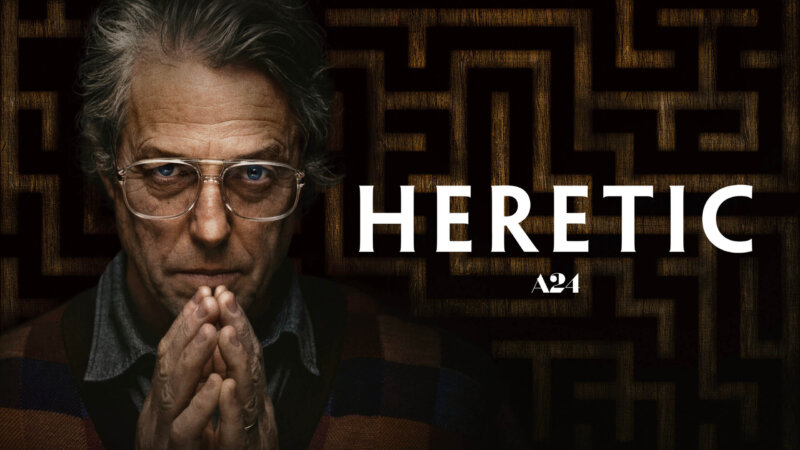
The film shows a deep maturity that is typical of the best of twenty-first century film. Dressed in a cardigan and adorned with eerie 1990s big glasses, Grant’s Mr. Reed represents a particular type of charming weirdo.
One of the main points of the film is that this charming weirdo can be found trying to teach his high school biology students that “God is dead” or this charming weirdo can be leading his own cult brand of Christianity. The sadism hidden beneath Mr. Reed’s exterior pops out when he attempts to make a biting joke about Sister Barnes’s father’s death. He quickly smoothers this cutting comment under evasive charm and joking. Things, however, decline as the girls realize they are locked into Mr. Reed’s house and are interrogated by him about the history of Mormonism as well as religious belief in general.
The film, however, is not an attack on Mormonism or Christianity or religious belief. Indeed, the girls fire back at some of Mr. Reed’s attempts to reduce Christianity to merely one of many myths. Moreover, as the film continues, and Mr. Reed attempts a host of games and experiments (including one involving the murder of one Mr. Reed’s slaves that he previously had captured), Mr. Reed proves himself as a foolish and fallible scientific conman who lives in a world of delusion and his own personal atheistic mythology.
Sister Barnes is also revealed to be much more worldly wise than it appears, and Sister Paxton must confront the fact that not all Mormon missionaries follow Mormon morals.
Sister Paxton reveals herself to be the true hero of the film who practices true faith under extreme threat and charity for others—one of the first things she does when she discovers one of Mr. Reed’s slaves is give the slave her coat.
Mr. Reed, proven to be a fraud and cruel maniac who deludes himself with his own atheist narrative ultimately reveals himself to be a man both desperate for affection and a pervert.
This is one of the films other themes: the reality of corrupted human sexuality in the background of human interaction. Indeed, the film begins with a contrast between a shot of a numinous mountain top and a very crude conversation between the Mormon girls taking place while sitting on the bench adorned with an explicit image—more sensitive viewers might want to skip this scene or “Vidangel” it out of the movie.
The message here provides a twist on one of the key points in Harvard scholar Harvey Mansfield’s recent book Machiavelli’s Effectual Truth: Creating the Modern World. As the Italian Renaissance philosopher Niccolò Machiavelli noted, some people attempt to hide their (wounded and sinful) humanity behind religion—with disastrous consequences. In a similar manner, the secular Mr. Reed attempted to hide his pervy desires as well as his desire to control and hurt others behind a smoke screen of scientific rationalism.
Despite the effusive praise it has received, Heretic is not a perfect film. The cinematography is tight and beautiful for much of the film, but there are odd close ups at points, showing the girls nervousness, which are a bit much. Moreover, the “gross out” and “fear factor” moments involving Mr. Reed’s torture of his slaves over the top and more at home in a different gorey horror film.
The ending of the film will not leave Christian viewers entirely satisfied: the message seems to be a combination of Christian charity with millennial New Age “magic moments.” However, the film, despite its few (moderately) lewd moments, provides a sober and mature vision of both faith and doubt. Christians are well aware of the abuse committed by some of their leaders. Christians are also well aware of atheist “gotcha” critiques of historical Christianity. At the same time, Christians in the twenty-first century have matured because of these critiques from the often saccharine and naïve Christianity of the 1990s and 2000s.
Moreover, people in general are well aware that jumping off the life raft of Christianity into various twenty-first century alternative spirituality as well as atheist movements by no means guarantees that one will be part of a movement free from corruption and abuse—indeed far from it.
The ultimate message of Heretic is that prayer, despite being ridiculed and scoffed at in our disbelieving age, does, in fact, work and that love is greater than any evil.


Related Posts