Finding Light in the Darkness
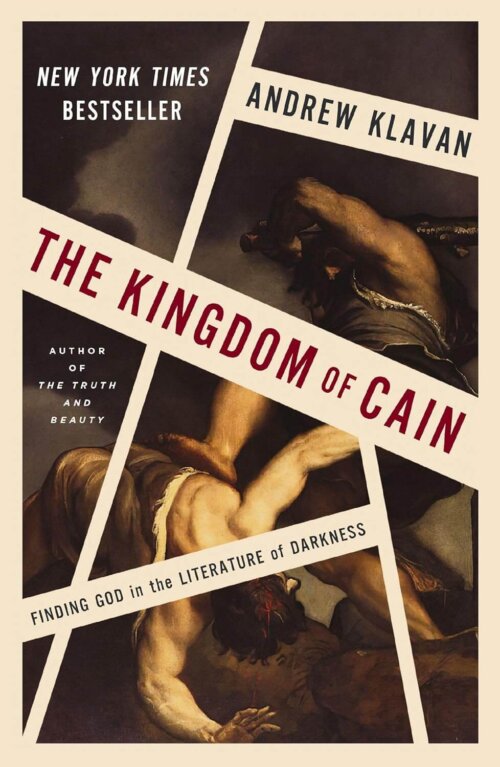
For his most recent book The Kingdom of Cain (2025), Andrew Klavan received an endorsement from Eric Metaxas and was invited to the latter’s “Socrates in the City” podcast to discuss it. Klavan is better known as the author of murder mysteries and in his new book provocatively endeavors to analyze such “literature of darkness” from a religious perspective. Metaxas, it must be stated, is the author of a book on the German pastor Dietrich Bonhoeffer, a courageous martyr who stood up to the face of perhaps the greatest evil of the past century: the war his own nation released upon the world. The book was published in 2020, not so long before the Russians inflicted war on Ukraine and Hamas’s horrendous attack on Israel and perfidious weaponization of human shields to wage war. And so the problem of evil has returned to a re-instigated history, or it can be interpreted as the devil having returned to the grand scheme of history, if he has ever left.[1] This also makes Klavan’s book especially pertinent. As its subtitle intimates, that is “finding God in the literature of darkness,” the question arises where is God in such times. To answer that question, for a start it is best to do as the author does: instead of studying killing fields, start with the single murder. As becomes clearer through Klavan’s penetrating reflections, this question concerns each and every one of us.
For those unfamiliar with the author, Klavan was primarily an author of murder mysteries of some renown. One of them was adapted as a movie by no less a director than Clint Eastwood. And the storyteller is present in this book as well. More significantly, a couple of decades ago he converted to the Christian faith. He even wrote an autobiography that gives an account of his transformation. In the current book’s introduction he continues this account. In his earlier book which the author quotes, he claims, “I prided myself on seeing and describing the world as it was, not as I wanted it or thought it was supposed to be.” After his conversion his life became “centered on Christ” and he essentially became a Christian novelist. But he surprised even himself in the darkness that emanated in his work, despite the joyfulness that emerged in his life. He explains the darkening of his vision that came across in his writing from an “acknowledgement of the existence of God” which requires one to “confront the reality of the moral order.” Among other things, this order is not “a social construct, or a subjective narrative dependent on culture, time, and place.” And so for a time he continued to write murder mysteries in this light, or rather darkness.
Writing this book, Klavan engages a straight-forward principle: a reflection upon “murder and the imagination.” And he explores the Christian imagination at one end versus the atheistic one at the other extreme. For the former, murder is evil. And this seemingly simple judgment is hardly so at the other end. He cites American philosopher Sally Neiman who blandly states she “will not offer a definition of evil”—something she considers superfluous a century after Nietzsche. Much of the book studies the results of the consequent inability to define evil when faith is lacking or even denied, and that includes within historical and contemporary terms that are closely wedded in the art of the kingdom of Cain, the author perceives to be our world. And this is what Christians must appropriately respond to in a world where there are no happy endings: “We are called to creation, the telos of love…. We are called to joy. Now. In a world full of murder.”
The core of the book is divided into two parts. The first analyses and discusses three murders and the works of art that reveal or struggle with the nature of their evil. In some cases, the works are inspired directly by the murders, and in others, they are a consequence of such earlier works. The second part is a rather personal reflection on the part of Klavan in which he reflects on creative practices, as he puts it, that make it possible to confront the elicited evil “with love and, through love, joy.” He is aware that sounds like a contradiction; what he means is “preserving the gusto of living, even when you are living honestly, which means acknowledging grief and pain.”
The point of departure for this ambitious effort begins with a gruesome murder by an elegant French thief, Pierre Francois Lacenaire, who wrote a memoir with philosophical musings before his execution, that caught the attention of Fyodor Dostoevsky and inspired him to write the classic novel Crime and Punishment. The Russian author was not taken in by the sleek criminal. In his account of the latter’s trial for a literary magazine, he wrote the killer possessed “a remarkable personality . . . enigmatic, frightening and gripping.” Although attempting to “set himself up as the victim of the century,” he added, this was a deed of “endless vanity.” This understanding undergirded his own literary portrayal of the deed. Working from a Christian perspective, Dostoevsky introduces a killer who finally understood the evil of what he had done.
Fredrich Nietzsche published his first book several years after Dostoevsky published his. Although he rejected faith, he was terrified when he attempted to predict what might follow the collapsing moral order. However, his sister and literary heir fashioned his work in a manner that pleased the subsequent leader of National Socialism — Hitler even attended her funeral at the onset of the century. Catholic philosopher Rene Girard summarized the consequences of the National Socialist way of being Nietzschean: “Nietzsche shared with many intellectuals of his time and our own a passion for irresponsible rhetoric in the attempt to get one up on the opponents. But philosophers, for their misfortune, are not the only people in the world. Genuinely mad and frantic people are all around them and do them the worst of all: they take them at their word.” Ideas have consequences.
Dostoevsky’s novel inspired two movies by Woody Allen, Crimes and Misdemeanors in 1989, with the title referring directly to the novel, and subsequently Match Point in 2005. Klavan notes that both are the same film at their core. “Allen’s struggle with Dostoevsky,” he points out, “dramatizes the cultural elite’s attempt to free itself from the logical conclusion of a moral order: the existence of a God who holds the lives of others dear.”
The next murder Klavan studies is a terrible crime by the psychopath Ed Gein, who murdered women in the American Midwest of the 1950s, wearing their bodies as costumes. This inspired a novel which in turn inspired Alfred Hitchcock to make Psycho. This cinematic masterpiece subsequently gave birth to the slasher film genre, with its mixture of the occasional serious film at one end of the spectrum, to trash and torture porn. The novel and film The Silence of the Lambs was also based on the Ed Gein murders. Klavan points out “the theme of this cycle is… the confusion of sexual identity, but it is also the role of psychiatric theory in creating and confronting that confusion.”
The author saved the first murder, the killing of Abel, to the end of the first part. In the interview with Metaxas, he admitted this was the most difficult part because it cannot be demonstrated by specific works, since to some degree all works deal with this question. It is the cruelty and injustice so powerfully present in the world that demonstrates we live in Cain’s kingdom. The problem is how to deal with such a virtually omnipresent question. The author chooses to encapsulate this through “trac[ing] Cain’s continued presence throughout the Old and New Testaments because [Klavan] believes the Bible contains, in microcosm, all history and all art.”
The second part of the book is the author’s more personal response to the dominant issues brought up in the chapters of the first part. The first chapter reflects upon the ritual of communion as an answer to the elegant first murderer and the collapse of the moral order that followed. The second chapter looks at atheistic psychotherapy, which he himself experienced in his time of dire need, and how paradoxically the restoration of sanity opened him to accept God’s grace. He summarizes the matter: “This is my answer to Ed Gain and, through him, the misbegotten nature of today’s therapeutic culture and the gender confusion that has arisen along with it.” The last part implicitly follows Dostoevsky’s prophecy that beauty will save the world, but it is a Christian beauty that Klavan envisions in the most successful art.
So how does the author proceed to confront the collapsed moral order within the kingdom of Cain. The point of departure involves comprehending the goal to maintain it and understanding the obstacles. His personal foray starts with the name he was given by his Jewish family: Chaim, that is “life.” But although he had rejected the religion of his family, he finally understood the fullness of life when he became a Christian. He subsequently concentrates on how the collapse of the moral order was understood. Nietzsche understood the consequences, yet he could not accept the Judeo-Christian “slave mentality.” Dostoevsky predicted the collapse, but mourned that without it, “egoism, even to the point of evildoing” logically becomes the honored norm. Indeed, it is in the vision of the Marquis de Sade, who understood that: “The strong who immolate the weak, the weak victims of the strong: there you have nature.”
What can we do to counteract the kingdom surrounding us that resonates in the art inspired by Lacenaire. Klavan’s conversion led him to rituals that brought life. “In the ritual of communion,” he insists, “we live the story of Christ’s sacrificial passion.” Thus, in this and other rituals and inspired works, “we teach the body to know itself beyond material reason…. Not so we can lose our joy in living but so that joy might be complete. Now and forever.” In this he has fulfilled the promise embodied in his family name and can proclaim: L’chaim.
Next, Klavan enters the most personal part of the entire book in the chapter with the significant subtitle “The Role of the Therapeutic.” In discussing this question, he provides the example of his own journey when he himself suffered severe depression and required psychiatric therapy. The therapy was successful, but he eventually realized that it was not the therapy itself that provided the ultimate cure, despite the brilliance of the psychiatrist; it was the love that evolved between the therapist and himself, and that process and its aftermath transformed him.
The author informs us that the therapist was not a strict Freudian, rather a neo-Freudian. Nevertheless, he himself became profoundly Freudian to the extent that he took on the materialist world view it engendered. But studying the atheistic philosophers that inspired him, eventually led him to the conclusion that they could not explain the moral order that even Freud had understood existed. It was actually the Marquis de Sade that helped him understand that: “the road to unbelief led to a hell of cruelty—cruelty unto murder, if only in the mind.” Once his sanity was restored he understood the false nature of Freud’s psychotherapy, which research has since confirmed. He indicates how art has unconsciously illustrated this by the evolution of the traditional psychiatrist in Psycho to Hannibal Lecter, “the cannibalistic author of evil who used his sophistication to manipulate and destroy the minds and bodies of lesser men.” Klavan applies the earlier analysis of Girard to conclude: “As with Nazism and Nietzsche, therapeutic libertinism and its blithe ignorance of the Sadean evil lurking in our flesh was inherent in Freud’s approach.” This understanding led the author to faith, which at one point he confessed to his erstwhile therapist. This upset the man, and he never fully understood Klavan’s path, which he relates to the reader: “It was he who had given me the tools I needed to find the faith that completed the work he had done…. It was he who had broken the mirrored walls of my prison and opened the door so that I heard the music of creation singing to me from the world beyond.” The author’s experience proves that despite all he can teach us through art, at times life is indeed stranger than fiction — and more wonderful.
Klavan feels only in art and beauty a theodicy entailing a faithful response to suffering can be suggested, that “no mere philosophy can provide.” In the last chapter of the book, by means of this conviction, he provides his “answer to Cain.” What underlies this conviction is a sense that currently the arts, that have essentially lost their connection to faith, are in decline. “Since beauty is an expression of God’s nature” he claims this should not be surprising. What is most fulfilling in experiencing art is expressed in C.S. Lewis’s dream “to be united with the beauty we see.” And this he creatively attempts to provide the reader by means of an imaginary journey through symbolic Western art.
The author takes the reader through an envisioned crystal gallery that is entered through massive doors, and the journey is then initiated at a crystal foyer. The details of what is subsequently seen are quite elaborate. Soon, we come to the artistic vision of creation, so Michelangelo’s fresco from the Sistine Chapel unfolds, and the image of God and Adam are confronted. The space between the fingers of the creator and created are dwelt upon: “it is the locus of our faith and freedom. And of beauty, the transit of the heart across the infinite in-between.” The Renaissance is further presented with its exquisite beauty and understanding until the more contemporary symptomatic works conveying their declining beauty drag the viewer downwards. In the Picasso Room the space is full of bits and pieces, “Shapes suggestive of humanity.” That much can be said, with beauty virtually absent, which Jackson Pollock subsequently fully abandons.
The author then leads the reader to the top of the crystal tower. Now Michelangelo’s Madonna of compassion—commonly known as the Pieta—comes into view. Klavan explains that it is a marble image of “the greatest suffering that can happen.” He goes on about a mother losing her adult child: “a man of perfect innocence condemned to death.” He explains the history of the event portrayed, which ultimately is:
The logos of the world murdered by the world. The author of the moral order, the bridge across the empty space between time and eternity, the spirit that poured down into Mary, out of Mary, dead on Mary’s knees. (. . .) His death is the death of creation. The world that began with the murder of Abel has evolved into the kingdom of murder, the kingdom of Cain.
Yet the ultimate tragedy of the world that has been depicted in the work has been carried out with extraordinary beauty in white marble by a human artist. Klavan concludes: “We live in the kingdom of murder. But if out of our suffering such beauty can come, then surely there is another kingdom.”
The insights attained by the Klavan when he found the road to faith that the Creator has, for each of us within the woeful kingdom, are presented quite forcefully. The master storyteller finally found the true story. Looking around, we also see that the devil has not been locked away in history; we see his presence all too clearly in the wars that have erupted so close to us. In the kingdom of Cain, we cannot forget his evil aims toward each and every one of us, as Klavan’s reflections remind us, and we can only make our own acceptable sacrifice, in the manner of Abel, to our Lord if we open ourselves to the love that is for us and within us here. That is an indication of the greater love that ultimately awaits us.
The Kingdom of Cain: Finding God in the Literature of Darkness
By Andrew Klavan
Grand Rapids, Michigan: Zondervan, 2025; 272pp
NOTE:
[1] See, for instance, Vladimir Tismaneanu, The Devil in History: Communism, Fascism, and Some Lessons of the Twentieth Century (Berkeley: University of California Press, 2012).


Related Posts