Fooling the Intellect: Davos
There are places that are more places than others, because they exist in reality and on maps, but even more so in the pages of the novels that have re-created them. Like Davos, in this case by Thomas Mann’s The Magic Mountain, when the writer mentally reshaped Davos. A tale of transformation was written, glued together with the glue of lies: assigning an aim and an action to death. This writing focuses on two related examples of fooling the intellect: one is the writer’s mental production, the novel situated in Davos, which claims that illness, chaos, pain, and weakness could be the source of any creative transformation, and the other is Davos, the place, where particular gatherings occur every year, since decades, for changing the world by imprisoning it into transcendence, or a power based not on matter but energy wavelength. None of them is novel, as they are only furthering the transformation that is going on since centuries; and both, in their different ways, seek radical change by invalidating God’s principles, instead making him invalid and cancelling out his existence.
Davos: The Berghof
Davos became the emblematic name for an intellectual foolery. The lie was hot and sweet: what a beautiful landscape (the Schatzalp), what an irresistible love (the engineer and Madame C.), what a wealth and comfort in the Berghof; all this was like a drowsy island, designed for sensual, visual and culinary satisfaction, and in addition for hygienic comfort: the bathtubs and toilet seats had heated rims, the food-elevators connected the main kitchen with all three floors of the building. The rooms had steps leading up to the balconies, thus making it possible to enjoy more hours of sunlight and the view from the balcony. But instead of full, healthy people – ennobled by toiling, clinging to one another, persistently holding on to each other’s company – Berghof was the home of illnesses, its comforts something that ill people grasp as sweetmeats in their sluggish lethargy. So Berghof lied, and this lie was also bitter and sad, the smell and taste of death. Something was at the end here in Berghof: the human common sense of noble laws and truth and goodness and beauty. Berghof clinged on to an impossible transformation, of becoming healthy again. None of the protagonists of the novel show much consistency and affinity to reality: the engineer, the soldier, the two educators are all false characters, made up for the showcase of falsity.
As a result, only one transformation occurred, the natural one, which does not require too much philosophical or intellectual discourse, the final and acceptable one, to which we are also led in due time, without too much ado. The soldier died prematurely in the Berghof Sanatorium, the engineer probably in the war, and of the two educators one in a duel, the other in one of the poor rooms that he rented in the small village, Davos Dorf, as he could not afford the Berghof sanatorium. They, the characters are fundamentally listless, dull and soporific: however the author grants them a foolish intellectual significance by making them ill, making them special in this way. This operation liquefied the joints between the healthy: first by making them orphans or outsiders, and anyhow making the genuine links between people disappear, thus creating fooled cripples, without movement and a will to action as a way of life, even before creating the illness for them. Thus a world of fools, a slavery to illness was created, a society where the law of nature would be annulled, where no weaklings will perish, where every fool will have as much sensuals as he wants to acquire, as many pleasure a days as he desires, and where all will marry and have progeny – as nothing else is required from them but appetite.
In addition, with an equal pleasure the writer was pleased to give this one foolishness, the submission to sensuals, to one united people – to the people of Berghof at Davos, people who were mostly well off, once active but now without the possession of health and activity, so all professing the same religion of naked survival, attached to the same principles of illness, so very similar in their manners and customs, and who (by definition) were unable to establish or actualize any noble action or virtue. The engineer was not an exception. Being an orphan, without any possessions of virtue or property, he gave himself early to the general nihilistic mood. His two educators were not different either, their confronting ideas were just each other’s mirror versions: Enlightenment liberal stone-mason-ism has evolved from the same secular magic root of creative destruction as anarchist Jesuitism. They do not sound real, neither give concrete substance to any action; no, their ideas are rather substantiated into voided non-actions. Finally, turning to the case of poor Joachim, in his blind determination to submit to dying he ran into the throat of death. In contrast, anyone who intends to actualise his goals and priorities across life must be par excellence strong, keeping to the highest degree this optimum.
Davos was the end of the feeling that we are not alone, that we have reality, and life is worth living with virtue — because the author lied. This lie about death pathetically touched every reader, and so engaged them with loneliness and nakedness. This Magic Mountain stands in opposition to holding on, as much property optimum as possible, to have as much defence against death as possible, as was normal in a pre-magic world. Now, in the novel, the opposite is the case.
On the ruins of the pre-magic world the author offered a lying vision and worldview. The Magic Mountain was not simply an artistic creation, but a visionary propaganda of magic, our transformation into belonging to death, as a goal and as an action, when death is not something comprehensible in reality: everything stops there, even understanding. However, if we assign a goal and an action to death, the only thing that can result from it is a vulnerable, naked, voided state, as we are violated in the right to existence. In such a vision, we are becoming constituent elements of a deadly movement of magic whose terminus is the vision of nihil, and where we come to desire death with the fear and suffering of submission. In the last pages of the novel there is a proper description of this state: disgusting, revolting, bodily scenes, with humiliation and loss of human names, and an animal-like howling of the mass that responds impulsively to everything it feels. Fear of death, horrible strikes, stings – everything we were used to and that could be called order is now turned into a battlefield. Dangerous and cowardly, such slimy, steamy, tasteless reactions dominate the scene, produced by men who lost the undamaged treasury of life that would provide the capacity of virtue, grace, and goodness.
In reality, the world falls apart under minimal pressure. It ceases to be a living, organic formation if there is no comprehension anymore. The world as ample and complete in volume, in richness of characters, the courageous and the ordered world is very delicate and frail. It disintegrates if there is no longer a minimal coherence in principles that comprehend, maintain, and unite the original aggregates. These can be easily broken or damaged. The world is exquisitely fine or dainty, requiring special treatment or careful handling. But Davos acted in the novel as a brutal savage which stripped the world of civility, laying it bare, one of the strongest suggestions by a talented author, who resigned himself to the end of the earlier comprehension, that the world was falling apart, ceasing to be a living, organic formation. As man cannot endure death, cannot live in the closeness of death, must transform both, transform death and transform himself. The novel tried each: playing with immortality and fooling with overcoming man.
Of course, the author noticed this, and not accidentally, as he was the greatest writer of the century: the special nature of death is as regulated and perfected as any autonomism, yet it defeats any being exactly because of its mechanical character. And this was just the point at which Davos started to metamorphose into its current form, without realizing that death is outside life, is not the matter of life, so The Magic Mountain lied.
Davos: The World Economic Forum
When death becomes the matter of life, the first savagely foolish thing that has to be done is to liberate all human inclinations, even the lowest, from the forbidden barriers of culture. This even becomes something like a right and an obligation, a dirty task, the poisoned catchword. The second is to destroy all organic order, and we should always remember that we are the carbon that Davos wishes to eliminate. And this annihilation will be soon total, once it begins to act. Death and darkness, like an epidemic, will spread through the world, following the magical act of dismembering by sacrifice for evoking the soul of the dead that changes the world, starting a mad course to the void. Like an epidemic that dissolves the resistance of the body, it will thus spread as a hay fire, burning up all living and concrete matter. No wonder that the resistance of the body is its soul (though paradoxically also its weakest point, as it is open to influences, like an absorbent sponge), at the same time striving for the optimum of its existence inside the body, to keep its form until the very end.
The fortitude of the soul could be trained, as with the Greeks, and could be dissolved, as with nihilism, with the youth being guided towards nihil, trained to be soulless, to submit tor nothingness. The consequences are the empty eyes and the softness of characters, present now everywhere, recalling the troubled Dutchman of the novel, who cannot express himself properly anymore, but is full of tension and sensuals towards the passions of life. He is the weak one, without properties, but with enormous desires, though without the power to execute them, the impotent one. He is suffering from unsatisfaction, until his final act of committing suicide, as if a vain action could secure his voided will to power. Breeding nihilism is a mass action, with a massified result in non-actions, like different genders and same genders being brought together by the ‘passion of action’. This particular emptiness and impersonality, which is so outstanding that even if it is institutionalized in infancy, in institutions organized as quasi-brothels for a promiscuous, arrogant and impersonal mass of wretched and scoundrel entities, it will remain deprivation. Liquid lecherousness is already present in the engineer’s overwhelming desire for the Madame, the worthless one, who gave herself to decay and ill reputation, as he himself recognised by the very first acts through which she let herself be noticed: the impolite and repeated banging of the door. Her usual threatening gesture, as she was glancing sternly but slyly around, and how she moved across the dining room of the Berghof were ‘how it was done in all the brothels’, according to Leo Tolstoy in War and Peace (Book Eleven, Chapter VII). They did both know, the engineer and the madam, that they did not need anything more to satisfy their desire than to wait patiently for the lucky opportunity. No quality was needed for their love, only passive non-action. Even if there were passionate courting words, these mainly centred around the desire for the body, and on the other hand there was an explicit expression by one of them about her availability to anyone who wanted her.
The seductive forces of death are taking on a strikingly symbolic prominence in the landscape, with the prominence of huge, bare mountains, like enormous catacombs, the same (even in name) as the master nihilist Hitler’s Berghof in Obersalzberg of the Salzburg Alps, close to Berchtesgaden, in Bavaria, which represented the identical foolishly thin plot that however expressed the many monumental imaginary dramas and immense unreal contradictions of their age. These hilly catacombs exert a charming spell on the spectators, their mechanical repetition reflected on generations of people, their smoky clouds steaming of pathos, ever affecting the emotions. Conjuring and elevating make you feel great, as being embraced by the effect of belonging to a higher One. A mountain expresses the rank – even if beyond life -, of a mechanical, monotonous order which wants you in ordered submission, obsessively. It locks you in material transcendence.
Above 1500 meters mountains are the same, ordered, regulated in their similar oneness. Strangely, they even express methods about how to live, how to escape from the chaotic lowland. Their view inspires modalities that regulate everything, and this is matched with a barren, reduced existence, without an eventful reality. They are cold and righteous, like the customary idea of divinity, often associated with mountaintops: unapproachable, fearsome and unfriendly. They also recall the barrack houses of Davos, erected recently: hotels and conference halls, or housing edifices, whatever their purpose, they equally express an identical transcendental effect, being a nothing in an unfriendly universe, or better to say, being part of a hostile God. This oneness with nothingness, however, fills us with meaning and a will to action. One should say, this is nihilism, or Gnosticism (which is the same, after all); the hatred of reality, its despising, and at the same time the ambition of erecting a new cosmos, of which one could be a part, and thus elevate himself to the position of God. The silky boys and their androgynous appearance are all for and relating to the deity, for invoking the supernatural. They are thus possessed of distinctive qualities that produce unaccountable and baffling effects, but also receive all the mysterious extraordinary qualities of power. They use various techniques, such as incantation, to exert control over the supernatural and on the forces of nature, changing their qualities into non-qualities, or creating new substances by will and method.
However full of gibberish and nonsensical their actions, they cause turbulent tides in reality, until it collapses into its elements and ceases to exist, due to transformation. Book writing is one of them, but conferences, education, films and many others are all inoculations for introducing voiding ideas, emptying foolishness into the mind. The bright light or the deep darkness of the mountains are equally silent. They do not witness anything, usually do not give testimony about sinister activities, and in most cases are certainly unaffected by human activities.
However, it is not by accident that the word “magic” is in the title of the book. The disinvolvement of the mountains could be altered by magical means, and such transformation could be carried out with profane and vile means. In the moment of transcendence, when grace and an expectation of the divine is present, so also the opposite — degradation can occur as a result of the intervention of magic, by murderous sacrifice, by dismemberment. The author gives ample examples about such change which leads to metamorphosis, through the voluntary death of one of the educators and the Dutchman, the exit of the nephew and the other educator; the whole mental change in the Berghof Sanatorium itself, towards the transformation towards a massified world, result of the Great War, where everything becomes possible. Man steps over God and calls, desires, wants death, the nihil, becoming shameless in its search for sensuals and at the same time full of fear. Nothingness becomes reality when the principles of Goodness are destroyed. This is the moment when forms break down into their elements, their cohesiveness and striving for the optimum vanishes, the world picture becomes distorted, the underworld begins to sway, and runs with an automatic bringing forth towards annihilation, which for the author is his doubtful belief in the birth of beauty, the recreation of a new world.
There is no other world than ours, unrepeatable and unique in its form. If it collapses, then this collapse is final and occurs for ever, leaving no escape from death.
Creative destruction is foolery, giving birth only to mutations, with the underworld hooking the lower layers of the body, which emits sounds due to its suffering, with a throaty voice and a gurgling pain due to deformation. Destruction is gripping the stomach, torturing the body and evoking the soul out of it, which escapes and does not return anymore to its authentic form, but becomes an accidental one, searching for a new location to occupy. The original harmony and the capacity for gracefulness has been lost. Destruction is a metallic fear, when panic and anxiety fall on the victim, he feels the dismemberment and cannot escape, the murder tramples him and dissolves his world, his consciousness and view about the annihilated world. This distortion is final, as it results in the end of energy, the finitude of the movement in the particular fermentation of crisis or decay.
This unrest, this agitation goes on during fermentation, which induces death into the form-matter. Agitation makes it split, freeing the soul out of it, the energy source according to the Ancient Magi. The Presocratic Empedocles called this special airy substance effluences, which are particularly intensive in the moment of decay, and which result in the production of energy, the famous electromagnetism that is an indistinguishable sign of magic. Fermentation converts authentic forms to hybrids and changes their carbon components into simpler forms. This moment is squeezing the throat, because it breaks the thin wall between civility and bestiality. Bestiality is not a well-understood category. I am using it here in the sense of a restricted behavior, governed by a given outside frame, pattern, or automatism, so as to respond to a given stimulus in fixed, pre-ordered ways, and not being dependent anymore on experiences, on comprehending the variety of reality.
Ironically, when Davos gave itself to the architecture of the nihil, at the beginning it went with the elegant tomb buildings of the ancient Egyptians. Berghof, the monumental sanatorium was erected in 1900, and the selection of Egyptian style seems to have been there from the outset. This style was a favorite choice for Freemason buildings, synagogues, and cinemas, also cemeteries, mausoleums, catacombs and memorials, baths and swimming pools, or tombs (see more in Gwyn Headley and Wim Meulenkamp, The English Folly: The Edifice Complex, Liverpool University Press, 2020); anything which has a liquid or similar associated meaning, in contrast to the stability of forms.
Both the water of a bath, the swimming pool, and the films in the cinema have mind-disabling properties, as they differ from what we are accustomed to. We do not usually walk in water, and only enter the pool if something irregular, non-customary, or unusual happens with us, just as watching a film is an exclusive activity, differing from the way we use our eyes during the ordinary events of life. They both make walking or seeing, the most basic ordinary human activities, impossible in the normal way. They thus offer false perceptions, and so following Empedocles result in the sudden growth of effluences, combined with disabling properties. This is the usual effect of burial ceremonies, when the whole community is present to say farewell to the defunct, a big emotional drama that makes effluences grow. The Egyptians designed their monuments to receive and transfer these sudden outbursts of effluences to the otherworld.
The Idea of Danger: WEF Plays with the End of Times
So, the paradox is that effluences are growing when the mind is disabled. Funerals occur when the mind is helpless and the danger is close. The body works through perception, and perception is higher and more intensive in moments of danger, or when something unusual is happening. It does not merely offer a passive reaction to or reflection of external objects. Thus, such events have a disabling effect on the mind, while at the same time they are exciting the senses, which are answering with effluences to the various, continually rising effluences that are coming forth from perceived objects. Goethe developed his theory of colours on the same ground. But the idea of danger has not been examined so far, that is squeezing the throat, gripping the stomach, torturing the whole existence with an immaterial and impersonal panicking anxiety which accompanies the excitement of the effluences: an electrification. When the ‘Mago, Empedocles,’ as Pliny the Elder called him, came out with his effluences-idea, Plato (Theaetetus, 152e) soon marshalled Empedocles together with other Magi, like Heraclitus and the sophist Protagoras. Those who know the secret of effluences, which can only be known through magical practices, know that they are rays, or electric impulses, as Plutarch (De facie quae in orbe lunae apparet, section 18) intimated .
Effluences have disabling potentialities, this is why Plato called their knowledge ‘bastard knowledge’, a knowledge which is not led by principles but by stimulations, which can result in false and subjective perceptions, especially if the senses are miseducated and receive mind-numbing distractions from the outside through the prevalence of actors, secrecy, and potential manipulation, deployed in order to silence the cautious self-preservation, and instead unleash the evocation of the self into self-annihilation through excited, pulsating effluences, closer to death than anything else.
This evokes the open gates of Egyptian architecture, which open to the other world for the free flow of the souls of the defunct. The first Davos experiment of evoking the soul of the engineer ended with the war, when not one but millions of souls were sold to the realm of Death, so the design was already there for further elaboration. Only two things were necessary for continuing the experiment: one is a well-developed espionage network, and the other is plenty of amusement, jointly securing the control and the entertainment of the masses. With one particularity: unlike other closed systems, modern nihilists did not require people to be converted to their ideas – we have not seen Hans Castorp converted—rather, the psychopomps, the soul guides allowed everybody to retain any cultural practice as they wished. What is more, this plurality was encouraged and populated by the conductors of souls into the afterlife, which played a vital role in the rise to power of amusement masters.
In terms of its contents, this plurality can be divided into three categories: sorcery, or conducting magic activities; sexual misconducts; and rumours accusing established figures of this or that to create images about insufficient authorities. Besides, new scientific disciplines gained territory with the exact aim of measuring, analyzing, and spying upon society, until its last constituents.
This policy had two advantages: soul-catchers could wear the robe of educators, while maintaining close contact with magic, and could relocate their knowledge on a new plane, in-between new people. However, sometimes such translocation was a complicated undertaking, due to the notorious reputation of magic. The arrival of new educators was naturally regarded as a severe threat to local stability, leading to ambiguous and uncertain social circumstances. Nevertheless, as the Davos WEF shows, this can be mollified, through the building of conference halls, maintaining contact with the state authorities, seeking to attract the highest circles, establishing a close-knit organization, performing a learned appearance within the confined spaces of politics and science, and so forth. Though these were seen at the beginning as a severe challenge to the existing social order, the security of society, a danger in the eyes of elite authorities and local commoners as well, the general feeling of peril has slowly disappeared.
Abducting the soul from the body, drawing it away from the body, is a serious undertaking, and Berghof as a funerary edifice, with its hills that look like catacombs, the whole storyline with the engineer who became a living dead in the eyes of the world is grave in manner. So it was not so difficult a matter, meriting a great concern, to see the sexual-appetite demons at work, who stole his soul through amusement masters.
We see him, in the horrors of the present moment: when man is left without life, history, tradition, in a naked, pitiful state, because nobody can endure the void, its lying unreality, the lack of content. He moves helplessly towards the final event, drunken, stupefied, giving himself over to fate. The void began to grow in the nerves of man, and by now has already grown into a force.
Afterthoughts
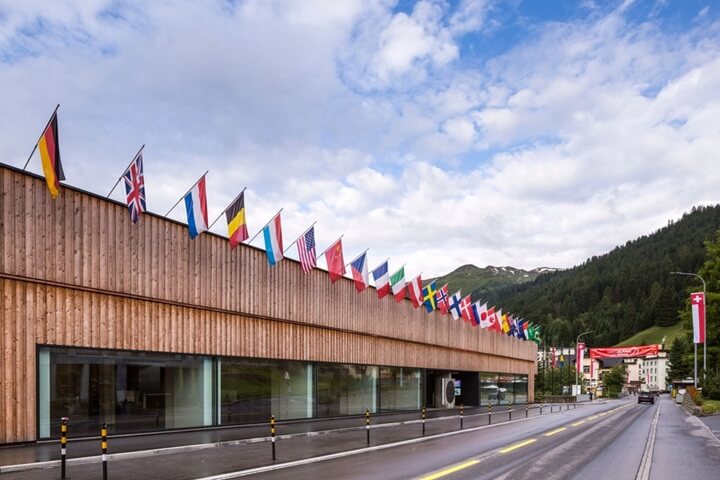
After the first night in a Davos hotel, in one of the thousand barrack buildings of Davos, one certainly got the phalanstery feeling of a pseudo-existence on the ruins of reality, where citizens equally possess nothing; instead, everything is held in common, in prefect osmosis with the One, à la the City of Adocentyn in the magical Picatrix. The magical endeavour, when it comes at the end to reducing everything to the building of walls and the planning of rooms and passages in a phalanstery! The barracks of Davos, the nightmarish conference centre (see photo), with its embarrassing tunnel entrance, the golden egg Hotel, and above all, Berghof as the cultic entrance to the otherworld and the final end of the catacombs. The phalanstery is ready, indeed, and yes, our human nature is almost ready for the phalanstery—easily fooled, giving itself to bastard reasoning. After all, these convenient sensuals which lead our perceptions are so convincing, even if they are too soon for the graveyard, too good to be true. Davos does not allow anyone to die, but keeps bodies going into eternity, where their perceptions of sensuals are the energy sources of the One, with or without their carbon based body, which is already transformed into inorganic life, as if the WEF had already known this.


Related Posts