
The Enduring Relevance of Human Dignity
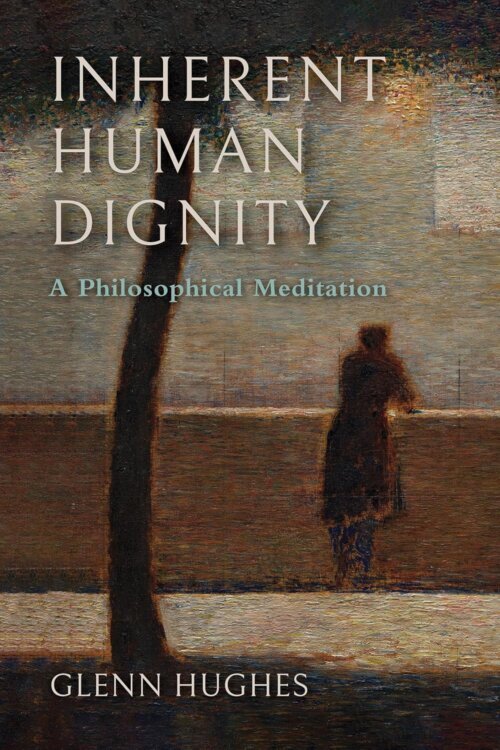
With the notable exception of continental philosophers, twentieth century thought was dominated by analytic thinkers and positivism. The variegated forms that these took and their attenuated values marked a devastating and lamentable departure from reflection on the human person. The twenty-first century continues to accentuate this intellectual and cultural debacle; taking the sorry state of sterile and politicized academic philosophy into an unprecedented moral, cultural and intellectual gutter.
Today, thoughtful thinkers ask themselves, can the rut of academic philosophy continue to fester? What would a suitable corrective to this dearth of imagination and genuine philosophical reflection require?
Glenn Hughes addresses these and many other relevant concerns about the state of contemporary philosophy in Inherent Human Dignity. Eschewing academic jargon, neologisms and other expedient social/political forms of acadamese, Hughes has written an intelligent book that presents the inherent and essentialist superstructure of human existence to a general audience of reflective readers.
One fundamental reason that Inherent Human Dignity is a timely book of philosophy is due to the author’s marked Christian treatment of fundamental aspects of perennial philosophy.
Late postmodernity is an age ruled by the dehumanizing infringement of philosophical materialism and its many variants into all aspects of human life. This takes the form of biologism, psychologism, scientism and many other forms of reductionism that reduce the human person to a wispy and diluted effect of matter.
Hughes counters the ever-expanding tentacles of philosophical materialism by addressing human concerns of an existential order, which in spite of attempts by philosophical materialists to de-form the essence of the human person, remain ultimate metaphysical questions that display a transcendent nature.
Being at its core a book of philosophical anthropology, Inherent Human Dignity poses the question, what is it about the human person that differentiates it from other forms of being? Hughes goes to the core of this perennial human concern by arguing that to ask this question is already a sign of the privileged position that human beings enjoy in the hierarchy of being – what the author refers to as the transcendent mystery – in a chapter entitled Eclipsing the Transcendent Mystery.
Inherent Human Dignity is divided into twenty-one short chapters, not including a foreword and epilogue. The author contemplates the place of man in the cosmos through a nuanced appeal to human nature and the essences that inform human reality. Hughes achieves this by positing the importance of self-reflection, a necessary facet of the lived-experience that serves as the ground of understanding and knowledge about man, the cosmos and time.
By locating the essence of individual persons in their inherent and intransferable spiritual fingerprint, Hughes goes on to assert the meaning and values that human exceptionalism proffer for human existence. The author tackles meaning and values by appealing to Christian values, which humanize the here-and-now and man’s carnal physical reality.
Inherent Human Dignity is a work of Christian humanism that respects the self and man’s fundamental existential condition. In this regard, Inherent Human Dignity is in keeping with the Catholic existentialism of Marcel Gabriel. Hughes writes: “Why is it reasonable to claim that humans are born with a special value – a dignity – peculiar to them?”
Hughes explores human existence from within, what is the guiding impetus of the lived-experience and what the Spanish philosopher José Ortega y Gasset refers to as interiority, and Bernard Lonergan Self-Appropriation.
By focusing on the essence of the human person as the ground of meaning and values, Hughes contributes vastly to the most ominous and unprecedented threat that man has ever faced: Artificial General Intelligence (AGI). This is the second reason why I contend that Inherent Human Dignity is a timely book.
Hughes is explicit about man’s capacity to link meaning and values with the mystery of being: “Thus I am aware of existing as a conscious participant within a process of reality, as an infinitesimal part of this process, intelligently aware of my personal existence.”
If late postmodernity is truly serious about argumentation – a contention that I believe has been subsumed to mere technological whim – Hughes’ presentation of the human person as possessing an integral dignity, a being capable of knowing itself from within, serves as a counterweight to artificial general intelligence and the further zombification of man.
Inherent Human Dignity is akin to a balance scale that weighs immanence and transcendence. The fulcrum of the scale is man. Hughes reminds us that man is an existential being that can appropriate physical reality through a metaphysical/existential lens that does not belong, properly speaking, to the objective, physical realm.
On closer inspection, taking time to reflect on the objective order of nature, we quickly realize that the cohesion, logic, logos and language that man uses to organize human reality are all extra-natural, that is, metaphysical in makeup.
Hughes’ existential trek into philosophical anthropology reaffirms that man is situated at the top of the hierarchy of being. The objective realm of physical reality does not cease to exist in the absence of man; it just ceases to mean anything in itself.
Inherent Human Dignity: A Philosophical Meditation
By Glenn Hughes
South Bend: University of Notre Dame Press, 2025; 152pp


Related Posts