Freedom for Authenticity
“Freedom demands that individuals resist domination as much as it calls them to oppose being the perpetrators of domination.” – Melvin Rogers
I could be overplaying my hand here, but I take Rogers’ quote to reinforce my thinking regarding humanization and authenticity. My own individual freedom, I think Rogers is saying, consists not only in my not being dominated by others, but also in my refusal to dominate others. To be crystal clear on this point: my refusal to dominate others is relevant not only for the freedom of these others but precisely, and perhaps counterintuitively, for my own freedom. If I’m dominating others, I’m not free. And this is no mere pragmatic calculation: that dominating others invites reprisal and therefore endangers my freedom. No, I am, in my hypothetical, perfectly realized freedom, inherently non-dominant.
There has always been some ambivalence for me in how to understand Machiavelli’s famous claim regarding society’s “two humors.” The nobles want to dominate and the people want not to be dominated but not merely that; the people also want, I have claimed, perhaps misappropriating Machiavelli’s thought, not to dominate. Otherwise they are not properly called “people,” that is, they are dehumanized.
One way of clarifying this is to clarify that “freedom” is sort of shorthand for “freedom for authenticity,” which presupposes that inauthenticity is our starting point: we are always already somehow less than we should be (what Rogers might call an “aspirational” model of human selfhood: “Our nature is not self-executing” but requires attention and practice). One is not “free” to do whatever one pleases (mere license) but free to become authentic. Implicit in this very distinction, though, is a critique of the idea of mere license as the desire to do “what one pleases.” My usage of “authenticity” should convey that I don’t finally know what I please. This uncertainty is foundational for all I have been saying and want to say.
Uncertainty—regarding who I am and much else besides—is constitutive for the human condition, and calls for humility (I don’t know what I should do) and charity (I don’t know what others should do). This is precisely not reducible to moral relativism, since, if we don’t disavow the reality of uncertainty, we are guided to be humble and charitable. A person lacking these virtues invites negative moral judgement.
Related to all of this, I think, is Rogers’ conception of racial solidarity as “the condition for transforming the polity as such.” As he later writes, “In light of black subordination and slavery, civic virtue no longer requires attentiveness to a social whole that excludes. Rather, civic virtue among the excluded becomes the foundation for responding to the polity as a whole.”
The immediate context of this passage includes a reading of Martin Delany’s disillusionment with the capacity of white Americans to change: to abolish slavery and racial subordination. Such an incapacity to change amounts to producing unfreedom, inauthenticity, and dehumanization. The dehumanization and oppression of a slave is in the same gesture the dehumanization of the master. Delany’s disillusionment with white Americans might then be recast in terms of the intractability of the presumptuous form of dehumanization, as opposed to the oppressive form which latter is more likely to generate resistance.
One reason that “civic virtue among the excluded is foundational” for true republicanism in light of the history of white supremacy is that dehumanization among the excluded is more recognizable as such than it is among the included. Belief in what Voegelin called the “ineducability” of the included might have motivated emigrationist projects like that of Delany.
“Faith” in the title of Rogers’ book refers partly to the insistence, on the part of Frederick Douglass and others, that white Americans are potential friends in the growth of freedom and emancipation, or “susceptible to transformation” in Rogers’ words. The book carries forward Rogers’ project of showing that African American political thought, rightly construed, “revolutionizes the study of American political thought as a whole.” One way to articulate this claim is in terms of human dependence, uncertainty, and finitude—terms which resonate interestingly with Voegelin’s thought. Rogers writes,
In their struggles to contest white supremacy and transform society—in their dependence on those over whom they do not [exercise] control—African Americans often model a form of non-sovereign existence that mirrors the interdependence and uncertainty of democratic life. In other words, the specific and heightened state of vulnerability black people experience bespeaks a general form of vulnerability that all democratic citizens must confront in their reliance on their fellows.
I am viewing this partly in the light of one of Voegelin’s most memorable and affecting passages, where Christianity’s basic contribution to our understanding of the human condition is articulated:
Uncertainty is the very essence of Christianity. […] The bond [of faith] is tenuous, indeed, and it may snap easily. The life of the soul in openness toward God, the waiting, the periods of aridity and dullness, guilt and despondency, contrition and repentance, forsakenness and hope against hope, the silent stirrings of love and grace, trembling on the verge of a certainty that if gained is loss—the very lightness of this fabric may prove too heavy a burden for men who lust for massively possessive experience.
I think one sense of “massively possessive experience” that indicates a dehumanizing fall from grace is interpersonal domination. It’s in connection with David Walker that Rogers differentiates being human from being a slave on one hand and a tyrant on the other. “This in-between position [neither tyranny nor slavery] is the standpoint of what Walker calls republican liberty, understood as the absence of arbitrary power.” I think the “revolutionary” dimension of African American political thought might be located here, in insight into what Voegelin might have called the metaxic nature of human existence, the “heavy burden” of which might at least partially explain why this tradition of thought has been so unfortunately neglected. We should have the courage to advocate a freedom for authenticity—authenticity for all, especially those who have been historically oppressed and remain so as a legacy of the past.
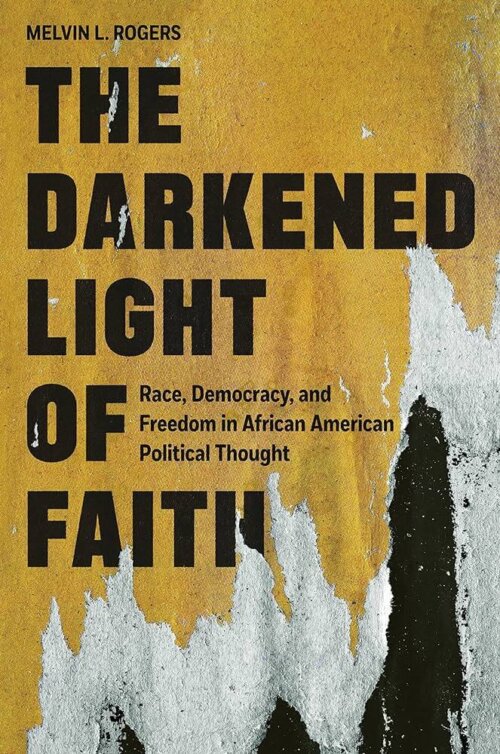
The Darkened Light of Faith: Race, Democracy, and Freedom in African American Political Thought
By Melvin Rogers
Princeton, NJ: Princeton University Press, 2023; 400pp


Related Posts