Hellenic Tantra
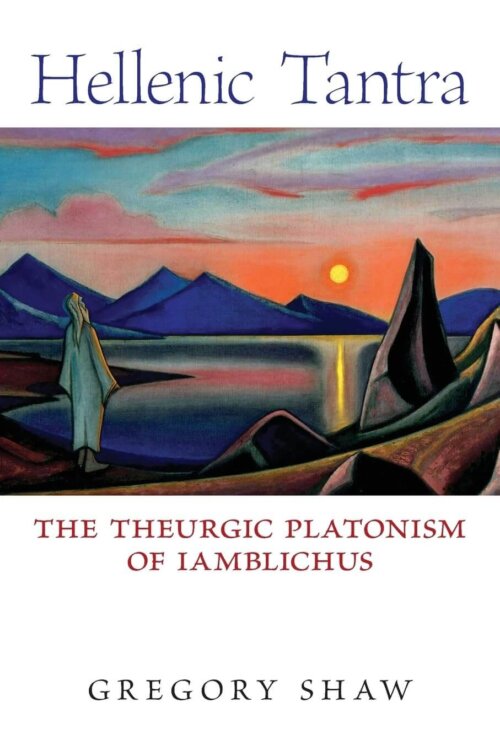
Legions of Westerners taking up seemingly benign “spiritual technologies” such as sound healing and mantra meditation often do not realize that tantric praxis also a long precedent in the history of Western religion, often described as Neoplatonic theurgy and at times adjacent to what has in some periods been described as “Gnosticism.” As such, Hellenic Tantra by Gregory Shaw draws a much needed comparison of the philosophical, doctrinal, and practical applications of the Western theurgic traditions and tantric traditions, including their core focus that by performing certain rituals, often involving sound or intoning particular syllabary, that one could “become a god.”
Naturally these contentions conflict with Orthodox Christianity, especially as it became defined in the third and fourth centuries, and as such the textual record of many of these earlier traditions was eradicated and, furthermore, leads to the arduous scholarly quest of reconstructing centuries of religious praxis based on fragmentary texts. It also overlaps, in a sense, with the Voegelinian critique of gnosticism insofar as none of these groups were ever able to create a coherent and consistent sense of community praxis; their quests towards gnosis were inner, solitary, and often abstracted away from the broader needs of society at that moment.
Iamblichus, the focus of Shaw’s work, is particularly important in this regard. First, unlike many of the other Platonist thinkers, Iamblichus is patently a “guru” in the sense that tales of miracles analogous to the shaktipat or other energy transmission concepts of Indian gurus (thinking especially of Anandamayi Ma, Yogananda, Sivananda and others) were attributed to him besides the formal system. He is also important because the translations of his works were central to Ficino’s understanding which, by extension, was the cornerstone of the De Medici regime and, thus, the Renaissance.
Despite recent enthusiasm of many practitioners for yoga, including various elements of tantric practice, it is unlikely they will achieve anything like the ostensible goal without first understanding the larger traditions in context, including their core concepts and how they differ from other inherited systems including “Platonism” as was circumscribed via the Cambridge Platonists and related disparagement of Neoplatonists and mystical or apophatic side in the post-Dodd era.
One of the core contentions of Neoplatonists, consistent with many Christian mystics from Meister Eckhart to St. John of the Cross, is that to name God is to constrain him and, thus, religious dogma can only be an entry point. In the Iamblican version this highest good is the “megiston phos,” or the greatest light, of which various rituals are made to experience this light in full form.
As Shaw states, “Theurgy and Tantra both use the metaphor of light to portray union with divinity. Iamblicus’ megiston phos, the great light that shines from above in photogia, reveals itself through celestial and terrestrial media; it coagulates itself into the cosmos, and this same light coagulates into each human embodiment. Drawing from the Stoic imagery of a noetic fire that permeates the universe, the Oracles portray deification as an immersion in divine fire. “
Related to this light and the embodiment of it several key terms are described that have analogies in both Neoplatonism theurgy and Tantric traditions. One key concept is the liberation taking place inside of the human body, described as taking the shape of the Gods (τὸ τῶν θεῶν σχῆμα/to ton theon schema) in Theurgy and liberation while living (जीवन्मुक्ति/jīvanmukti) in Tantra. Another is the manifest divine reality, described as The One (τὸ ἕν/to hen) manifests through multiple levels into matter while remaining transcendent in Theurgy and as Shiva (शिव)/ or Supreme Reality manifest through multiple levels while remaining transcendent. Another key concept is Sacred Sound, known as Divine Names (ἄσημα ὀνόματα/asema onomata) and barbarous names (βάρβαρα ὀνόματα/barbara onomata) in Theurgy and Mantras (मन्त्र) and bīja mantras (बीज मन्त्र) – sacred syllables in Tantra. Similar concepts also apply for the subtle or light body know as Vehicle (ὄχημα/ochema) and divine breath (θεῖον πνεῦμα/theion pneuma) in Theurgy and Subtle body (सूक्ष्म शरीर/sūkṣma śarīra) with vital breath (प्राण/prāṇa) in Tantra. Divine Possession also appears in both, contrasted with other forms of possession, known Divine ecstasy (ἔκστασις/ekstasis) and possession (κατοχή/katoche) in Theurgy and Divine possession (आवेश/āveśa) and immersion (समावेश/samāveśa) in Tantra. They also have critically overlapping ideas of matter. In Theurgy you have matter (ὕλη/hyle) contains divine light/power (θεῖον φῶς/theion phos) and in Tantra material reality (प्रकृति/prakṛti) is manifestation of divine consciousness (चित्/cit). Similarly and appropriately, the body is the vessel for this change,
referred to as an altar in Theurgy (βωμίσκος/bomikos) for divine manifestation and as a temple (देवालय/devālaya) of divine consciousness in Tantra. Naturally none of this appears without some action, notably divine activity (θεουργία/theurgia) transforms material experience into divine realization in Theurgy and divine practice (साधना/sādhana) transforms material experience into divine realization in Tantra.
While there are several strong analogues, including the embodied godhood, the focus on light and vibration, the matic recitations, the concept of a subtle body, and purification rituals, there are also several poignant contrasts. For example, whereas in the mantic recitations of names is an important practice in Theurgy, Shaw describes it as the “essence of Tantra” (145). Similarly the word Tantra has been absorbed and promoted in the West as sexually permissive behavior, which in the original context often has a specifically subversive context and led to a centuries long impression of tantric groups as those pursuing orgiastic license. This same focus and problematic emphasis does not appear in the theurgic traditions. Regardless, both are unified in seeing all of these components, whether including sexual rituals or not, as creating an embodied light that is equivalent to a form of godhood.
Without getting into an extended debate about the emergence of Christian Orthodoxy in the first several centuries after Christ, it is clear enough that Catholic Orthodoxy evolved into a state that prioritized post life considerations, inclusive of developing the extra-biblical idea of purgatory and selling indulgences in a purported claim to be able to reduce ascribed afterlife penalties. The emphasis of these traditions, which in some ways may map more closely to early Christianity as well, seems to be more radically immanentized in its focus on the personal perception of divine light and the body, with still a concept of God as light.
One major conclusion from the praxis of “inner light” vs. the scholarly study of gnosticism is that the two are not necessarily antithetical. The interior praxis seeking progressively higher versions of divine light is considerably different from a historical phenomenon in which absorption in collective mindstate leads to an apocalyptic epiphany and attempt at salvation from history. In this sense, there is a strong contrast additionally between a demiurgic Gnosticism of the essential evil of matter and the “nous” of Plotinus and Iamblicus which is the ultimate source material of both matter, harmony, and mathematics.
In one case, there is a tendency to a solipsism, a hostility towards matter, and, as Voegelin correctly summarized, as an “immanentize eschaton” and escape from history. In the other case, there is the concept of purifying matter through the contemplation of the good, which is simultaneously realised through leaving behind impure elements, and engaging in the contemplative life, including studying the insights of key historical figures such as Pythagoras and practically exercising of harmony through music.
Though the overall tone of the book is analytic and historical, At rare moments Shaw breaks into rhapsodic advocacy:
To understand what Iamblichus means by the “mantic power distributed throughout the whole world and within specific natures,” we need to suspend our habitual thinking and imagine a world permeated by spirit. We need to enter the vision of Romantic poets like William Wordsworth, who calls on us to suspend “the motion of our human blood [and] become a living soul.. With an eye made quiet by the power / Of harmony, and the deep power of joy… [Then] we see into the life of things.” With Wordsworth, we need to recover our “sense sublime” and feel the mantic power that “rolls through all things.” Like Emerson, we need to feel that “we lie in the lap of immense intelligence,” A World Soul. We need to recover the imagination of ancient Platonists before it was uprooted by the Church.
The historical context is clear, despite the lack of intrinsic conflict in Voegelinian terms, in the Constantine era of the Church these traditions were brought into conflict. In this sense, one can note that just as materialist science often cannot recognize the existence of anything that cannot be measured in a microscope, all Orthodoxies are at risk of reducing concepts to a binary assent to a written text. Nonetheless, a more vast and harmonic scope is possible, learning and continual contemplation of the Good manifest in many forms.
Additionally, in contrast to a mainstream academia and humanities which has progressively abandoned a concept of the Good, new areas of mathematical research overlap with music in finding hierarchies of order in the topological structures behind, Such as Stephen Wolfram’s work on Metamathematics and my own papers on encoding music via hypergraphs and multi-way turing machines, or the work of the Qualia Research Institute on the harmonics of interior brain states. Thus, in a world that often deliberately emphasizes flatness and deliberate dissonance, there may be a new science of harmonics emerging from the edges.
Hellenic Tantra: The Theurgic Platonism of Iamblichus
By Gregory Shaw
Brooklyn NY: Angelico Press, 2024; 278pp


Related Posts