Hope and Optimism on the Planet of the Apes
The rebooted Planet of the Apes movies must be among the bleakest and strangest Hollywood blockbusters of the past decade and a half. The three entries before now are dark works of apocalyptic science fiction with the characters and the world ending up in a worse place than where it started. Friends become enemies, allies betray one another, and the world itself succumbs to pandemics, paranoia, bigotry, war, and death.
The only exception to this comes among the ape characters—the only consistent element of all the movies. As a story told from the apes’ perspective, it is a strangely optimistic trilogy. The ape’s near-literal exodus from confinement to the promised land creates one of the strangest Moses allegories in contemporary fiction, while still being about humorous talking monkeys. The human characters that form the ensemble never return between movies, due to being implicitly killed off. Caesar, Maurice, and Koba are the most empathetic and consistent characters of the trilogy, and the story of apes seeking their freedom—united by brotherhood and loyalty—is the lone spot of hope in a franchise where the only possible ending is the end of the world and the fated end of mankind.
Considering these are being made as a prequel to the original beloved 1968 Planet of the Apes, much has to be in place for the inevitable future of the year 3955—when apes rule the Earth. Caesar’s apes eventually evolved into the dominant species on the planet. And with the recent announcement that Kingdom of the Planet of the Apes is the fourth in a nine-part saga leading up to that, there appears to be plenty of stories remaining to tell.
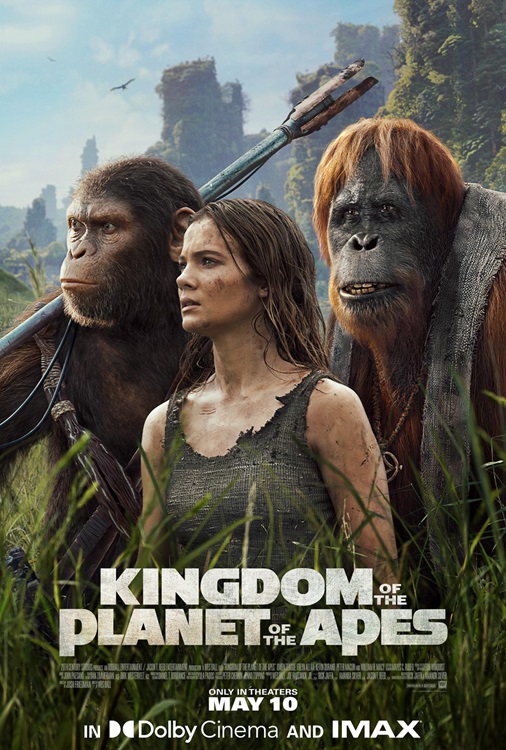
Kingdom of the Planet of the Apes is the latest in this prequel series, which began with Rise of the Planet of the Apes in 2011. Being directed by Maze Runner director Wes Ball and no longer headlining the great Andy Serkis as Caesar, it was easy to enter the movie nervous and uncertain. Thankfully, the final product in theaters is a solid science-fiction experience that lays the groundwork for a new multi-part story.
The story picks up generations after Caesar’s death, with his funeral being presented in the film’s prologue to emphasize his legacy and the impact it will leave on his species going forward. Noa is an adolescent ape in an isolated clan of falconry-practicing eagle farmers. He is on the cusp of performing a bonding ceremony that will make him a full member of his tribe when a surviving human appears, which brings down the violence of a more militant tribe of apes claiming to be Caesar’s descendants.
With his entire tribe kidnapped and his father murdered, Noa sets out on a journey beyond his narrow valley to save his people, which puts him in the path of a friendly elderly orangutan named Raka—the last of a dying religious order that follows the true teaching Caesar, in comparison with the self-proclaimed Proximus Caesar and his expansionist ape kingdom.
This fourth film sets itself apart from the prior films by leaning into a much more traditional fantasy story structure, which resembles a popular film like Star Wars than the gritty Apocalypse Now-inspired predecessors like War for the Planet of the Apes.
Noa (pronounced Noah) has a traditional Campbellian “Hero’s Journey,” with a clear crossing of the threshold, an inability to return to his old life, a wise sage who teaches him new truths, and a descent into an abyss. He even saves his people from a flood at one point, to make the biblical allusion to his name rather explicit. This film is centrally his story, with an overarching coming-of-age narrative that transforms him from an anxious teenager into a strong leader like his father. After everything he has seen and participated in, he is a much wiser and more cynical ape by the movie’s end.
This franchise has always attempted to be one of the more thoughtful B-movie premises coming out of Hollywood, partly due to its being co-written by Twilight Zone creator Rod Serling. It has always been willing to grab the third rail on issues like religion, bigotry, animal rights, and the collective fear of the apocalypse in a thoughtful and thought-provoking manner. These movies necessitate a bleak undercurrent given the inevitable status quo of the original film, which bodes poorly for the optimistic humans we meet in this film who are conspiring desperately to avoid devolving into mindless apes. However, the apes are so human-like that they’re functionally indistinguishable from humans. The apes are metaphorically us, in all of our foibles and sins. Their story of brotherhood, loyalty, persistence, and compassion elevated the first three films into greater films, and it is now expanding into a larger story about the fate of the future.
Kingdom of the Planet of the Apes is the first part in a larger narrative that will likely take another half a decade to finish, and it has already had a great deal to say about how time turns history into legends. The original films are distant history when this film starts, and the last vestiges of truth and virtue have been handed down to a single member of this new generation. Tyrants arise in the name of great men and tell lies to gain power.
Noa’s actions going forward will create the future of the civilized creationist apes we meet in the original film, whether he carries down that wisdom or not. What he learns in this first film will set the tone for what comes next, as the last vestiges of human civilization struggle to survive and apes continue to advance. Both sides must steel themselves in hope and perseverance against the ongoing entropy, ignorance, and death surrounding them. It is this glimmer of hope that keeps them alive and persevering into the future.


Related Posts