How to Change Your Mind
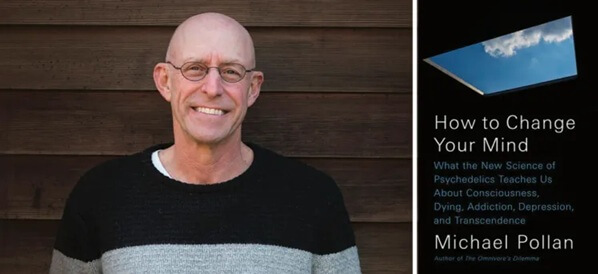
How To Change Your Mind by Michael Pollan gives a history of psychedelics in the twentieth century. It covers the synthesis of LSD and utopian fantasies of transforming the world through getting political leaders and captains of industry to take psychedelic drugs. This was the mission of a very odd man named Al Hubbard (not to be confused with L. Ron Hubbard the inventor of Scientology, which was my tendency, “Al” and “L” not being wildly dissimilar.)
Al Hubbard had a third-grade education, was early into radio technology used to guide alcohol smuggling ships from Canada during Prohibition, spent time in prison as a result, started his own aircraft company, possibly worked for the CIA at some point, liked to dress in a military uniform and carry a gun, became a multi-millionaire and contributed to the psychedelic origins of Silicon Valley. The theory was that LSD could boost creativity. Engineers have to work with irreducibly complex areas and psychedelics can help find patterns in complexity. Doug Engelbart was one of these. He invented “the computer mouse, the graphical computer interface, text editing, hypertext, networked computers, e-mail, and videoconferencing, all of which he demonstrated in a legendary “mother of all demos” in San Francisco in 1968.”
At one point, Al Hubbard would fly famous actors himself discreetly to San Francisco to be treated for alcoholism; a quick process since one dose is usually enough.
LSD and psilocybin, the chemical in magic mushrooms, were used therapeutically therapists in the 1950s to treat things like alcoholism and depression. To have any therapeutic benefit and to minimize the chances of a bad trip, it is important that there be a guide with “flight instructions” and someone to calm you down if things get rough, sometimes literally holding your hand. The flight instructions are to go with the experience and not to fight it or to run away from frightening things, but to move towards them. The setting should also be calm and inviting. In psychedelic-assisted psychotherapy, even in hospitals, they will try to make the room look like a living room with pictures and couches, with gentle music playing and eye coverings. Psychedelics can be thought of as an active placebo which is highly sensitive to suggestion. Patients will tend to have the experience they think they are going to have. Al Hubbard’s patients (he was not a credentialed therapist, but he did a lot of work as a “guide”) tended to witness the entire evolution of the universe, the emergence of life on earth, culminating with re-experiencing being born. Other guides will tend to have patients who experience the after-life, God, and the “all is one” phenomenon. Given that these are mystical experiences, words fail to capture the experience and to sound rather banal. People will say things like, “I realized that love is the most important thing, and, in fact, love permeates all.” The difference between this and reading some New Age book is that these statements are based on experience and as such they tend to convince “the heart,” not just the head. Intellectual assent is not the same thing as actually believing something. You can “know” that, after a certain point, money stops contributing to happiness without actually believing it and continuing to aggressively pursue it.
After the experience, patients sit with the therapist or guide, to try to figure out how to integrate the experience into their lives. What does the experience mean and what is its significance for how one might live one’s life going forward?
Pollan theorizes that psychedelics work therapeutically by disrupting engrained habits of thought similar to electroconvulsive therapy. One scientist compared it to tracks in the snow that a toboggan inevitably goes down, with psychedelics providing a fresh layer of snow, opening up new possibilities. The brain works efficiently by inhibiting some parts of itself while activating others. A brain on psychedelics tends to have many more cross connections and large-scale activation. This could be good for creativity, but not for focus. Depression, smoking, alcoholism, anxiety and so on are problems of monomaniacal fixation. Ideal brain function is some middle-ground between order and entropy. Those disorders are too much order. Psychedelics introduces entropy and disruption. One smoker after her experiences said that smoking just suddenly seemed irrelevant. She also had an image of bent over gargoyle dragging on a cigarette which she remembers whenever she gets a craving for nicotine.
Psychedelics are no good at all for psychosis, which is a problem of having too little order and too much entropy.
Meaning is a matter of connection to context. Since psychedelics encourage new connections in the brain and to apparently spiritual phenomena, experiencing them tends to encourage a sense of meaning. Since depression is mostly about feeling a lack of meaning and significance in your life, then this could also be how psychedelics contribute to decreasing depression. Pollan comments that the effect on depression tends to wear off, so it might be necessary to have repeated guided psilocybin-assisted therapies, unlike for smoking and alcoholism. There are two things about this. One is that for some of the depressed having any reprieve at all (lasting several months) from crippling depression is welcome. The person can see that there are other ways of being. The other is that there are currently no reliably effective medical treatments or psychotherapy for depression at all. SSRIs (selective serotonin reuptake inhibitors) seem to be mostly placeboes, and like many placeboes, they have lost their effectiveness over time. So, it is not as though psychedelics are competing with effective treatments they might displace.
Psychedelics have been found to substantially reduce or eliminate the fear of death experienced by terminally ill cancer patients. There is a diminishment and even dissolution of the sense of self during trips. The sense of self seems to be generated by the “default mode network” – most active when the brain is resting and is involved in metacognition – and lessened with psychedelics. As meditators have also found, there can be awareness without a self as the center of that experience. Losing the self can be frightening at first, but then tremendously liberating. Having experienced the dissolution of self, and having found that it was actually quite joyous, the cancer patients tend to lose their existential dread. Cancer patients can also live in fear of the end of their remission even when they recover, so this is useful for that circumstance, too.
“Existential dread” is not an official psychiatric disorder in the DSM – the Diagnostic and Statistical Manual of Mental Disorders – and there can be the practical and socio-political problem of curing something which is not officially recognized as a psychiatric problem. On top of that, some psychologists and psychiatrists are opposed to the use of psilocybin-assisted therapy for monetary reasons. Things like alcoholism can often be treated with a single therapeutic session instead of years of psychotherapy, destroying therapists’ economic model. The pharmaceutical industry is not going to like it either. The patent on LSD expired long ago and psilocybin is a naturally occurring chemical.
The fact that psychedelics work by giving patients a profound mystical experience does not sit well with many psychologists, too. First of all, they already have trouble getting their field taken as serious science in the first place (I would say justifiably) and many of them do not want yet another reason to not being taken seriously. Secondly, science and mysticism are inherently oppositional. Thirdly, double-blind controlled studies are basically impossible. The patients and the therapists can tell within twenty minutes whether the patient has been given a psychedelic or not. Historically, therapists have also been encouraged to take psychedelics themselves, though not at the same time as their patients, in order to be able to be useful guides and this contradicts the scientific dispassionate objective ideal.
Thanks to people like Timothy Leary, with his slogan “turn on, tune in, drop out,” who wanted as many people as possible to take psychedelics, the government got nervous. Horror stories were circulated about suicides or staring at the sun causing blindness. The latter story was false. It is true that people were being admitted to hospitals in states of anxiety. Panic attacks were being mistaken for psychosis. One doctor said his preferred method of treatment for these people was to say, “Excuse me, I need to go see a patient with serious problems” and then leave. With this indirect reassurance, the patients would then to tend to calm down by themselves. There were also the experiments by the CIA to see if they could use LSD as mind-control with the infamous MK-Ultra experiments often on unsuspecting people. One subject either jumped out a window, or was pushed. It would be pretty frightening to be tripping on LSD without knowing what was going on, which happened to LSD’s inventor, Albert Hofman. Also, like marijuana, if one does have a predisposition to schizophrenia, these drugs can bring it on.
While some want to emphasize the medical use of psychedelics, and for psychedelics to gain legitimacy that way, others are interested in it as mind-expanding, life-changing, self-exploration. Healthy people can use them, too. The term “entheogen” (Carl Ruck) or “entheon” (Alex Grey) is an alternative to the word “psychedelic” and means “en” (within) “theo” (god) “gennao” (to generate) – generating god within. Entheon would then be “the god within,” or full of god. It is recommended that people have a guide for this purpose as well, and to also carefully set up the sitting area for relaxed positivity. That is the main problem with indiscriminate use of psychedelics. With no guide/therapist and no attention paid to setting bad trips are much more likely. There is also no post-trip integration of one’s experiences. One person imagines a scenario where some student has some profound God experience on magic mushrooms and his friends just disparage the experience and say, “No more ‘shrooms for you!”
Having a life-altering psychedelic experience where the ego is lost and there is communication with God can make someone feel very special indeed; even egotistical. He can feel that he must tell the world about it; the philosopher returning to the cave to tell the prisoners there the good news. It might be comparable to near death experiencers who want to tell everyone what they have discovered, having become instant theists. Unfortunately, their friends and families are often atheists, as they themselves were a short time ago, and find it tiresome to hear about it repeatedly. My father used to endlessly repeat bizarre stories concerning synchronicity. “How about that?” was about all one could say. So, becoming a mystic might be fun for you, but not for the people around you. The person can feel like the chosen one, specially selected by God, with a God-given mission. More than one such person has started a cult – remembering that these experiences happen spontaneously, too. Experiencing ultimate reality is not the same thing as wisdom. Interpretation is key.
Michael Pollan took guided psychedelic trips in the course of preparing to the write his book, very carefully selecting the guides. The first involved LSD. He experienced various landscapes related to the music to which he was listening. He visited people in his family and was filled with love and compassion. He saw the mycelium connecting trees underground and witnessed their communication, feeling a part of it all. He did not experience non-dual consciousness.
The next drug he tried was psilocybin, found in magic mushrooms. Much of what he experienced was a nighttime urban landscape that appeared to be computer-generated, all in shades of black, inspired by the insipid electronic New Age music that was playing. He hated the nightscape and it seemed to go on for hours. Finally, his “self” turned into something akin to Post-It notes that scattered in the wind. He felt no desire to catch them – or any desires at all. He had become a disembodied awareness, feeling calm, unburdened, and content. It gave him the sense that there is life after the death of the ego.
At the end of the trip, listening to Yo-Yo Ma’s cello playing, first he became the string of the cello, then the horsehair of the bow, then he entered the sound hole and the wooden interior. He felt reconciled to death and beyond the reach of suffering and regret.
He tried watching a rotating face mask illusion earlier on in the experience that was supposed to not work when on psychedelics, but the illusion worked anyway. When he tried it later, having taken a larger dose, the mask just dripped off the screen.
Supposedly, children and schizophrenics do not experience the illusion which involves the mind’s expectations of faces being convex. Its relevance is that psychedelics might temporarily return one to the innocence and wonder of childhood before our perceptions have become stereotyped in the name of efficiency and survival. Mental energy is limited and spending large amounts of it on mundane perceptions would not be optimal. But, this does engender a “been there done that” feeling that needs a remedy. Too much order, not enough of the unexpected.
Pollan took 5-MeO-DMT (different from the regular DMT found in ayahuasca) which is got from milking the glands of a particular toad and squirting them onto a mirror where it dries and is then scraped off. It is then smoked. The process eliminates the poison in the venom. The trip lasts just 20 to 30 minutes. An interviewee described being “shot out into an infinite realm of pure being. There were no figures in this [two-dimensional] world, no entities of any kind, just pure being…after the rush of liftoff, I found myself installed in this infinite space as a star. I remember thinking, if this is death, I’m fine with it. It was…bliss. I had the feeling – no the knowledge – that every single thing there is is made of love. Pollan found his “I” exploded and overwhelmed with a sense of terror (though no “I” to experience it). He writes that it felt like holding on to the outside of a rocket (doing his best to put it into words), and also like the Big Bang in reverse with everything rushing back 14 billion years and collapsing until nothing was left. He found it horrible. But, then the universe reconstituted itself – including space and time and his sense of self. He was ecstatic to have these things returned. He had a gratitude for existing.
Pollan remains (probably) an atheist and materialist. He continues to think brains generate consciousness, for which there is no evidence: no cosmic consciousness for him. Brains and consciousness are frequently correlated, though not seemingly during near death experiences. But, as they say, correlation is not causation. Pollan is obviously god-curious, but cannot seem to get over the hump to a relaxed and appropriately tentative theism. I personally find this kind of hesitancy frustrating. Iris Murdoch would have liked to have believed in God, but claimed it was not possible for modern rational people. Roger Scruton was in two minds about it, though seemingly leaning towards theism before he died. I mention these two because their writing is never boringly reductive in nature and they both have interesting things to say. Bo Winegard from Aporia magazine recently wrote in his article “That God Doesn’t Exist,” “Philosophers in the West long ago eschewed supernaturalism and the traditional notion of the soul” because they found them impossible to reconcile with science. Did they abandon them? Are they irreconcilable with science or does science simply have nothing to say about them? This phenomenon is mostly true of so-called “analytic philosophy” which is mostly devoted to materialism. Materialism is a speculative metaphysical theory that is not “supported” by science. It is just assumed by much of science as a precondition of its methodology. There is a lot more to life than science – including the Good, the True, and the Beautiful and consciousness itself; the latter generating scientific theories in the first place. Winegard might need to update his reading list. Or alternatively, one might comment, “so much the worse for them.” The professionalization of philosophy introduces all sorts of backside-covering, conformity, peer pressure, worries about promotion, publish or perish, and all the rest. Non-materialists are typically either actively excluded, or take themselves off elsewhere once they discover what is tolerated in the field. Anything experienced by psychedelic use is effectively banned from consideration, even though the father of Western philosophy, Plato, was himself a mystic; a mysticism most likely garnered from ritualistic psychedelic drug use in the Eleusinian Mysteries that took place in Eleusis, a scant 14-15 miles from Athens. What Plato called the Form of the Good plays a central role in his most famous dialogue, The Republic and his central inspiration.
Somebody, I cannot remember who, recommended that I check out the museum Entheon, which is part of the yet-to-be-built Chapel of the Sacred Mirrors in Wappingers Falls, NY some years ago, and it is also mentioned in the book. The museum is mostly devoted to the psychedelic-inspired art of Alex Grey, and partly to his wife’s art, Alison Grey. Personally, I liked it a lot. The admission is very reasonable (twenty dollars) and the associated Grey House has rates for rooms of around a hundred dollars. Entheon is off the beaten path, so there is no chance of random people showing up. Grey seems to be an important figure in the psychedelic world and has the endorsement of Ken Wilber. Timothy Leary’s ashes are located there, as are Al Hubbard’s spectacles.


Related Posts