Marked by Love and Life
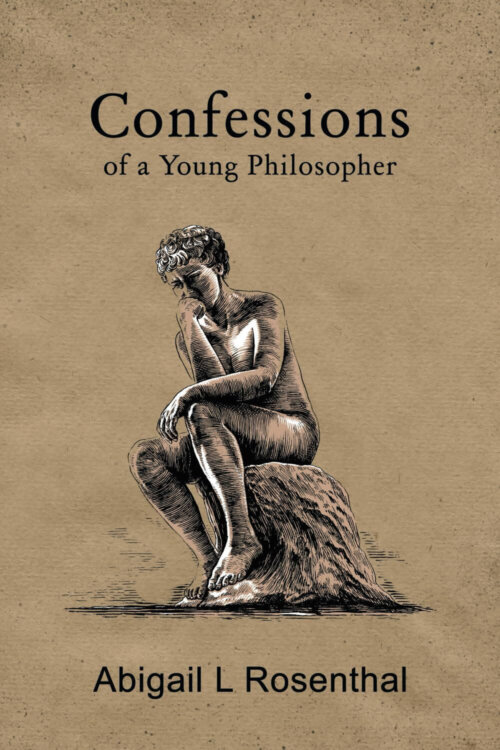
What does it mean to practice philosophy and from where does the motivation come? And what does this mean specifically for women in a male-dominated profession? Abigail L. Rosenthal, Professor of Philosophy Emerita at Brooklyn College of the City University of New York, addresses these questions autobiographically in her latest book, Confessions of a Young Philosopher.
Rosenthal starts her work by recounting her time as a twenty-one-year Fulbright student in Paris to study “the Concept of Man in Aesthetic Experience.” In her search for Absolutes, Rosenthal discovers that the life of the mind is not a self-sufficient object but rather something to be worked out “between human beings and the historical God in settings that were real and concrete, not imaginary.” This is poignantly and philosophically described in her relationships of love and friendship as a young woman in Paris: how to “endow our feminine existence with ineradicable value.”
In these relationships, the body plays a prominent role that confirms and contradicts our thoughts about aesthetics and philosophical ideals. Carnal acts can punctuate artistic depictions of love and romance; and the possible consequences of such acts raise fears instead of inspiration. For the feminine body this is particularly true because of its potential for procreation. Because of this, women encounter the world in a way that is radically different from men where values like “equality” and “respect” have concrete meaning rather than rhetorical abstractions.
When Rosenthal returned to America, she asked the question what it meant for a Jewish person to live historically in partnership with God. For her, the covenant between the Jews and God was the reference point after which God acts as witness in history. Thus, Rosenthal acted as a witness to herself: the history of parents, the fate of her friends from Paris, and her academic education.
In writing her thesis, Rosenthal explored whether philosophy and the female mind were compatible. She was motivated by her desire to find what “ideas had blocked my union” with her boyfriend in Paris. Unfortunately, she was discouraged from this pursuit with Stanely Rosen advising her to destroy her femininity in order to become a successful philosopher.
Rosenthal then traveled to London in all its dreary, damp, and frigid wonder. It was a conversation with a Gnostic Christian that Rosenthal understood “how not to be erased a woman” and could reclaim that knowledge of femininity in the male-dominated profession of philosophy. With this “Gnostic turn,” she completed the reading for her dissertation and gained confidence about pursuing philosophy as a profession.
However, in her adventures in Portugal, Rosenthal rejected Gnostic Christianity in a surreal, hilarious, and frightening account that included the Portugal police, the U.S. consultant, and other international actors (it reads better than a contemporary Hollywood film out now). At the end of this journey, Rosenthal realized that we are both mind and body, psyche and soma. This insight allowed Rosenthal to be truly free, “to regain my hold on historical intelligence. And it’s a romance, that.”
Rosenthal concludes that she is a philosopher by profession and a woman who loves. As a woman to practice philosophy historically is to discover “feminine existence with ineradicable value.” It is not abstraction but the problem of living in the concrete, real, and historical that gives rise to philosophy, a lesson that philosophers often forget. The best that they can do is “be present to themselves and their circumstances and to the God who shares history with us.” To accomplish that is more than most people can do and well worth the journey.
Confessions of a Young Philosopher
By Abigail L. Rosenthal.
Doylestown, PA: Caladium Publishing, 2024; 336pp


Related Posts