Identity, Idolatry, and Discord in the City of Man
“Western society is experiencing severe internal disorder. Stimulated by progressive politicians and radical Identity proponents; enforced through legal sanctions based on juridical decisions contrary to an originalist interpretation of the U.S. Constitution, the rise of irrational Identity Ideologies has adversely affected all aspects of the public arena.” This is a common trope found among rightwing thinkers and pundits, repeated almost endlessly through conservative and alternative media sources, be they newspapers, radio shows, or Twitter accounts. The thrust of “radical Identity” ideology, according to this common outlook, threatens the “cultural Christian values, which constitute the core tenets, morals and ethics underpinning Western civilization.”
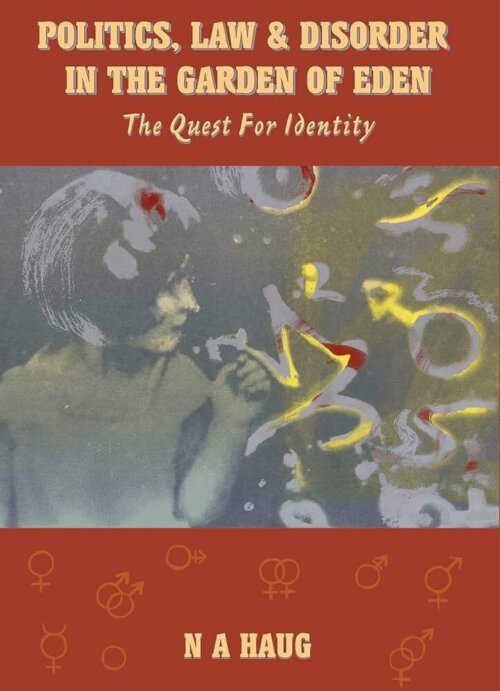
Nils A. Haug, in his recent book, Politics, Law, and Disorder in the Garden of Eden, attempts to trace this war of radical Identity against the sacred image of God back to, as the title states, the Garden of Eden. Haug enlists a wide range of rhetorical bludgeons against the enemy of Western civilization, from “cultural neo-Marxist materialism” to “ancient Greek Gnostic,” “secular humanist,” to “neo-pagan.” One is subsequently left dizzied by what Haug really means by all these terminological descriptions of the opponents waging war against the Christian faith that he repeatedly maintains is the true underpinning of Western civilization. In its simplest sense, Haug maintains a dialectic of faithfulness to God (the Christian underpinning of Western culture) vs. lack of faithfulness, or idolatry, which would distract souls away from God. This battle, Haug asserts, “This is a war that commenced in primordial times, at the beginning of creation, at the time of the first man and woman. The book of Genesis reveals details of the drama at Eden where a rupture took place of the Creator’s eternal plan which was for his people to live in a peaceful theocracy under his loving oversight.”
Haug insists the battle for the soul of Western civilization is the current “social upheaval amount[ing] to a ‘battle of ideas and ideals’ comprising an internal clash within Western civilisation. The clash indicates a culture war of neo-Gnostic inspired ideologies, free of a coherent moral paradigm, confronting entrenched Judeo-Christian creedal orthodoxy, with its clear moral and ethical principles, and the ‘history of facts.’ Polarization of society, therefore, stems from an attempt to politically and legally enforce a reframing of the long-standing, fundamental, values sustaining Western culture into an ‘authoritarian-populist,’ secular, humanist, idea of the ‘common good’ which reflects partisan political Identity theories.” This is problematic for several reasons. First, Christianity acted as a social upheaval, overturning the slave and imperialist pillars of the Roman Empire and the militarist ethic of domination which sustained it, and promulgating new ideas and ideals as it spread. We shouldn’t forget that the Roman critics of Christianity charged Christians with atheism and revolution. The historical reality of Christianity overturning the libido dominandi of the Roman Empire would necessarily imply and entail Rome as not belonging to Western civilization as its ideas and ideals were antithetical to the ideas and ideals of fraternal love and subservience to the godman Jesus Christ. Second, Haug’s dismissal of the “common good” as a secular and humanist idea reflecting “partisan political Identity” means that Saint Thomas Aquinas, the founder of common good philosophical theory, is an enemy of Western civilization as it was Aquinas who theorized our modern notion of the common good and the language we use for it. Third, most of the oppositional ideologies and philosophies to Christian theology were moralist in their articulation even if free of Christian creedal orthodoxy. Adam Smith’s theory of moral sentiments is a clear, moral, and ethical system of philosophy as is Rousseau’s continuation of this tradition of moral sentimentality (itself rooted in basic Christian ideas as many scholars have pointed out). There is nothing incoherent about them if one accepts their axiomatic starting points. That’s the real issue, then, at hand—what is our starting point for existence. I shall return to this in a moment.
I now want to address a matter relating to identity that is rather obvious once the hysteria of anti-identity polemicism subsides. We all live by identity. No one lives without an identity. The problem is not identity politics, per se, but that the normative identities we have grown accustomed which provided meaning and stability to our restless souls are fading away.
Take the issue of Christian identity as the most obvious example. 100 years ago, nearly everyone living in countries counted as “Western” were Christian and they would have used the term Christendom instead of Western Civilization as a point of identification. It is not that we are besieged by radical identity politics but that we have lost all sense of identity that causes mass swaths of people to look for the stabilizing anchor identity provides. The real tragedy of the identity crisis too frequently condemned as “identity politics” is that we are not embracing individual and personal identities but rather bland and mass identities which permit individuals to be used for devious ends. When Saint Paul introduces himself to the Christian communities of the New Testament, he always introduces himself as Paul, “an apostle” or “bond slave” of Jesus Christ, true, but we always know we’re dealing with Paul because he says so. More ubiquitous identities come after our personal identities which allow us to grow in knowledge and love of individuals. I know Tom. I know Sarah. I know Sophie. I know Scott. I actually don’t know much about someone if they are simply introduced to me as a man, a woman, or an American, or a German, or a Russian. Mass identities are vague, intentionally so, because in their vagueness they are easier to manipulate and control. Lest we forget the most important part of the story of Adam and Eve in the Garden of Eden—they had personal names! God knows us by name, as Scripture says, not as some bland universal identity that the modern world describes us as.
*
Politics, Law, and Disorder in the Garden of Eden is a very learned book. Citations abound and references to a myriad of thinkers, philosophers, and political theorists made this former philosophy and political philosophy blush with excitement. And I would concur with Haug that so much of commonplace deconstruction and critical theory really aims at eliminating the fatherhood of God and any trace of Divine nature or belief in human beings, leaving humans as hunks of meat burdened by the trauma of finitude. The best aspect of Haug’s impressive tome is in his deconstructing the deconstructionists. But Haug’s more basic framework is problematic in the blanket criticisms of identity and some of the rhetoric that blends pre-Christian Greece and Rome with Christendom. It is the conservative vision to see Athens and Rome somehow married with Jerusalem, but the reality is very from that. Early Church fathers, like Lactantius in his Divine Institutes, and Augustine in The City of God, really show the barbarism and infidelity of Rome and the rationalist philosophers. The Christian revolution changed Greece and Rome. In that change we developed a new conceptual relationship with the pre-Christian past. When Haug speaks of the West he means it in Christian terms, not Greco-Roman.
The real issue, though, that Haug is addressing—sometimes directly, sometimes obliquely—is the question of starting existence. What is the first principle of existence? Is “the West” dedicated to God or to the state (or the self or mere matter, etc.)? It is patently clear that Marxists, progressives, socialists, radical identity revolutionaries, secular humanists, and all the other groups Haug identifies as waging war against a “Judeo-Christian” West are enemies of the biblical God placing either themselves (“ye shall be as gods”) or the state (“we have no king but Caesar”) or random matter as the starting point of all existence. These enemies of God would rather us bow and worship at the idol of the state or the subjective-self (endorsed by the state) than to Love itself. Haug recognizes this as the true battleground: God or the self/state. Do we take Love itself as the starting point of existence from which all else flows or do we submit, in fear, to political authority from which all else comes?
Thus, when Haug talks about Western culture and civilization, he means a civilization built more upon Christian ideas than non-Christian ones even if we are polite enough to include some Greek rationalism and Roman jurisprudence to be included. Thus, it makes no sense to speak of “Western civilization” but only of Christian civilization. Christians are already hobbled if they are trying to defend the city of man instead of baptizing the nations into the city of God. Jesus Christ didn’t come to defend the ancient city; he came to save his Elect and left his apostles with the Great Commission to baptize and save souls.
What Haug describes is not new. It’s very old. Read Augustine’s City of God, who also traces the contest for the souls of men back to the Garden of Eden. Even though Haug acknowledges Augustine’s work very briefly as “laudable,” Augustine’s assessment of the conflict between the city of God and the city of man is far more insightful and on point. Those of us who orient ourselves to Divine Love as the order needed to heal the disorder of the soul belong to the city of God and only to the city of God, even if we, in this common mortal body, do find ourselves in the civitas terrena. But this entanglement is only found in time and not from the wellspring of eternity. Haug, however, seems to want a synthetic city, a third city—a Western civilization that is both the city of God and the city of man simultaneously:
While the veracity of Augustine’s analysis that society is comprised of those members of the ‘heavenly city’ comingled, yet in competition and tension, with those of St. Augustine’s ‘earthly city’ is laudable, and reflects a situation enduring throughout history, it is proposed that an ‘earthly city’ cannot effectively survive as a stable society without the vital influence of those of the ‘heavenly city’ imparting their humane and virtuous values. Whereas it can be inferred that the tenets demonstrated by devout adherents of the dominant faith would in fact influence the society, in addition there would also be virtuous persons of differing faiths and beliefs such as certain humanists, pagans, and heathens with their own moral codes, sometimes reflecting elements of the natural law emanating from a non-theistic background. Even so, it has to be accepted that civic virtue, giving life to a common good in society, can never be fully achieved until the eternal order. Nonetheless, a well-functioning society actually requires and desires something more realistic and immediate, and that is both internal and external peace and order. It is therefore the duty of Christians to continue their influence on the culture of the ‘earthly city’ so that just laws and values can arise to create the required peace and order.
We do, as Augustine repeatedly says, and not as Haug implies in his interpretation of Augustine, have duties and responsibilities within the earthly cities we find ourselves temporary citizens of. Augustine calls upon Christians to be advocates of a “compromise of wills to attain the things which are helpful to this life” and that we should enact laws so “that a man, in the first place, injure no one, and, in the second, do good to everyone he can reach.” Moreover, it is incumbent that this responsibility includes our invitation to the wounded souls of this world which include all those Marxists, pseudo-Marxists, secular humanists, socialists, progressives, and gender identity radicals. As Augustine deconstructs the lies and mythology of Rome, he doesn’t do so to leave the Romans out of the body of Christ but does so in order to extend his hand of friendship and love so that they too become citizens of the heavenly city, “Incomparably more glorious than Rome, is that heavenly city in which for victory you have in truth; for dignity, holiness; for peace, felicity; for life, eternity…Now take possession of the Heavenly Country, for which you will have to endure but little hardship; and you will reign there in truth and love for ever.” Augustine’s offer, though, is to baptize the Romans into Christianity and not Christianity into the Rome of Romulus, Numa, Julius Caesar, or Augustus.
Like our forebears, we mustn’t forget our true home is not in the Acropolis of Athens, the Capitoline Hill of Rome, or the Beltway of Washington D.C. Augustine’s outlook is correct, not merely laudable; even though we are citizens of the heavenly city, we still have responsibilities in this earthly city, not to the earthly city itself but to the souls who populate it. Christ didn’t come to save cities or civilizations. He came to save souls. Our responsibility is to love others to make them brothers and sisters in Christ. We shouldn’t make the equally erroneous mistake of conflating the two cities to create a third. We are not being sent into the world to create ideal societies or even a “well-functioning society.” We are sent into the world to heal and save souls, bringing souls out of the city of man and into the city of God by baptism and conversion. If, by doing this, a “well-functioning society” emerges, that is merely a secondary benefit of the primary duty to “make disciples of all nations.”
Politics, Law, and Discord in the Garden of Eden by Nils A. Haug is a laudable work. It would be best if one reads it as a continuation of the first half of Augustine’s City of God, with Haug adding to Augustine’s blistering criticism of the earthly city and its malevolent purposes alongside the deficiencies of the new philosophies which serve as hollow and empty substitutes for the good life. But then we must turn to Augustine’s insight, not Haug’s—to realize we are citizens of the heavenly city, not the earthly city. As Saint Paul says to the Galatians, our home is the “Jerusalem which is above [and] free, which is the mother of us all.”
Politics, Law, and Disorder in the Garden of Eden
By Nils A. Haug
Washington D.C.: Academica Press, 2023; 498pp


Related Posts