Leviathan: Beast or Machine?
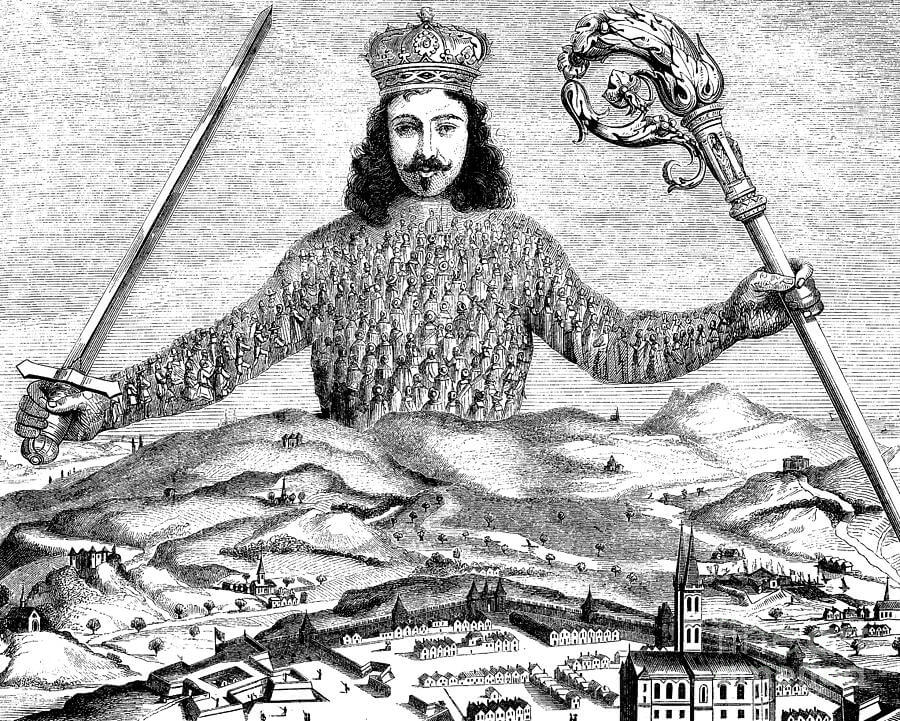
In 1651 Thomas Hobbes published Leviathan, his treatise on the necessity and nature of the modern state. Traditional forms of authority were being challenged and Hobbes argues that without some transcendent power or “sovereign” men would revert to a “state of nature,” a perpetual “war of all against all.” Guided by reason, human beings could enter into a “social contract” and delegate authority to this sovereign which could guarantee a degree of stability and security for all citizens.
“Leviathan” is what Hobbes calls this sovereign. Insofar as we humans are rational beings in a rational universe, Leviathan is a creation of human reason. In creating Leviathan, we imitate the mind of the original Creator or “Artificer.” The “art” of man can imitate the “art” of God. God made rational man, we can now make a rational Leviathan: “For by art is created that great LEVIATHAN called a COMMONWEALTH or STATE … which is but an artificial man.”
Rather than a living breathing king or emperor we will be ruled by an “artificial man” possessing a kind of “artificial life.” Hobbes likens Leviathan to “automata” with “engines that move themselves by springs and wheels as doth a watch.” The universe is a machine, man is a machine, so now we will create a machine to guide and protect us. The rest, so they say, is history. Virtually all modern states consist of various iterations of the human made machine Leviathan.
Hobbes is often, and no doubt correctly, portrayed as one of the great theoretical founders of the modern state. But an even more radical aspect of his thinking tends to be overlooked. The full temerity of Hobbes is revealed by his use of the word “Leviathan” to evoke the extraordinary power of the modern state. The pious Christian Hobbes was quite aware of Biblical references to Leviathan, specifically the very ancient and pre biblical passages toward the end of the Book of Job. God points to Leviathan (portrayed as a crocodile) to compel Job to consider the awesomeness of His powers:
“Canst thou draw leviathan out with a hook? Or his tongue with a cord thou lettest down?
Canst thou put a hook into his nose? or bore his jaw through with a thorn?
Will he make many supplications unto thee? will he speak soft words unto thee?
Will he make a covenant with thee? wilt thou take him for a servant for ever?”
~ Job 41:1-4
The whole frightening drama of Job’s travails and the dilemma of faith is driven home by God’s evocation of Leviathan. God mocks Job’s and all human pretensions of understanding the essential nature of reality. Here Leviathan represents, not the reasonableness of His creations, but their elemental unknowability. Leviathan is not just a beast, Leviathan is the Beast, the archetypal Beast. Leviathan in the Book of Job represents all that is unknown and unknowable. Leviathan cannot be known or constrained by human ideas. Leviathan is “king over all the children of pride.”
The God speaking in the Book of Job uses Leviathan as a metaphor for His powers. Leviathan’s universe is His universe. This universe is not merely filled with beasts, it is a Beast. By associating Leviathan with a machine, Hobbes doesn’t merely extend or modify the meaning of Leviathan, he completely inverts it. Imagine using the word “plague” as a metaphor for health, or the word “rock” as a symbol of fragility, such is the world historical audacity of Thomas Hobbes. We prideful humans are to be restrained, not by elemental forces beyond our control, but by a human contrivance.
The inversion of the meaning of Leviathan represents nothing less than an inversion of the universe itself. We have gone from a Beast Universe to a Machine Universe. This transition has unfolded over centuries, even millennia. There was a time when human beings experienced themselves as living powers enveloped by greater living powers. We were participants in a universe saturated with energy generating one form after another. By the early Christian era we had largely abandoned a dynamic creative world of many gods in favor of a created world of one true God. And by Hobbes’ time the universe appeared to be a great clock set in motion by a remote but all knowing watchmaker. Following Hobbes, God continued to recede as a living power and within a couple of centuries we would dismiss Him altogether. We determine that what appears is simply the result of meaningless material forces. In today’s Machine Universe the watchmaker is blind.
In the Beast Universe knowledge once consisted of poetic descriptions of forces which enveloped us. Hobbes himself belittles the “heathen poets.” In the emergent Machine Universe our common knowledge consists of what is revealed by the methodologies of reason and science. A universe of opaque and unknowable living powers has given way to a universe of transparent and knowable material powers. Almost everything we identify with in the modern world—our reason and science, our technologies, our forms of government, our sense of progress and individual rights etc.—are all profoundly influenced by our presumption that the world is some kind of machine to be remade as we please. Our Machine minds see machines everywhere; we have even determined that beasts are kinds of machines. Machine thinking is an adaptation to a Machine Universe.
While our understanding of the Machine Universe has become evermore detailed and sophisticated, Leviathan as sovereign has gone through many iterations with varying degrees of success and failure. Today, everything and everyone is becoming interconnected in a vast electronic web of digital information presumably guided by reason and ideas of perpetual human progress. Our Machine minds have been connecting all lesser Leviathans into a single great global Leviathan.
Yet Leviathan keeps acting like a beast. We cannot seem to avoid talking about it without resorting to describing the attributes of a creature with its own nature and needs. We can see Leviathan absorb energy, grow and, unlike a machine, seemingly pursue its own interests and power. Leviathan appears to be a jealous beast, perpetually wary of any entity which threatens its authority. We commonly speak of it as “watching,” “grabbing,” “crushing,” “devouring,” “dominating,”… Leviathan will “chew us up and spit us out.” Even apologists for Leviathan speak of it as if it is a beneficent creature who will protect and care for us. So, was Hobbes wrong from the beginning? Is Leviathan a beast or is it a machine? Or, more to the point, do we inhabit a Beast Universe or a Machine Universe?
The words “beast” and “machine” are metaphors. They describe aspects of reality. All metaphors are analogues—they tell us one thing is like something else; they affirm a kind of interconnectedness. They are human interpretations, but we humans tend to confuse our interpretations of reality for reality. Forgetting the metaphorical and poetic nature of language, we humans are prone to superstition and idol worship.
In the Beast Universe superstition manifests as we confuse the words and stories generated by our poetic imagination for reality itself. Over time metaphors lose their vitality and they do indeed tend to become forms of superstition. Hobbes ridiculed “heathen” societies with their “fabulous doctrine[s] concerning demons, which are but idols, or phantasms of the brain, without any real nature of their own.” To take a metaphor literally is to destroy a metaphor.
The Machine Universe is prone to its own kind of superstition and idol worship. The Greek etymology of the word “machine” suggests a “contrivance”, a human made tool or technology like a hammer, a pot, a boat etc, In the Beast Universe, a tool or a technology was presumed to be an imitation of nature, but it was also understood that all tools were limited because nature consisted of powers beyond human control. Prometheus might give humans technologies but always at the price of invoking the wrath of Zeus.
As we’ve transitioned to the Machine Universe we now insist that we humans do not simply control some contrivances but that all of nature can be transformed into a contrivance. A machine is not simply like nature, a machine is nature, which is to say, a machine is like a machine. The word machine now loses its metaphorical qualities; it becomes literalized, a superstition, an idol of the mind. When all of nature is a contrivance under human control we lose our capacity to think metaphorically, to think poetically. We enter, not only the world of superstition and idol worship, but the world of hubris. Prometheus is unbound and Zeus vanishes.
Our inability to think metaphorically is manifest in our fixation on the parts of reality and our inability to see the whole. Human beings most absorbed into the logic of Leviathan are often those most blind to the limitations of their own Machine thinking. For these “children of pride,” reality consists of fragments and all problems are to be solved by some expert of some particular set of fragments. Machine minds look at other human beings in distress and do not see fellow beasts with their own unique integrity and creative powers. Rather, they see little configurations of data which require tinkering, manipulating, engineering. Fragmented minds only see fragments.
Here, now, manifests a world-historical irony: it is precisely Machine minds with their Machine thinking which facilitates the growth and power, not of the Machine Leviathan, but of the Beast Leviathan. Those of us not fully absorbed into Leviathan can now observe that out of the efforts of millions of fragmented Machine minds emerges a single great Beast. Leviathan, observed as a whole, behaves less like a smooth running Machine and more like an inscrutable Beast beyond human control.
Leviathan is a vast configuration of energy which grows and proliferates by relentlessly absorbing lesser forms. It is energized by human ideas of infinite progress. To be rendered into data is to be rendered digestible. Leviathan’s putative human masters are its actual servants. Our best and brightest claim Leviathan to be beneficent, but they themselves tend to be abstracted from the brutal consequences of the empowered Beast. In action, Leviathan appears indifferent or even cruel as it crushes and devours whatever it needs: it fragments individual minds, dissolves social bonds and subverts the integrity of whole nations. What makes us think that we human beings, we configurations of energy, are immune to being absorbed by a greater configuration?
It appears then that we have never truly left the Beast Universe. The eternally self creating/self destroying universe rolls on indifferent to human fantasies of liberation and power. For millennia we acknowledged ourselves as participants in a universe of greater powers, then for centuries we have not. Our Machine minds, for all their ingenuity and cleverness, are and always were subject to powers beyond our control. We were never the artificers ex nihilo of anything. We always were participants, whether we knew it or not. Historically it was not the systematic thinkers, but the great poets who best understood that we must be wary of the persistence of powers beyond ourselves.
Will he make many supplications unto thee? will he speak soft words unto thee?
Will he make a covenant with thee? wilt thou take him for a servant for ever?”
Job 41: 3-4
Big Beasts eat little beasts. Leviathan will devour what it must in order to grow and sustain itself. If this is so, then perhaps we might begin to ask: Why do we keep feeding it?


Related Posts