Love in the Western World: René Girard vs Denis de Rougemont

Denis de Rougemont’s Love in the Western World has many appealing features. It has a long discussion of Tristan and Iseult (“Tristan und Isolde” in German and the title of Wagner’s opera), and it is always nice to review classic literature and archetypal themes. De Rougemont’s discussion of love is written in ordinary language and avoids the jargon-filled idiocy of postmodernism or analytic philosophy. The love to which he refers is that of which we are all familiar.
He contrasts the passionate love associated with chivalry with Catholic marriage and claims that the two represent quite different ideas. Passionate love requires an obstacle. The surest way of killing passion is to get what you want. Two characters in the movie Diner describe getting married young and imagining how great it would be to have all the socially sanctioned sex you want whenever you want, only to find that passion wanes when your partner is ever-available. “But then, when you get married — it’s crazy, I dunno. I mean, you can get it whenever you want it! You wake up in the morning and she’s there. You come home from work and she’s there. And so all that sex planning talk is over with.” The husband belatedly discovers that he actually has nothing to say to his wife. “You know, I can come down here and we can bullshit the whole night away but I cannot hold a five-minute conversation with Beth. I mean, it’s not her fault, I’m not blaming her, she’s great. It’s… It’s just, we got nothin’ to talk about. But, it’s good. It’s good.” Passion and the frustration of desire are inherently linked, and this connects passion to misery. A desire for passion is a wish to be miserable.
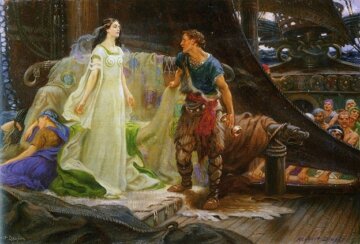
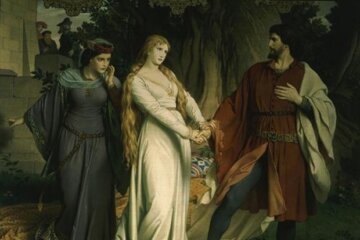
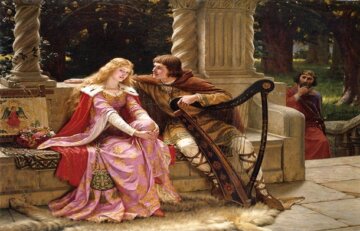
Tristan and Iseult is a strange story. It is relevant that the name “Tristan” is linked to the French word for sadness, “triste.” Tristan’s mother, Blanchefleur, dies when he is a child, and he is raised by his uncle, King Mark of Cornwall. He fights and kills the maiden- and youth-eating monster Morholt but is wounded with a poisoned barb in the process. He asks to be put on a boat without oars, but with his sword and harp, to die, and by chance ends up in Ireland where he is nursed back to health by Iseult, the daughter of the Queen of Ireland, Morholt’s sister. Thanks to her sibling relationship with the monster, only the Queen knows the antidote to the poison. Tristan, of course, has to be careful not to reveal his role in the death of Morholt. Later, King Mark receives a blond hair from a bird, and Tristan is sent out to find its owner. A storm brings him to Ireland again. He fights a dragon again, is wounded again, and is nursed by Iseult again. But this time, she finds out he slaughtered Morholt and threatens to kill him. To avoid this, Tristan tells her about the golden hair and proposes she come to England to marry King Mark. She agrees. On the boat ride over, they accidentally drink a magic love potion intended for King Mark and Iseult, and Tristan and Iseult fall in love. From then on, the passionate love between Tristan and Iseult is exalted over her marriage to King Mark. The barons who find out about their affair and attempt to tell their king about it are described as “felons,” as though they are doing something wrong. In real life, unfaithful queens threaten to disrupt hereditary monarchies and are thus a threat to the state, so this is not trivial behavior. Promiscuous kings, on the other hand, merely have bastard children who are never in line for the throne, barring a coup.
But mostly, they do not consummate their love. Even when they run away to live in a forest together, King Mark finds them lying asleep with a sword between them, indicating their chastity and he does not kill them as a result, though he could. De Rougemont notes that even when there is no tangible obstacle to their love, the two lovers create an artificial, arbitrary and symbolic obstacle to stop them acting on their feelings.
De Rougemont’s description of the origin of courtly love has generally been debunked. It should be noted that, though the concept arose in 12th-century France, the actual term amour courtois was first used in 1880 by Gaston Paris to refer to love between Guinevere and Lancelot. One of de Rougemont’s claims is that Christian crusaders, being inherently interested in religious matters, were more open to foreign influences on that topic than one might imagine, and that they brought back Iranian/Persian love poetry from their travels, which exalted a feminine ideal that symbolized God, and that this is connected to the Cathar heresy. Cathars were Gnostics living near the France/Spain border. Gnostics are dualists who claim that the world is created by an evil God and, thus, that physical reality is evil. The One gives rise to Sophia, who bears her son, the Demiurge, in rivalrous imitation of The One’s creative abilities. The Demiurge is evil, and he creates the physical universe, which is thus evil like him. In some stories, the One provides the spark of life for human beings. If one knows the secret passwords, the initiated can ascend through the levels of heaven and have their divine spark reunite with the One and have one’s painful individual existence extinguished.
“Gnosis” means esoteric knowledge, and the Gnostic is he who possesses this, allowing him to ultimately achieve extinction.
It should be noted that Gnosticism arose in the first century AD before being denounced as a heresy by orthodox Christianity in the second century. It “solves” the problem of evil — why evil exists if there is an omnipotent and good God — by inventing a second, evil god. One then has the problem of good, instead: why does good exist at all in this world if Gnosticism is true?
In order to achieve his goal, the Gnostic would not want to be too attached to physical reality. Since the world is evil, Gnostics generally either promote abstaining from worldly affairs, or they go in the opposite direction — towards reveling in debauchery — since this world cannot be corrupted or made worse by their behavior; it is already at its nadir. A devil-may-care attitude then has justification based on a rather strict, negative, and judgmental diagnosis of man’s position in the world. The Cathars, as is most common for Gnostics, took the “abstention” route, which would discourage free sexual assignations and aims to have as little commerce as possible with fallen reality, especially among their spiritual elite. Spiritual purity is the goal.
There are similarities between Gnosticism, and thus the Cathars, Persian love poetry, the Troubadours, and chivalric love, but no real evidence that there was a causal link between them. Sometimes, ideas are just “in the air.” De Rougemont, however, claims that the Troubadours spread the Cathar Gnostic heresy from castle to castle, generating the cult of courtly love. The Troubadours did indeed promote courtly love, but probably not due to the Cathar heresy.
He also claims that the cult of the Virgin Mary was a Catholic response to this heresy — appropriating a popular trope for their own purposes, like a politician who defangs his opposition by adopting their most popular policies. Theologians have pointed out that God is obviously not biologically male or female, and the cult of Virgin Mary is a way of celebrating and recognizing the feminine aspects of God. In terms of the cyclical view of history found in Vico or Spengler, it would be coextensive with the decline from the Age of Heroes to the Age of Men in Vico, where the brutal warrior ethic is replaced by something more “civilized,” represented by a sentimental concern for women and children. Courtly love can also be thought of as a way to get men to sublimate raw sexual desire in the name of the idealized feminine.
Sir Gawain from Sir Gawain and the Green Knight had a picture of the Virgin Mary on the inside of his shield, symbolizing both his Catholic piety and his devotion to chivalric values. Medieval tournaments and banners at the time (12th century) frequently also displayed pictures of Mary, and knights would dedicate their feats and battles to her. This seems more Catholic than Gnostic.
The Virgin Mary would represent the ultimate in unobtainable female beauty in this context. To put it in Freudian terms, the energy generated from sexual desire is sublimated and bursts forth in other arenas. The passion from frustrated desire finds other outlets.
In the transition from the Age of Heroes to the Age of Men, the rule of the “foxes” takes over from that of the “lions,” to use Vilfredo Pareto’s terms. Lions dominate by strength, brute force, and direct action — this is the nobility and warrior classes paired with the peasantry. Foxes, on the other hand, use cunning and manipulation to get what they want and avoid direct confrontation. They consist of the priestly and intellectual castes paired with the merchants and bourgeoisie. This latter modus operandi is distinctly more feminine. Women are more likely to be passive-aggressive because, as the physically weaker sex, direct violence is generally a losing proposition for them. Merchants are prone to want to live forever, as we see with the tech oligarchs, whereas the warrior aspires to die in battle and with honor. Modern Western societies are typically dominated by these more feminine foxes.
De Rougemont’s thesis is that courtly love is really the product of Gnosticism’s Manichean division into two: the transcendent goodness of The One versus the earthly evil created by the Demiurge. His version of metaphysical desire is the desire for transcendence, and the love for the eternal feminine is the route to this goal. A knight would find an unavailable aristocratic woman, and pledge his fealty to her. Typically, she would already be married. She would then give him a token of her reciprocal devotion — like a scarf — and he would go off to battle in her name. The knight therefore fights holding her image in mind, and he will fight with more courage and vigor in order to be worthy of her. He is driven by his love and passion to ascend the metaphysical ladder that has earthly matters at its base and transcendence and God at its summit. The woman becomes a symbol of the divine, inspiring him to greater feats of which he would otherwise be capable.
It is crucial that the woman remains on a pedestal: out of reach and unobtainable, hence why an obstacle to their sexual union is crucial. If they actually had sex, all this passion fueling the quest for self-betterment and God would diminish, and the knight and his idealized love would be brought crashing down to earth.
The Eastern esoteric practice of Tantrism has some similarities to this, where sexual frustration is slowly amplified in the name of a frenzied spiritual ecstasy that forgoes bodily satisfaction. The initiate is first to sleep in the same house as a desirable woman, then in the same room, then in the same bed. Then they actually touch. Then they have sex, but never to the point of climax. Among those cultures where tantrism is practiced, it is considered an incredibly dangerous and difficult method for spiritual progress, and most monks will not attempt it.
De Rougemont writes that the metaphysical ladder idea, linked to Gnosticism, at least makes sense. Cultivating “passion” has a spiritual point and ambition. It is related to moral aspiration. The problem is that modern culture — and particularly fictionalized representations of romantic love: drama, film, and novels — have retained this obsession with passion, but there is no longer any reason for it. Practically no one is a Gnostic anymore, and therefore the metaphysical basis of passion in need of an obstacle is redundant. More importantly, long-term companionable devotion and love, seen in Catholic marriage, is more valuable and permanent. Passion as an ideal is actually destructive because it can only be obtained at the price of misery. People will try to have relationships where they hardly ever see each other — such as one living in New York and the other in California. There will be plenty of frustration and thus passion prominent in such an arrangement, but no real relationship. You cannot relate to someone who is not there. Desire for the absent partner will ramp up, but so will emotional and physical dissatisfaction and general agitation. Such a person does not sound fun to be around.
A student once mentioned that her sister, who was around 30, had experienced a long series of relationships. The sister was obsessed with passion and heightened states of emotion. Since passion is killed by satisfying the object of its desire, the sister would leave whoever she was with in order to find a new man after a short period of time. The student was understandably disapproving of this frenetic and immature behavior.
Every fictional representation of love promotes passion, and passion requires an obstacle. So, writers of love stories have no choice but to set up a scenario that stops the lovers from getting together and the only variation is in the choice of an obstacle. It can range from the naturalistic to the fantastical. One of the best natural obstacles is death. The tearjerker “Love Story” has the lovers separated by the death from cancer of the woman. War is another common trope, where the man is conscripted into the army. As his train departs with the soldier possibly never to return, the woman runs alongside the train, crying and waving goodbye. Romeo and Juliet are divided by families at war with each other, and so on. These are at least realistic, but science fiction includes couples where one is a time traveler who must return to his own time, or a couple who occupy the same house but in different time periods, and who somehow know of each other’s existence. One story is about a man who returns home after a war, but the wife is not sure it is really her husband or an imposter — epistemic uncertainty creates a barrier between them. Superman cannot earn the love of Lois Lane because she only knows him as the dweeby Clark Kent (he wears glasses!) and she yearns for the Superman. Clark Kent cannot reveal that he is really Superman without showing his real identity and harming his ability to save the world.
In reality, de Rougemont writes, it is not getting together that is so difficult. It is staying together. But a happily married, content couple has no dramatic value. Stories are driven by conflict. The typical resolution to the love story is that the couple get together, they kiss, and then fade to black. They are not depicted waking up the next morning with bed hair, pre-toothbrushed bad breath, settling down to breakfast while reading the newspaper (OK, scrolling their smartphones). There must be some closure and resolution, but it must be as brief as possible in order for the passion not to be satisfied. Richard Gere carries Debra Winger out of her factory job while dressed in his immaculate white uniform with surging music. An Officer and a Gentleman does not skip to the future with four kids in tow and a stable marriage.
The need for conflict required by entertaining stories and these representations are pernicious, since they exalt passion and poor scorn on calm, stable love. They can make happily married couples feel like there must be something wrong with their relationship because they are not immersed in a frenzied desire for and obsession with the other person. The primary beneficiaries of marriage are children. Marriage is not designed to promote the hottest sex possible and inflamed passions, but for stability and structure. Husbands must make way for their children as a huge focus of their wife’s attention.
The trouble is that fictional depictions of normal, stable relationships are going to lack the drama needed for an interesting story. So these misrepresentations of desirable love are not going anywhere.
De Rougemont is correct about passion needing an obstacle, but René Girard correctly argued he was wrong about what kind of obstacle was needed. The obstacle that creates the most out-of-control passion, desire, and obsession is a romantic rival. The romantic rival is both the mediator/model and the obstacle. This is the phenomenon of triangular desire. The triangle consists of the desired person at the peak and the two rivals at either end of the base of the triangle. I like Rachel, but then I notice Timothy likes her, too. As a mimetic creature who copies just about everything, I copy Timothy’s desire for Rachel. This increases my desire for Rachel and Timothy’s liking her confirms in my mind that Rachel truly is desirable. Timothy then notices my love for Rachel, he then copies my love for her, and his high opinion of her is also reinforced. I then notice Timothy’s increased ardor, which raises my own, which in turn raises his, until the rivals are going out of their minds with longing and desire. This is where maximal “passion” comes from. Timothy’s love for Rachel might even be a figment of my own imagination, and something similar can still happen.
Timothy is not just my mediator or model, but also an obstacle. He is preventing me from having unilateral access to Rachel. I want to be like him — a lover of Rachel — and yet he is stopping me from getting her all to myself. More fundamentally, I cannot be him because he is already him. He is not just an obstacle to getting Rachel, but to being him. “Be like Mike,” referring to the advertising campaign featuring Michael Jordan in the 1990s, is setting up the consumer for assuming an adoring role and frustration. Michael Jordan represents the pinnacle of success; a goal drawing you forward, but the closer you approach, the more he appears to be in the way. Metaphysical desire is wanting the being of another.
We consider someone like an old boyfriend who refuses to retire gracefully and hangs around like a bad smell, claiming to be “just friends” with our beloved, a nuisance. He is likely to seem like a rival. And we think we know from evolutionary psychology that these opposite-sex friends do in fact serve as back up lovers should the main relationship fail. The “friends” tend to have similar characteristics to those we look for in a lover.
The story of Tristan and Iseult with which Love in the Western World starts has exactly this structure, with King Mark playing the role of the rival, as Tristan does for him. This is why the story is so archetypal. Having a non-human obstacle like a war, sickness, or death, does not excite the same frenzy of passion that having a King Mark, or a Tristan, does. To bring evolutionary psychology in again on a rather unseemly topic, when males see that someone else has slept with a fertile female or thinks that someone else might have after an absence, then they ejaculate more and harder. Biologically, the human phallus is shaped like a kind of pump that sucks out sperm that is already inside a vagina in order to replace it with one’s own, and having a larger ejaculate increases the chance of conception. Porn videos usually have a man having sex with a woman, and most viewers of such porn are men. Having another male in the picture (literally) is likely to excite this evolved tendency and to produce stronger orgasms as a result.
Triangular desire is desire maximized. It can, of course, result in violence towards the hated rival and also to the object of desire along the lines of, “If I can’t have you, no one can.”
It was not until I had read and taught Deceit, Desire and the Novel by Girard, which identifies and explains triangular desire that I realized that the two times I had fallen in love with this kind of over-the-top passion were when there had been a rival involved. It can seem like if the woman would only accept you, heaven would be the result. In both cases, the women had been attracted to me, only for their feelings to wane and, in one case, for the rival to get the prize. It is the person who desires the most strongly who is in the weakest position, while the “I can take it or leave it” person is in the strongest. The desiring person needs something from the other person, the non-lover needs nothing from you and thus cannot be manipulated. Being grasping, needy, supplicating, begging is repulsive and merely generates a feeling of disgust in the other person, who wants to brush you away. Nobody admires a weak beggar. We look up to the person above the fray, seemingly self-sufficient.
The best relationships are between two moderately happy people who join forces to be moderately happy together. As soon as you start imagining that the other person can make you happy, you are probably involved in triangular desire. There can be a period of infatuation and the subjective feeling of being “in love,” but the goal should be a calm, loving enjoyment and celebration of the other person. There can be moments of passion, of course, but that cannot be the basis for a lasting and satisfying relationship. Respect, admiration, and trust typify this kind of love. The psychologist Brad Wilcox claims that this kind of romantic relationship cannot be the result of a pact between friends who say, “If neither of us are married in 5 years, then we will marry each other.” Being such a consolation prize is inherently insulting, and apparently, companionable love must first go through in the infatuation stage; it cannot be skipped.
Unfortunately, it is not possible to tell one’s actual loved one that you are glad that you never fell insanely in love with her, not like those other girls, and that this is because you would not still be together if you had. “Passionate” triangular love can last probably about two months tops before the final rejection by the supposed beloved. And, of course, it is not meaningful love anyway. It is more like a psychotic state involving an obsession with the other man and his feelings than the putative object of desire, the woman. In this case, it is not possible to state something that is true because it sounds like you are saying, “I never loved you as much as I loved her,” which is offensive. What you are really saying is, “I never loved her at all. I just got involved in a love triangle and it did my head in.” Often, you were not really compatible anyway, which is why a rival was in the picture in the first place. Knowing intellectually that the beloved is bad match for you somehow does not remove the pain and longing. The first time this happened to me, I was living at a single-sex boarding school, after coming from an all-female household with three older sisters and a divorced mother. The girlfriend in question was my only connection to the feminine at the time, and together with the urgent desires of the hormonal teenager, and then the presence of the rival at the end blew up any chance of a more moderate, sustainable relationship.
A classic and typical kind of triangular desire is the mistress of the married man with his wife. The man has his cake and eats it too. He gets a stable, “committed” relationship and extra fun and sex on the side. He tells his mistress that he will leave his wife for her and strings her along. The mistress waits patiently for the day that never comes. The married man is desirable because he has been vetted by another woman and found worthy. The mistress imitates the wife’s desire for her husband, and mimesis elevates her feelings to levels that involve the pinnacle of “passion.” It seems like there should be a public service announcement not to find oneself in the position of the used and abused mistress.
French culture is notorious for the wife/mistress dynamic. It can be viewed as a form of polygamy or mini-harem. So long as the man can afford to support the mistress and any children she might have from him, from an evolutionary point of view, nothing too terrible has happened.
In conclusion, de Rougemont draws comparisons between the Cathars, Persian love poetry, the troubadours, and chivalric love. He notes that passion can be fine in the context of sublimated sexual desire that is channeled into more productive ends and used to produce more courage and drive than might otherwise be possible. He is probably not right to connect Gnosticism and chivalric love, although the two things are interesting to juxtapose. But, he is correct that passion and marriage do not mix for long, and that seeing passion as the ideal is not a good idea. It is René Girard who identifies the heights of passion with the presence of a romantic rival for reasons that are not at all mysterious, and this dynamic can be seen in the very story with which de Rougemont starts his examination – Tristan and Iseult.


Related Posts