Nikos Kazantzakis: Lawyer, Author, Intellectual Terrorist
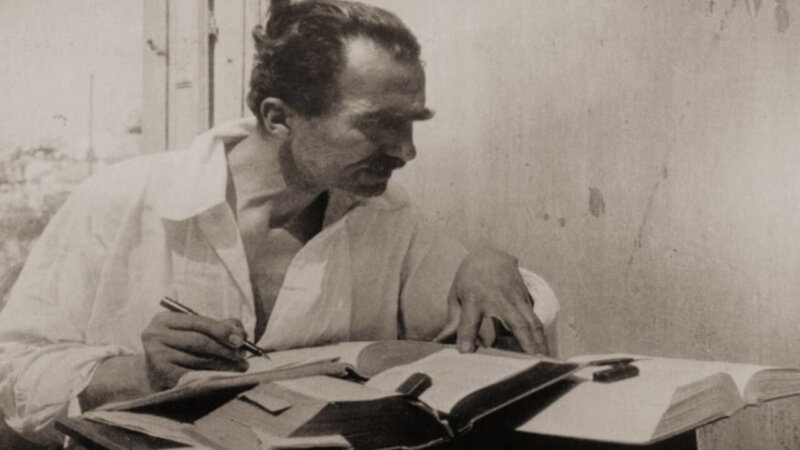
When I was an undergraduate student at Villanova, I stumbled upon the foreign literature section of the library. Naturally, some sections were larger than others, but the Greek section was dominated by the writings of one Cretan in particular – Nikos Kazantzakis. Nikos Kazantzakis. I was familiar with him previously through some of his more popular titles, and their subsequent controversies, but I thought I would delve into his writings. What I found was a man who was deeply religious, but entirely unorthodox in his methods. His letters and plays can best be described as ‘furious’. He seemed oddly driven by a mission to reinsert humanity back into the broad framework of European intellectual life.
For his part, Kazantzakis belonged to that older, more combustible class of literati for whom literature was the chosen arena of metaphysical combat. He would seem more at home with the likes of Arthur Schopenhauer and Joseph Priestley, than the re-emerging Hellenic intellectuals of his own day. At the time of their publication, his sundry novels scandalized the devout and would be seen as shocking for some years after his death. This was not a product of our own age, where blasphemy has become a marketing strategy that preys upon pretentious teenagers and is vapid enough to hold sway amongst contrarians. No, for Kazantzakis theological provocation was not part of this kind of vain posturing. For him, it was vocational. He firmly believed that it was his God-given mission to disturb the well-assumed piety of the Western world with uncomfortable accounts of Greek plebians, twists on ancient myths, and a revisionist telling of the human struggle of Christ. He was, in his own fashion, an intellectual terrorist. One who believed that his ideas must explode in the conscience to ultimately be effective.
Born in Ottoman-ruled Crete in 1883, Kazantzakis was trained as a lawyer at the National and Kapodistrian University of Athens before studying philosophy in Paris under Henri Bergson. The juridical discipline never quite left him or his writing. His prose retains the structure of legal argumentation. His heroes engage in prolonged soliloquies and conduct interior trials against themselves. Reality, Kazantzakis learned, was not static essence but creative surge – élan vital struggling upward through all matter. This metaphysical approach would become the scaffolding for a lifelong spiritual insurgency. Kazantzakis’ most famous work was, of course, The Last Temptation of Christ, which broke with most historic portrayals of Christ by emphasizing his humanity, as well as the flesh and blood desires that he encountered. In it, Kazantzakis did not deny the divinity of Christ, but sought to explore divinity outside of the overtly supernatural trappings that are commonplace to portrayals of Christ. It dramatized the moral struggle of God having become man, something flirted with by theologians over the centuries, but often found too taboo to truly explore in any depth. The strange phantasy of a Christ who imagines marriage and domestic life was sufficient to provoke condemnation from the Greek Orthodox Church and outrage abroad. In the West the book was placed on the Index Librorum Prohibitorum, those works banned by the Roman Catholic Church, until 1966 when the list was permanently discontinued. Even when Martin Scorsese, decades later, adapted the novel into the film, protests re-ignited. However, Kazantzakis’ explosive central thesis was both prosaic and Socratic in its approach: faith without spiritual risk calcifies into sentimentality.
However, to reduce Kazantzakis to a single scandal is to misunderstand the full architecture of his intellectual ambition. While sometimes regarded as a truly bombastic undertaking, his vast sequel to Homer, The Odyssey: A Modern Sequel, extends the wanderings of Odysseus into a post-modern pilgrimage beyond the shores of Ithaca, beyond domestic peace, beyond even the quaint backdrops of Hellenic civilization. In this work, the influence of Friedrich Nietzsche is unmistakable. Like Nietzsche, Kazantzakis mistrusted the proposition of domestic comfort, despised moral and intellectual complacency, and regarded the challenges posed by Christianity not as a refuge for the faint-hearted, but as a virtuous summit to be scaled. However, in stark contrast to Nietzsche, he could never relinquish the person of Christ, seeing him as a reflection of his own mortal yearning. Instead, he would wrestle with Him, challenge the distance between heaven and earth, by uniting them in the God-man.
Kazantzakis was not a theologian in any sense of the word, and to that end, it would be difficult to fully describe him as a philosopher. He did not aim to persuade in the manner of a Thomist, or to preach as one would expect in the realm of orthodox theology, or reassure in the manner more accustomed to a Victorian moralist. He aimed to detonate. In The Saviors of God, perhaps his strangest and most revealing work, he proclaims that God is not omnipotent but embattled, struggling within the human soul to ascend toward freedom. This very personal essay appears as at least partially autobiographical, revealing a man who sought to embrace the moral struggle of life, and take courage in the face of civilization’s decay. For Kazantzakis the believer’s task is not submission to God, but collaboration. He takes the imagery from his own Greek Orthodox background, from St. Maximus the Confessor, speaking of the communal cosmic ascent of God and man. It is a theology of distension and strain, bordering on Christian heterodoxy, but animated by an almost monastic severity.
It is this proposition that appears to have so disturbed ecclesiastical authorities. While 20th century literati were known for their prevalent, and frequently shallow, atheism, Kazantzakis did not reject Christianity. Instead, he radicalized it. He stripped away the consolations of sentimentality and philosophy, and left only the cross, not as an ornament of soteriological triumph, but as an ordeal. This came to a head in his most celebrated novel Zorba the Greek, where the sensual exuberance of Zorba is set against the detached and ascetic intellectualism of the narrator. Zorba is an Übermensch of human passion and unrestrained action. As he tells Basil in the novel, “Boss, why did God give us hands? To grab. Well, grab!” Western critics have often read the book as a hymn to an old sense of pagan vitality, but this is purely academic introjection. Zorba is certainly drenched in Hellenic vitality, but he is not removed by the monastic spirituality of his time and place. As the title suggests, he is very much a Greek, and immersed in the world of Orthodox cosmology. It is more accurately an adroit study in spiritual envy. The narrator longs for Zorba’s immediacy because he himself is trapped in the abstraction so common to academics and intellectuals. He fears action, commitment, and perhaps the irrational passions that clearly drive Zorba’s unencumbered character. Much like the Last Temptation, the novel stages this issue, rather than resolving it, the tension between flesh and spirit.
Politically, it might be said that Kazantzakis was equally combustible. At times, he flirted with Marxism. In his youth, he traveled to the young Soviet Union, admired Lenin, and yet never surrendered to partisan orthodoxy in his native Greece. Ideology, for him, was another ladder to climb and potentially discard. He sought revolution everywhere and in everything – national, social, spiritual. Despite all of this, he remained irreducibly solitary. In this, he resembles the modernist titans more than the posh socialite intellectuals, the lonely and otherwise unknown prophet rather than the disciplined cadres. It is tempting, in retrospect, to domesticate Kazantzakis. To render him intellectually impotent by placing him in a convenient category. There have been many who have tried – existentialist novelist, modern Greek intellectual, controversial religious fanatic, et cetera. However, even for the casual reader of Kazantzakis, his work is impervious to these belittling taxonomies. He openly embraced contradiction. He desired Christian sainthood and the Nietzschean superman in the same breath. He could write with tranquil, liturgical solemnity one moment and volcanic sensuality the next. This oscillation was not stylistic inconsistency. It was his metaphysical and interpersonal orientation.
What, if anything, is his place in the world today? The West is no longer shocked by unorthodox theological claims. The ferocity of the Soviets has long been dismissed and is commonly the subject of ridicule. Yet, despite this, Kazantzakis’ challenge remains acute. Like the reformers of every age, he demands that belief be strenuous, that our doubts be honest, and that real art risks pain. He reminds a therapeutic age that religion is not primarily about comfort, but about confrontation with God, man, and the abyss. When he died in 1957, he was received as a “Frank,” as the Orthodox Church refused him burial on any consecrated ground. His epitaph, carved on his tomb in Heraklion, reads: “I hope for nothing. I fear nothing. I am free.” It is a sentence that could be read as stoic defiance to ecclesiastical authorities and the complacency of an age of philosophical comfort.


Related Posts