On Prayer: An Essay
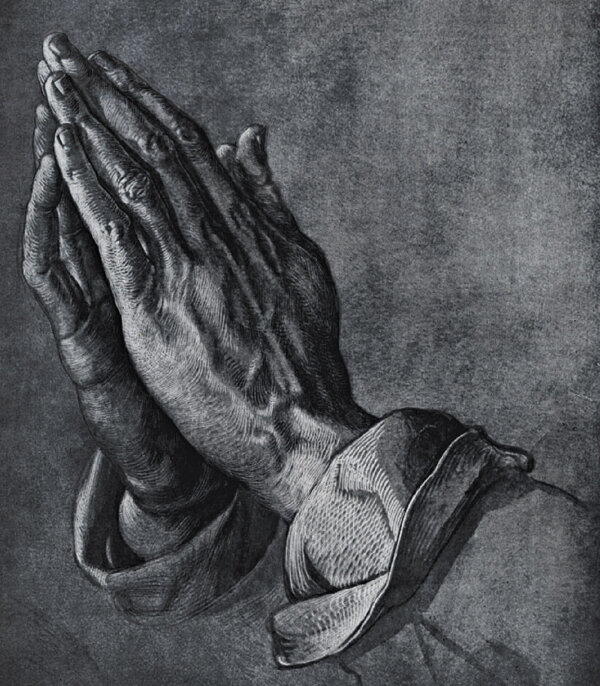
You are not here to verify,
Instruct yourself, or inform curiosity
Or carry report. You are here to kneel
Where prayer has been valid.
~ T.S. Eliot, “Little Gidding”
As the late winter morning light trickles in through the window, while the baby is still sleeping and my husband has already left for work, there is a sort of quiet reigning in the house. It is not a quiet that whispers, “Go back to sleep!” Rather, it is an inviting sort of quiet: the sort of quiet that lures one out of sleep into contemplation and prayer.
In recent months, I have attempted to build a habit of morning prayer, and in doing so I have been rewarded, and my faith has been enriched.
Many Christians undertake New Year’s resolutions to read Scripture or theology more; many take up daily reading plans that allow them to read the Bible in a year or two. The habit of reading Scripture daily is certainly a beneficial one. To me, however, reading Scripture each morning comes easily while bending my knees and bowing my head in prayer does not. Hence my recent resolve to set aside time each morning specifically for prayer.
Modern Christian culture – especially in evangelical circles – often highlights the intellectual aspects of the life of faith instead of its spiritual components. Our Christian schools teach doctrine to even the youngest of students, with prayer often receiving less time and attention than the study of Scripture and theology. As adults, we gather in small groups and Bible studies to discuss and dissect Scripture together; we buy popular theology books to learn more about the Bible and the God of the Bible. But, at least in my own experience, we do not often gather simply for the sake of prayer, nor do our communities receive much instruction or encouragement on spiritual disciplines like prayer, fasting, silence or meditation.
There is danger in failing or forgetting to pray, and failing to teach children to pray: without prayer, the Christian faith can fail to be a matter of the heart – of taking up one’s cross – and can easily turn into a heady set of convictions. Without prayer, our minds can easily become out of tune with spiritual realities. An oft-quoted verse in the worlds of classical Christian education and of Christian academics in general is Romans 12:2: “Do not be conformed to this world, but be transformed by the renewal of your mind.” Another is from Paul’s letter to the Corinthians: “take every thought captive to obey Christ.” In my experience in Christian academic circles, these passages are often quoted to support the idea that Christians should be well-educated and should hone their rhetorical skills. Again, we risk over-intellectualizing the faith here: what better way to train our minds than training ourselves in the habit of daily prayer? How else can we “take every thought captive” if not by presenting our thoughts before God in prayer? A rigorous Christian mind and spirit cannot simply be formed by rigorous study; no, we must be practiced in bending our knees before the Almighty.
Historically, the study of theology has been taken up only by the few privileged to have a spiritual education. But the habit of prayer has long since been practiced by all varieties of Christians. The Christian tradition is thus full of examples and resources for spiritual disciplines such as prayer. One such resource, from the Anglican tradition, is the Book of Common Prayer, which I have found helpful in my recent attempts at strengthening my prayer life. Another Protestant resource is the classic collection of Puritan prayers, The Valley of Vision. The Catholic tradition likewise has multiple traditional books for prayer. There are some worthy modern correlatives to these books, such as the collection of liturgies Every Moment Holy, but older Christian prayers are often superior in reverence and beauty than modern books. Such prayer books are helpful in that they provide a time-tested form for daily prayer, giving one a pattern of words to use when coming before God. But better than all human prayer books is the prayer book of the Bible, the Psalms. Praying the Psalms can be as simple as reading a Psalm aloud before a meal or as in-depth as meditating on a Psalm line by line.
In setting aside time for daily prayer, we are not only following the example of the church across the centuries. We are also obeying the command of our Lord, who commands through the apostle Paul that we “rejoice always, pray continually, give thanks in all circumstances.” Christ himself also exemplified the habit of prayer: the gospel of Luke tells us that “Jesus often withdrew to lonely places and prayed.” Even the Son of God found refreshment in prayer, and we ought to, too. As St. John Chrysostom once said, “prayer is the place of refuge for every worry, a foundation for cheerfulness, a source of constant happiness, a protection against sadness.”
And indeed, it is cheerfulness and refuge that I receive in those quiet morning hours – peace in fellowship with God before the day spins into motion. As Eliot writes in “Little Gidding,” our purpose is not self-advancement or even instruction but humility before God. What better way to learn the truth that we are “here to kneel” than by kneeling daily in prayer?


Related Posts