Post-Millennial Blues
In the unhappy 2020s, America is divided in a tug of war between two generations who dominate political and cultural discourse: the Baby Boomers and the Millennials—sadly, Generation X is the new “Silent Generation,” which must watch this war from the sidelines.
Born in the long Eisenhower 50s, which, as a cultural phenomenon, stretched both before and after the presidency of Dwight D. Eisenhower, the Boomers were the generation of the future. They came of age during the apex of the American century: World Wars I and II had been won, and there was a clear Soviet enemy during the Cold War against which (most) of America could unite. Many Baby Boomers found wealth and obtained a successful career, which they now can enjoy the benefits of in their retirement. Catholic Baby Boomers were born into the Golden Age of American Catholicism, lived through the tumult of the post-Vatican II era, and enjoyed the coming and going of the John Paul II era.
Millennials, on the other hand, came of age in the post-9/11 area. They lived through 20 years of the War on Terror. They have known ethnic and cultural strife that the Boomers thought were behind them. They live in a time when America appears to be in decline and the Church is riven by both radical progressive and reactionary traditionalist factions. Abuse scandals are now part of the regular rote of Catholic news, and many millennials, oddly in parallel to their Baby Boomer parents and grandparents, have embraced a whole host of alternative spiritualties and philosophies.
The Boomers have dominated politics and culture. The most talented rock bands—The Beatles, The Rolling Stones, Led Zeppelin, etc. (nota bene this is not an endorsement of these musical groups) are those that gained popularity during the Baby Boomer era. The Boomers further saw the end of high modernism with the death of figures like Ezra Pound and T.S. Eliot. Many classics of late 20th-century television and film are by, for, and about Boomers. The Boomers ultimately were branded by modernity, and their art projected their own experience and interpretation of modern life.
On the other hand, and in a similar fashion, Millennial art is quintessentially postmodern, consisting largely of reproduction and pastiche of Baby Boomer (and Gen X) culture. Many of the contemporary songs on Spotify and YouTube are remixes or covers of early songs—in a distinctly postmodern key, many Country music songs today are about listening to other country music songs from the 90s. There seem to be very few original millennial works of art by Catholic or non-Catholic millennials that provide an authentic pre-experience. One exception is Dr. Joshua Hren’s press Wiseblood books, which has featured a number of up-and-coming young Catholic authors. One of Wiseblood’s most prominent young authors is Kay Carl.
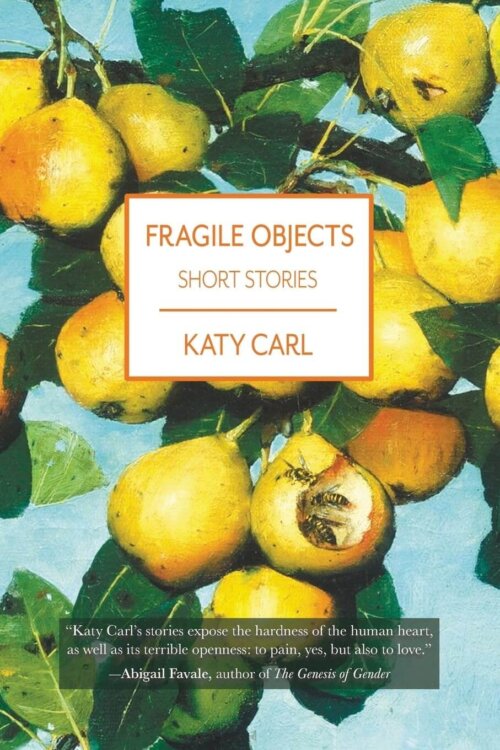
In her recent collection of short stories, Fragile Objects, Carl explores the struggles of coming of age as a Millennial in the twenty-first century. In twelve stories, we hear of quirky Church fairs and upsetting Church scandals, ethnic conflict, and troubled relationships—all under the veil of our chaotic postmillennial age.
Among the best works in the collection is the pairing “Allie” and “Jack,” which tells the story of the dissolution of a millennial relationship. The two stories have everything, which, on the surface, older people hate about millennials. Resembling elements of the young progressive millennial couple in Paul Shrader’s First Reformed (2018), Allie and Jack live a twenty-first-century bohemian life replete with “organic cotton sheets” and an “expensive French press.” Jack is the much despised lazy bohemian male millennial. Jack rides a bike (but doesn’t shower afterward), reads all day, and mooches off of Allie. Humorously, the progressive Jack, like his counterparts on the political right, has big dreams of achieving fame through creative endeavors but spends his time reading the seemingly infinite 24/7 21st-century news cycle and complaining about politics. However, what makes Carl’s stories “Allie” and “Jack” unique forms of specifically twenty-first-century realism is that she presents millennial life without varnish while at the same time with the strong politically correct or “woke” moral classification endemic in contemporary art.
Eschewing the “toxic positivity” of much of Millennial culture, Katy Carl’s “Allie” illustrates the profound disappointment many millennials have experienced in the workforce. Millennials stereotypically demand both easier and more accommodated work than their parents while at the same time scheming for rapid upward mobility into a higher income bracket. Allie works for a nonprofit called Greenspaces and hopes to achieve the director’s position but finds herself working non-stop and getting nowhere. As the story illustrates, while much is made about “equity” in the twenty-first century, the gaps between rich and poor and even rich and working class in the twenty-first century are much more profound than in the twentieth. Allie finds herself cut off from the social circle of her boss, Janet, whose parents, the Beauregards, were the major donors to Greenspaces. At the same time, Allie notes that the lack of direction in the Beauregard’s lives. They are like the other postmillennial American rich—many of whom lack any sense of purpose or direction other than making money and attempting to follow now tired and exhausting left-wing causes célèbres. Mirroring many contemporary Western women, Allie has achieved the feminist dream of a career but comes to resent her lazy husband, who is absorbed in a fantasy world of artistic dreams and internet news, providing Allie little comfort and no money. Jack and Allie eventually separate. Allie is “restructured” out of a job (a reminder that left-wing nonprofits can be as ruthless as for-profit companies). She finds a new job, becomes pregnant (there is a subtle pro-life message here), and has a seemingly tragic ending.
What is curious and what shows Carl’s skill as both a writer and a thinker is her (semi-) sympathetic depiction of Jack in the second of the twinned stories. Although callous and selfish, Jack is not a malicious monster as he would have been in an earlier Boomer or Gen X feminist story. He has more of an allegedly typically Millennial drift into mild sociopathy. After his separation from Allie, his thoughts move rapidly to a new woman. Jack is afraid to be a father, casually expressing his indifference to aborting their child in conversation with Allie over the phone. Allie had tried to convince him to become a salesman, but he refused both on moral principle and because of laziness. He has the perennial problem of the academic (he had earlier attended graduate school but did not finish) who hates both teaching and clerical work. He realized that graduate school was both boring and humiliating. He wants to do something for money “without feeling dead inside.” Jack sublets from someone named Ben and practices has a pop commodified version of Asian meditation techniques and (in very postmodern fashion) watches reruns of twenty-first century sitcoms. He drinks too much and makes a (violent?) fool of himself. He is ashamed of the American and wider Western past—at one point, he reflects with embarrassment on his ancestors who helped to found the Jamestown colony in Virginia. However, he does not have a vision for the future.
Near the end of the story, he thinks of tearing down the buildings around him, but thinks he can only build more of the same, eventually falling asleep outside with a splinter in his hand. This is a tragic story often (even in Millennial Catholic circles) played out. This is the story of the artistic couple that comes of age in the tumultuous, expensive, and cutthroat world of twenty-first-century economics. Like many of the other stories in Fragile Objects, “Allie” and “Jack” have sad endings in which dreams clash with reality. While it might be argued that the Catholic literary scene is long overdue for positive and wholesome stories, Carl’s works provide a deeply needed sobriety to not only the millennial generation but all Catholics who attempt to paper over reality with illusion and fantasy.
Both traditionalist and progressive Catholics have been criticized for living in variant forms of fantasy. Traditionalists allegedly paint a fantasy over the past, arguing for a pristine period of Western civilization. Progressives supposedly close their eyes to the hard facts of human nature and wish for a utopian society. At their best, both these fantasies contain elements of truth and can provide a blueprint for a Christendom 2.0. At the same time, as is evidenced in the tiresome cycle of Catholic bad news, these fantasies can have disastrous results. What Katy Carl achieves in the best of her stories in Fragile Objects is the ability to show the workings of human life in the present reality without varnish and illusion, all while leaving space open for true Christian hope and humility.
Fragile Objects: Short Stories
By Katy Carl
Menomee Falls, WI: Wiseblood Books, 2023; 313pp


Related Posts