On Science, Smallness, and Wonder
One of the aspects of my current teaching job that I have most dreaded – before the school year and during it – is teaching science. Though I knew I would be teaching science only to upper elementary students, the thought of leading students to understand the hidden workings of our cosmos was, to me, a daunting one. How could I, who hardly understood my high-school chemistry and physics courses, hope to train students in understanding even earth science?
As the year has progressed and now approaches its end, however, I have grown used to the rhythms, expectations, and requirements of lower-school science, and I have grown to appreciate my role greatly. Even though I studied little science in college and have always preferred humanities concepts and classes to scientific ones, I see, after teaching science to ten- and eleven-year-olds for a year, the rich gift of a good science class. Not that I can yet claim to teach science well, but I do understand, in part, what a good science class should include. Science, properly taught, teaches students of their smallness. Science ought to allow students to glimpse – among other things, of course – the scope of God’s world and their little yet significant place in it, and to thus lead students to wonder.
Our recent unit on space, constellations, and the solar system has especially clarified this purpose of science class in my mind. As we have surveyed the planets in our solar system and discussed both myths and facts about the constellations, my intention has not been to glue factoids into my students’ brains. I aim not that they can name all the constellations or rightly classify all the known galaxies. Rather, I aim that they learn to marvel at the life they have been given while they learn some basic principles about our universe.
In aiming to teach children to marvel, I have found that bare numerical facts – such as the diameter of the sun, which is about 1.39 million km – cannot rival comparisons or metaphors – such as the fact that the sun’s diameter is 109 times the diameter of the earth. The human mind, whether young or old, clings on to truths that relate to human life much more readily than abstract truths or numerical facts. Numbers detailing the size of the Milky Way galaxy would have passed over my students’ heads, yet my students were awestruck by the fact that if our solar system were the size of a quarter, then the Milky Way would be the size of the entire American continent. They marveled at the fact that that’s how small we are.
As I write this and as you read this, an estimated 8 million different species are living out their lives on earth, stars are forming and exploding into supernovas, planets are turning on their axis and orbiting the sun, light is traveling at incomprehensible speeds through the universe, and galaxies are assembling and changing and collapsing. As I write this and as you read this, the cosmos is faithfully thrumming out its vast rhythms of life.
Studying the cosmos has rightly made my students – and me – feel small. This is because we are small, when we compare our lives on earth to the grandeur of the cosmos.
Studying creation ought to relativize our sense of ourselves, for we have not created and can hardly even comprehend all that surrounds us. Rather, as Psalm 95 tells us, “For the Lord is a great God, and a great King above all gods. In his hand are the deep places of the earth; the strength of the hills is his also. The sea is his, and he made it: and his hands formed the dry land.” God is a mighty King, one who holds creation in his hands. As such, as the Psalmist recognizes in the next verse, we must take our proper place – one of humility – before him: “Oh come, let us worship and bow down; let us kneel before the Lord, our Maker.” While studying creation relativizes our sense of ourselves, it also ought to magnify our sense of the Creator. If we do not recognize the grandeur and goodness of the Creator as we put our lives on Earth in perspective, we will end up with only the cold naturalism that many moderns espouse.
In other words, we are small, but we are not merely small. We need to see our little place in the cosmos, but to see, too, the Creator of the cosmos who endows our little human lot with significance. Otherwise our little place in the cosmos is but a depressing and perhaps even overwhelming demonstration of human inconsequence. Taken on its own, science – especially the theories of modern science, such as Darwinian evolution – will render us hopeless.
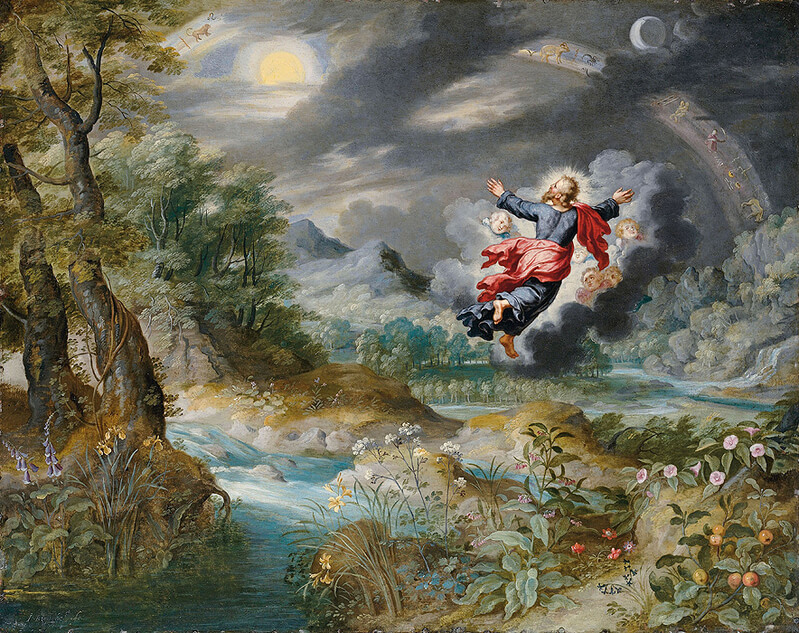
Yet if we see the cosmos not as a random product of chance but the loving work of the Creator and our species not as another one of many millions of forms of life but as the crown of creation – the imago Dei, the only life form given the likeness of God – we will not be left hopeless. We will instead be ushered into the awe and wonder and mystery and gratitude that God has intended for mankind to feel when looking at creation. As the Psalmist writes in Psalm 8, “When I consider thy heavens, the work of thy fingers, the moon and the stars, which thou hast ordained; What is man, that thou art mindful of him? and the son of man, that thou visitest him?”
A sense of our smallness ought to give way to a sense of God’s grandeur and transcendence, which, in turn, ought to give way to wonder. And wonder is a step on the path to wisdom. As Ravi Jain and Kevin Clark write in The Liberal Arts Tradition, natural philosophy – that is, science – leads to humility and wisdom: “The study of natural philosophy leads from wonder to wisdom and results in man submitting himself in imitation and awe of the wisdom innate in nature.”
I doubt my science students understand the radical difference between the vision and purpose of science that their classical Christian school is giving them and the vision and purpose of science that our world gives. I myself, educated at a similar institution as a child, did not understand until I was in high school or college quite how different the classical Christian approach to science is than that of the world. Though my students cannot yet appreciate the beauty that comes with framing our studies in submission to our Creator, they are beginning to grasp the true reason why we study science. For, at the end of each class, my science students answer the question, “Why do we study science?” with these words: “We study science to observe and marvel at God’s design of the world.”


Related Posts