The Lords and Limits of Tolkienism
On December 19, 2001, The Fellowship of the Ring opened in US theaters. Like Episode IV: A New Hope, the first film of the original Star Wars trilogy, The Fellowship of the Ring surprised and captivated its viewers, quickly becoming, along with its sequels, one of the most important cultural phenomena of the twenty-first century. As with A New Hope, the audience first watching The Fellowship of the Ring did not know what to make of the film. Cate Blanchett’s narrated opening prologue decorated with Peter Jackson’s masterful use of CGI is curious but does not draw the viewer in. It is only after the first five minutes of the film, when Ian McClellan’s Gandalf first arrives in the Shire to meet Elijah Wood’s Frodo, that the magic begins. As the Shire unfolds, the viewer is taken “home” to a world of comfort and simplicity that had been shattered just a few months earlier when Francis Fukuyama’s “End of History” 1990s collapsed along with the Twin Towers on September 11, 2001.
In the wake of Peter Jackson’s Lord of the Rings trilogy, a fleet of books rushed onto the market. The bulk of these books were Christians who sought to remind viewers that J.R.R. Tolkien, the author of the original series of books on which the films were based, was a devout Catholic who imbued The Lord of the Rings with his Catholicism. In addition to these books, there appeared an enormous proliferation of video and board games, toys, clothing items, and a seemingly never-ending stream of (often homemade and hand-crafted) Lord of the Rings themed knick-knacks and goodies available on websites like Etsy. Like Star Wars the Lord of the Rings has become one of the dominant mythologies and sources of intellectual and cultural formation in our time.
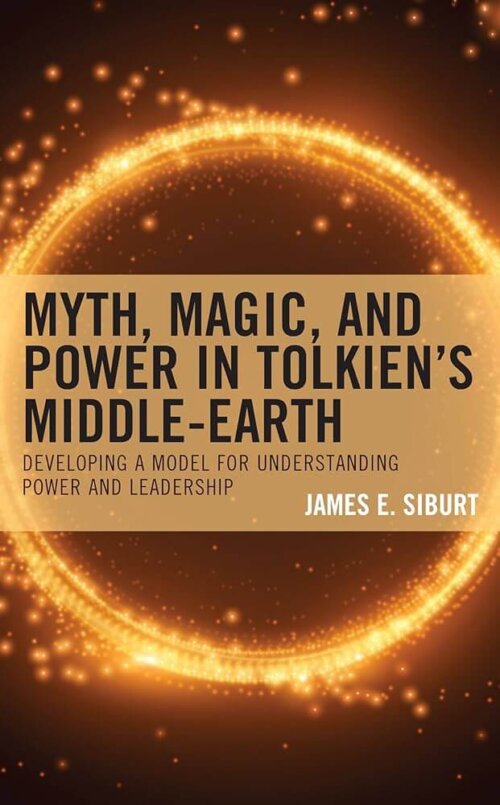
In his recent work, Myth, Magic, and Power in Tolkien’s Middle-earth, Immaculata University’s James E. Siburt attempts to provide a model for servant-leadership drawn from Tolkien’s fantasy world as well as the writing of Michel Foucault. Siburt notes that despite the heroic battles and larger-than-life world of knights and wizards in Tolkien, some of the most moving examples of heroics in Tolkien’s Middle-earth are, in fact, the seemly little and insignificant hobbits. Siburt interestingly notes that he saw the Lord of the Rings as a source of strength and guidance while he was being bullied during his teen years. Although he was drawn to Gandalf and Aragorn, it was only later that Siburt learned that the hobbits themselves had tremendous power. He further writes that as he grew older and entered the worlds of the military, academia, and business, he encountered a host of people not entirely unlike the “wizards, kings and queens, warrior and elves, orcs and goblins” of Middle-earth. This statement is very profound. While some may deride fairy tales and myths as fantasy, the mythic structure of works like The Lord of the Rings and The Hobbit reflect and even highlight and illuminate one’s experience of the “real world.”
From his research, Siburt has developed what he calls his Social Power Dynamics Model (SPDM). In Myth, Magic, and Power in Tolkien’s Middle Earth, Siburt explores his Social Power Dynamics Model in the work of Tolkien, who himself shows that power, if properly used, can serve to remedy evil and bring unity. Siburt’s primary focus in his work is the creation of The Silmarillion. Siburt attempts to argue that every person will inevitably encounter nodal points of power struggle, and, in these points, even the littlest person has power. Siburt criticizes the Social Bases of Power model, for it, in his view, realizes too much on a mimetic theory that encourages weaker individuals to imitate the strong. Siburt’s focus is on the reciprocal interaction of power in a relationship. He observes that a person’s capacity for power will change throughout his or her life—he also notes that children have very little power. As one’s power increases, he or she must choose when and where to use it and when to hide it. Siburt argues that many people do not realize what power they have, and sometimes power can be exercised unconsciously. Siburt’s approach, although initially sounding Machiavellian, is more in the realm of a self-help book seeking to empower individuals who feel powerless in their social relationships.
Developing his thesis, Siburt argues that there are similarities between the theories of power of Michel Foucault and J.R.R. Tolkien. Both Foucault and Tolkien recognized that power comes from a system. Foucault sought to see how the history of a system can explain a system’s present and perhaps even predict the future of a system. In Tolkien’s world, the system is a magic system, while in the world of Foucault, it is a “strategic social system.” Tolkien, Siburt argues, attempted to use English (or better “North Atlantic”) mythologies to provide a foundation for contemporary English culture. Both thinkers argue that the power of a system is understood by studying the mythologies of a system. Further drawing from Bertrand Russell, Siburt argues that power is in a state of flux. The mythologies of a society and a people’s understanding of their mythologies can help prop up power, inspire revolution, or cause healthy (or unhealthy) social change. This point is very important. For much of Western history, especially since the Early Modern period, for better or worse, mythologies have been critiqued and pruned. Whether or not such a pruning was necessary, usually the goal was to improve life or come to a better understanding of how individuals and people should live their lives. However, in the twentieth and twenty-first centuries, this pruning has now turned into a violent and destructive critique that is shaking the very foundations of the West. Power is, ultimately, an essential part of human social interaction and can be used for good or ill. As Siburt ultimately argues, using the example of the Silmarillion, one can exercise power for compassion and service or selfish manipulation.
In his 2004 Sacred and Secular Scriptures, Nicholas Boyle humorously begins one of his chapters with the comment, “There is something embarrassing about writing about Lord of the Rings…” After comparing interest in Tolkien’s masterwork to a model train hobby, Boyle nonetheless notes the tremendous power and influence of The Lord of the Rings. While there are strong arguments against The Lord of the Rings—especially from a traditional formalist analysis of character development as well as even, at times, Tolkien’s crafting of prose, this story escapes such criticism precisely because it rises to the level of mythos. It is a (mostly) Christian myth that celebrates the premodern world of Northern Europe while at the same time providing prescient warnings about modern technology. The work further is replete with an ethical framework rooted in Natural Law. James Siburt’s Myth, Magic, and Power in Tolkien’s Middle-earth is not without critique, but it nonetheless demonstrates the enduring power of The Lord of the Rings.
Myth, Magic, and Power in Tolkien’s Middle-Earth
By James E. Siburt
Lanham, MD: Lexington Books, 2023; 94pp


Related Posts