On What it Means to be Human: Eric Voegelin and Michael Oakeshott
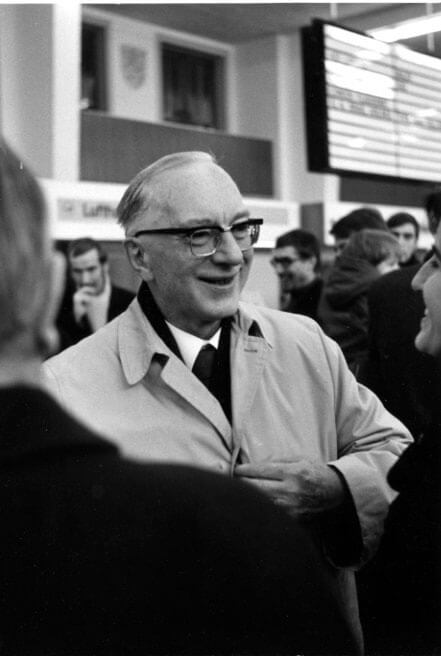
Eric Voegelin and Michael Oakeshott are two of the greatest thinkers in the 20th century. Together with Leo Strauss, they were a part of a rebirth of political philosophy in a time dominated by scientific and rationalist dogmas in the social and political sciences. Voegelin and Oakeshott are generally put together via their criticism of the way political issues were treated in society, especially by scholars and professors.
The similarities between both assessments towards rationalism, positivism or scientism are obvious enough. Voegelin and Oakeshott felt that political and social scientists just had a wrong concept of reason, and thought that all the problems concerning those human activities could actually be solved by our rational capacities.
Voegelin vehemently criticizes what he terms positivism, which encapsulates a lot more than the specific doctrine created by Comte. Positivism is essentially the same as scientism, which is an attempt to reduce all knowledge to natural science. Encompassing positivism and scientism, is gnosticism, the term that made Voegelin famous, but later was reduced in importance. Gnosticism is basically men’s revolt against reality. Seeing disorder all around him, the gnostic is certain that he can improve the world with his abilities, intellectual and practical. Ancient gnostics view the world as evil, but relinquished it for the believed in salvation from the beyond. Once the beyond is closed in modernity, the gnostic impetus cannot be to escape the only world there is, but save it. And for that most noble end in sight, any action, no matter how violent and cruel, is not only tolerated but encouraged.
Oakeshott’s main enemy in his mature work is the infamous rationalism. The problems involved in it are the same as those appointed by Voegelin and also by Strauss. Rationalism is a way of imposing purely theoretical knowledge into practical activities, especially morality and politics, critical areas dominated by this view in the 20th century. The rationalist is a character that believes his reason is all powerful and capable of improving society by rational thinking. Discarding experience, the rationalist believes in a narrow concept of reason, in which theoretical knowledge will solve all of society’s problems, as if it were an exact science.
It was clear for both that the conception of reason of the rationalist, gnostic, or positivist was narrow. It was missing important features of what constitutes human reason. Voegelin contends that a modern gnostic is blind to the spiritual dimension of mankind and therefore any social analysis would be partial at best. Oakeshott did not give that prominence to spiritual factors, but challenged the biased view that rejected practical activities that should rely more on experience than on technical knowledge. The danger is that the rationalist-gnostic is arrogant in the use of his reason (although a limited concept of reason) and tries to shape the world accordingly, which can only end in disaster.
Many parallels between these perspectives were drawn, including Elizabeth Corey’s identification of the concepts of gnosticism and rationalism.[1] But I want to build a different bridge between them. One that is not via criticism, but something purposeful, although not necessarily unrelated to their denunciation. I believe they have something in common about their philosophical anthropology, by which I mean the answer to the question “what is a human being?” Both Voegelin and Oakeshott seem to divide human conduct in two poles, one physical and material, realm of practice; the other spiritual and reflective, realm of theory. That does not mean, though, that they are dualists. As a matter of fact, both clearly rejected cartesian or Kantian dualism in their metaphysics and epistemology. We have, therefore, to be careful of not hypostatization said spheres, as if they were concrete things. A danger, warned by Voegelin, which is always lurking. They are ‘poles’, or ‘ideal characters’, created to elucidate the human condition.
Before we deal with each author’s conceptions it should be stated that their perspectives are not identical, they are similar. What this text will try to do is begin a conversation between Voegelin and Oakeshott, one that is not initiated by common animosities, but by a constructive view of human nature.
Since what Voegelin terms the “leap of being” was achieved in Greece and Israel, the transcendent dimension was discovered and a new light was shed on our role in the drama of existence. Although we do not know where we are heading, we became clear of our participation. Later, Voegelin changed the term for the “epiphany of man” and understood that history is not a progression, in which we somehow ‘got better’ after the experiences in Greece and Israel. But the point remains: humans discovered our participation in Being.
Before the differentiation of the transcendent, human life was experienced exclusively immanently. In the societies Voegelin calls cosmological (such as Ancient Egypt and Mesopotamia), the world was seen as full of gods, and the sacred was everywhere. With the transcendent sphere in play, the world of things became de-divinized, because now God was beyond this world. Human life was discovered as a life experienced in a tension between poles, the transcendent and the immanent. This tension is called by Voegelin metaxy (μεταξύ), or ‘in-between’, a concept extracted from Plato’s Symposium.
It is important to state that, for Voegelin, immanence only gets its meaning in relation to transcendence. Nothing is “simply immanent” or “simply transcendent.”[2] And again, they are not concrete things, they are poles in man’s experience. That means that although modernity tends to discard the transcendent pole, there is always the opposite danger, which is to reject the immanent pole. Since it is a tension, our existence is not easy, and many try to surpass it. But to close oneself to one of the constituents of the metaxy is necessarily to go against one’s condition of being human. That rejection is the “egophanic revolt” and what Voegelin has previously characterized as gnosticism.
Furthermore, to recognize each person as a participant in the metaxy is the reason why we love and care for others. Without this common ground or the recognition of a common nous (νοῦς) no society is possible. That is why the concept of homonoia (ὁμόνοια, common nous) was developed by Aristotle, and others that followed, to form the basis of a well-ordered human community.
To relinquish the metaxy is impossible and that misadventure can lead to what Voegelin calls second reality, when someone closes itself to the transcendent dimension. The second reality is a concept derived from Austrian writers Robert Musil and Heimito von Doderer and exemplified by Voegelin also via Miguel de Cervantes. It is noteworthy that Voegelin draws on literature to deal with such a phenomenon. Modern writers who are not clouded by the diseases of their time can help elucidate the present maladies. Precisely because humans are not a purely rationalistic creature, literature can be a source to penetrate within the soul and what afflicts it and the society around it.
Michael Oakeshott’s perspective is somewhat different, and does not rely on the same concept of the transcendent. In fact, the civil association should not derive its authority from anything external to it, and that point is made since his first essays, such as The Authority of the State. Nevertheless, there exist similarities with Voegelin’s characterization of humans. There are throughout Oakeshott’s oeuvre many reflections on what is the character of the human being. But this essay will focus mainly on a not so well known essay, probably written in the 1960s and published in the compilation What is History? And other essays, called Work and Play.
The main point of Oakeshott is that we can define humans from two forms of activities that differentiate us from other animals. The first is work, or the ability to satisfy wants. We are a creature of will, and to achieve our goals we have to act. This action is work. But that picture seems gloomy and also incomplete. As Oakeshott states, “[a] creature composed entirely of wants, who understands the world merely as the means of satisfying those wants and whose satisfactions generate new wants endlessly, is a creature of unavoidable anxieties.”[3] We have a condition of never ceasing desires, similar to what Hobbes proposes in the beginning of Leviathan.
But that is not the whole story. Humans are not only Animal laborans, we are also Homo ludens, we play. Play is an “activity which, because it is not directed to the satisfaction of wants, entails an attitude to the world which is not concerned to use it, to get something out of it, or to make something of it, and offers satisfactions which are not at the same time frustrations.”[4] It is an experience that has no ulterior motive. Who is familiar with Oakeshott’s essays already understands the importance of activities that have no pre-established goals and precise paths to follow. That is why, for instance, he defends a concept of civil society in which the individual is free to pursue his own goals. In other words he should have the liberty to play.
Play is not necessarily games, although it does include them. Play also refers to contemplative activities. Human activities that are not practical, such as those that seek to understand and explain the world (like philosophy, science, history) and also the poetic imagination. Art, philosophy, science and history are idioms or adventures pursued free from ‘work’ and practical considerations, although they can always be corrupted and lose their ‘playfulness’ character.
It could be said that human beings, according to Oakeshott, also live in tension. A tension between work and play, two aspects intrinsically connected to human nature, that cannot be left aside without endangering human life itself. In other words, discarding one of these features, life ceases to be human at all.
It is no surprise that authors like Karl Marx, blind towards an important dimension of humankind, are criticized by both. In Voegelin’s terms, Marx perceives reality only partially, neglecting the transcendent or human’s pull to divinity. Following Oakeshott’s conception, it can be said that Marx focuses on the dimension of work. Actually, more than that, work becomes the entire nature of human beings, what distinguishes us from other animals. So we have a world-immanent construction in which there is no openness in the soul, no playfulness and no imagination.
Lastly, it has to be said that both ‘work’ and ‘play’ are intelligent activities, which means that they involve some degree of consciousness. That separates human activity from what Oakeshott terms a ‘process’, generally natural or organic phenomena that are not the product of choice.[5] Both ‘work’ and ‘play’ are a part of what a human is, for they demand a free subject capable of choosing.
Even though Voegelin’s and Oakeshott’s conceptions differ in important ways, there is a fundamental lesson when we put them in a conversation. In the modern world, we frequently lose sense of the entire dimension of what we are, what human beings are, closing ourselves to experiences that are not ‘practical’ or ‘useful’. Human life is more than calculating usefulness and establishing specific goals; it is an adventure into the unknown.
NOTES:
[1] Corey, Elizabeth. Michael Oakeshott on Religion, Aesthetics and Politics. 2006.
[2] Voegelin, Eric. The Collected Works of Eric Voegelin, Vol. 33: The Drama of Humanity and other Miscellaneous Papers 1939-1985. 2004.
[3] Oakeshott, Michael. What is History? And other essays. 2004, p.308.
[4] Op. cit., p.310.
[5] Oakeshott, Michael. On Human Conduct. 2003


Related Posts